
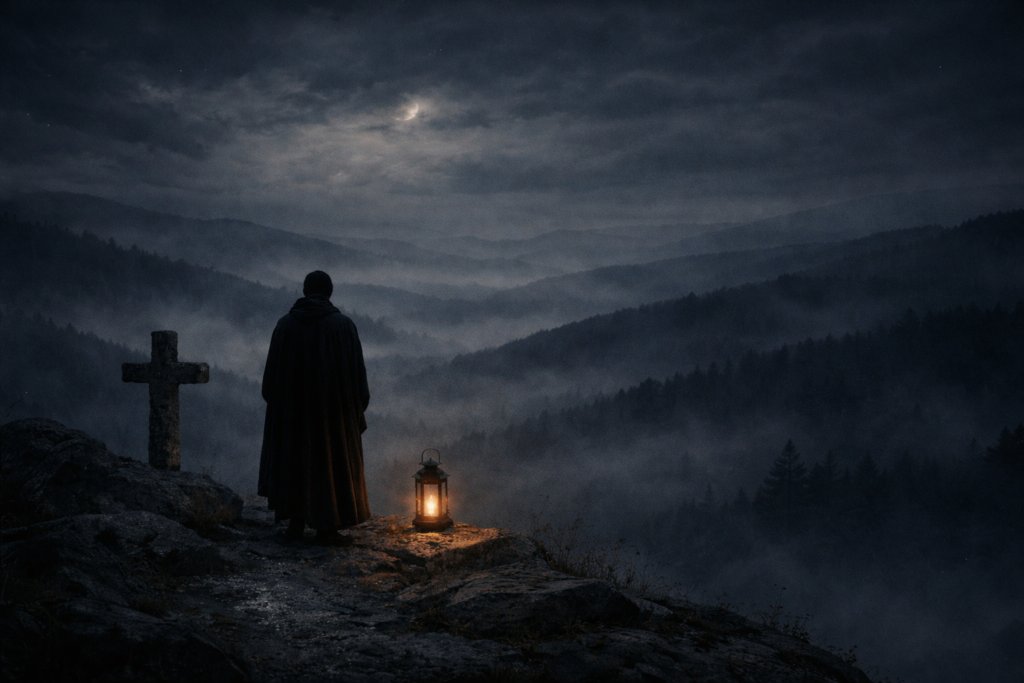
A friend recently forwarded me a video discussing the work of Simone Weil. In this particular piece, she detailed a kind of extreme, spiritual exhaustion. An exhaustion that goes beyond simple physical exhaustion; more than being tired from the day’s trials, demands of home, office, and other obligations. An all-encompassing exhaustion where every borrowed meaning collapses—status, usefulness, affirmation, even piety—and what remains is not sentiment but attention. This represents a willingness to stand still before what is, without consolation.
I’ve often spoken of this feeling in conversation and it comes up, in portions, in some of my essays. I call it the long dark night of the soul and it is something I have very much experienced. There is a feeling of utter dissolution where everything we use to define value in ourselves no longer has value to us. Nothing distracts, nothing convinces…even faith feels hollow as the platitudes of religion burn away.
Modern language calls this depression—it is not. This is no chemical imbalance to be managed by therapy and there is no pharmaceutical solution (at least not if one is honest with oneself). Depression implies a malfunction; not revelation.
It is instead philosophical; perhaps even existential. It is the moment we see reality for what it is. The moment we can no longer lie to ourselves, G-d, the world. We finally stop mistaking value for stimulation, affirmation, purpose and take note—these things are merely distractions.
Origins & Design
The phrase, “Dark Night of the Soul” originates with St. John of the Cross—Roman Catholic priest, mystic, and Carmelite friar of Converso ancestry. He is one of the 38 Doctors of the Church; a title granted by the pope to saints recognized as having made a significant contribution to theology or doctrine through their works. He was a significant figure of the Spanish Counter-Reformation in the latter 16th century and well known for his writing. Noche Obscura is often considered the height of Christian mystical literature.
John’s work has been very much misunderstood, more so misused, over the centuries.
Modern usage has largely flattened it beyond recognition.
John was not naming a mood, a crisis, or even a poetic metaphor for sadness. He was naming a technical stage in the dismantling of self. Over time, the poem—and the term—became shorthand for grief, depression, loss, or psychological pain. John is explicit: emotional pain may accompany the night (it almost certainly does), but it does not define it. In fact, many who experience the dark night report not anguish but a flatness, an absence. It is the failure of feeling to motivate or orient. And while it may precede awakening and transcendence, it is neither brief nor worthy of romanticizing. This is a long, drawn out process that often takes many years to play out. Some never see the light, trudging through the darkness until their own end or turning back and taking solace in the comforts of illusory reality.
Truth or Stability?
The dark night makes sense only in a world that places faith in truth over stability.
Modern culture, systems of governance and order, rely upon stability. It is a cherished, protected attribute of these ideas; truly, it is sacred. Challenge it and one invites anarchy. Under these conditions, Noche Obscura cannot be understood.
This is also why it is seldom experienced en masse, but rather in solitude.
The individual has the ability to see reality as it is, without the shiny distractions placed around it. The one can, through intent, strip away the layers and learn to simply observe; to see without classification, categorization. Doing so requires suspension of utility, identity, and outcome simultaneously.
Our culture cannot tolerate unproductive states, distinguish silence from pathology, or imagine value without payoff. These things are baked into the very fiber of society. Noche Obscura violates all three. It offers no reassurance, no timeline, no narrative of improvement. There may well not even be a payoff in the end.
One thing that is clear: moving forward, into and through the night, is a choice and not one to be taken lightly. It is a deliberate deconstruction of the fabric of reality as we know it to exist. Seeing clearly, beyond the mist, is not comforting; it’s a maturation of self-awareness, clarity as burden. The night is not imposed arbitrarily; it must be consented to, perhaps after all other strategies fail, because without consent it becomes trauma rather than transformation.
And THAT is frightening to most.
Honesty and Obligation
The dark night is not something one goes through so much as something that, once reached, places a demand upon the one who has reached it.
When we experience reality without distraction, it is not something that can be unseen. Innocence is lost upon the realization that meaning can be simply manufactured. Consent to the night comes with an obligation to be responsible for what is now visible.
That responsibility is heavy. There is no instruction manual, no rulebook for living without illusions. St. John of the Cross never gives practical advice for what comes after the night and anyone who does has either not experienced the darkness or has chosen to abort the journey.
There is an imperative of restraint implicit in the trek of Noche Obscura. Not activism, proclamation, or even withdrawal—restraint.
Restraint from pretending certainty you do not possess, offering consolation you now know to be hollow, or participating in narratives you know are false simply to belong. This restraint is disruptive; it cannot be assimilated by systems. It produces people who are difficult to manage.
Not all who encounter the night are obligated in the same way, but those who recognize it as such are just no longer free to live as they did before.
At least not honestly.
The dark night does not grant insight as a gift; it imposes truth as a burden. One can choose to return to the deception, but there will always be a voice, howling with indictment, and the knowing of the hypocrisy inherent in the refusal to manifest the obligation itself.
The Long Vigil
One enters the long dark night without the promise of sleep. It is an acceptance of duration without end, presence without intervention, witness not as purpose but reality. It is not endless in the cosmic sense so much as it is endless in the lived sense. What has been seen cannot be unseen, and as such, the commitment is one of conscious vigil.
The long dark night changes the self. It is, ironically, an awakening of the self. It is worth noting it does not promise light although it also does not threaten darkness. Returning to slumber is nearly impossible and continued existence is one of living in the world yet not being of the world; participating without illusion or attachment from that point forward. It becomes an ongoing process of revelation, acceptance, and understanding.

Discover more from Many Lamps, One Flame
Subscribe to get the latest posts sent to your email.