
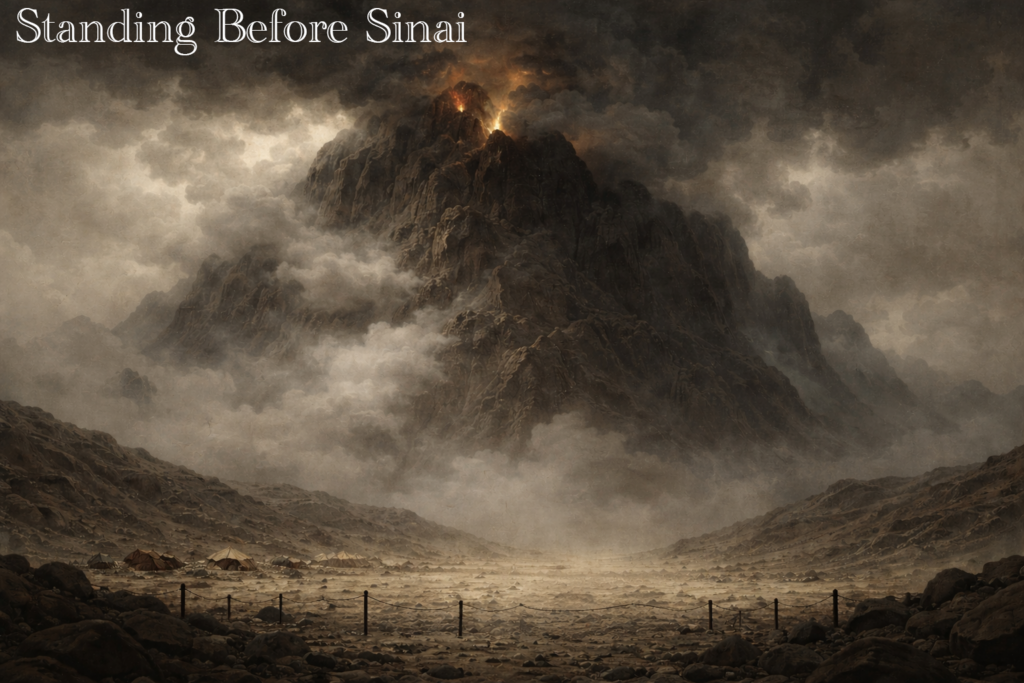
The Torah portion Yitro spans a dramatic arc. It begins with recognition—an acknowledgement of G-d’s reality—moves through preparation and ordering, and culminates in revelation at Sinai.
The Israelites arrive at Sinai having been freed, sustained, and guided. Yet, when the moment of revelation is upon them, the dominant themes are not intimacy or union, but distance, warning, and restraint. Fences are erected. Boundaries are named. Instructions are given and repeated.
The portion closes not with mystical absorption but with law grounded in restraint—no images, no uncontrolled approach, no assumptions of familiarity.
Relationship is not Access
Yitro quietly dismantles the fantasy that relationship with the Divine means access.
The people hear G-d’s voice and recoil. Their response is fear and a recognition of their own fragility before G-d. This is not fear as failure; it is fear as clarity. The text treats their reaction not as cowardice, but as discernment. Unmediated encounter is not something that human beings are built to endure.
The Hebrew is telling here. There are two forms of fear that appear throughout Exodus:
| יִרְאָה (yir’ah) | Reverent awe; awareness of divine gravity that orders behavior, establishes boundaries, and preserves alignment. |
| תִּירָאוּ (tir’u) | Panic or terror; destabilizing fear that overwhelms, collapses judgment, and drives withdrawal. |
Where fear is reactive, we see tir’u (Exodus 14:13, 19:12-13, 20:20). Where it denotes orientation, however, we see yir’ah (Exodus 9:30, 14:31, 18:21). The former destabilizes and must be removed, whereas the latter acts as guide and is an appropriate response to the Divine.
Relationship is not built on access or intensity, but on awe rightly held—fear that keeps one aligned rather than consumed.
Not Possession, Not Intensity
Sinai is often romanticized as closeness; the text insists otherwise.
G-d does not become available or even familiar. G-d becomes present, and that presence requires strict mediation. We all carry the spark of divinity within us; all things are part of the Divine. However, that does not make us divine, nor can we possess the Divine.
Early on in Exodus, Moses asks to see the glory (kavod) of G-d. G-d’s response is direct and clear: “You cannot see My face, for no human may see Me and live” (Exodus 33:18–23).
Unmediated exposure to the Divine essence is annihilating—not because G-d is hostile, but because we, as finite beings, cannot survive infinite reality unveiled. Even here, G-d places Moses in the cleft of a rock to protect him, further covers him to shield him, and allows him to see only what is described as G-d’s back.
This represents orientation without possession. Even Moses—arguably the most intimate human presence with the Divine in all of Torah—is denied direct access.
This idea is reinforced elsewhere in the ancient texts:
- Nadav and Avihu offer “strange fire” and are consumed (Leviticus 10). Not malice, but presumption—approach without instruction.
- Uzzah reaches out to steady the Ark and is struck down (2 Samuel 6). The intention is good, but the violation of boundary is fatal.
- Isaiah, upon encountering divine holiness, does not rush forward—he collapses, undone by awareness (Isaiah 6).
There is a pattern here, and it is consistent: holiness is not dangerous because it is hostile, but because it is real and beyond human capacity.
The clear and unmistakable takeaway is that boundaries, instruction, and distance are not punishments; they are acts of mercy that enable finite beings to remain intact in the presence of the infinite. This is communication without collapse.
Alignment is not fusion; it is orientation that preserves integrity and expands wholeness.
The Contemporary Error
Modern life is built around access. The common consensus: that which is meaningful should be available, immediate, and responsive. Information must be on demand; boundaries are obstacles. Mediation is unnecessary friction; access must be open and available to all without limitation. Anything that gets between us and the prize is something merely to be conquered or set aside.
Even in spiritual language, we speak easily of “connection,” “experience,” and “encounter,” often without asking what such encounters cost—or whether we are even equipped to bear them. We carry an expectation of access to the Divine—prayers to be answered, healing granted, and blessings bestowed.
Awe emerges when one recognizes scale—when the distance between the human and the Divine is neither denied nor collapsed. Kabbalah teaches the ways the divine flow reaches mankind through the sefirot (modes of divine self-disclosure). These emanations of divinity come to us as distinct attributes, interacting to produce a face of the Divine we can comprehend. It further instructs that this is far from a complete rendering; in fact, beyond these emanations, the Divine is specifically referred to as unknowable.
This is where humility enters—not as self-abasement, but as accurate self-assessment. Humility before G-d is the recognition that desire does not equal readiness, and that sincerity does not eliminate consequence. Proper fear, as awe (yir’ah), is not about shrinking oneself, but about standing correctly in relation to what exceeds us.
We inhabit a mindset that urges rushing forward without caution to claim what we name as the ultimate. That may be framed as G-d, meaning, purpose, or truth; we approach as consumers entitled to devour, rather than finite beings requiring formation. This stance denies the fragility of our own reality; an arrogance we can hardly afford in such endeavors.
The Limits of Knowing
Restraint is wisdom in these matters. Humility is not optional, but a requirement of the formative process. Together, these constitute the posture of relationship to the Divine.
The wise have long recognized that the limits of human knowing are not a defect to be overcome, but a condition to be acknowledged. What we do not know vastly exceeds what we do, and learning itself is not merely extensive but inexhaustible. Knowledge expands but never closes the gap.
Hamlet reminds Horatio:
“There are more things in heaven and earth, Horatio,
Than are dreamt of in your philosophy.”
(Hamlet, Act I, Scene V)
This is not indictment, but a warning against presumption. The wise man knows not simply that he lacks knowledge, but that certainty itself is always provisional. Socrates said this plainly. Laozi said it quietly. Others across centuries have said it in their own idioms, but the insight remains unchanged.
Because learning is infinite, approach matters. A rushed grasp exhausts itself; a mediated approach preserves the capacity to continue. Instruction, restraint, and humility are not impediments to understanding—they are what make understanding sustainable.
In matters that touch ultimacy, wisdom is not found in seizing, but in standing correctly. Not in consuming what we do not yet comprehend, but in approaching in a way that allows us to remain whole enough to learn again.
Back to Sinai
Sinai is less spectacle and more orientation. It stands as a story that illustrates the importance of mediated access, the insistence on awe over entitlement, and the demand for an instructed approach. Boundaries and limitations are not drawn to make G-d unapproachable, but because reality must be ordered to sustain existence.
We rush because we confuse access with understanding, entitlement with possibility. We grasp because we mistake intensity for depth. We exhaust ourselves because we forget that there is no prize, only realities to be approached over time.
- Stand where you are instructed to stand
- Approach as one who must remain intact
- Let awe govern desire
- Let humility pace knowledge.
Revelation does not belong to those who rush forward, but to those who know how to wait.

Discover more from Many Lamps, One Flame
Subscribe to get the latest posts sent to your email.