
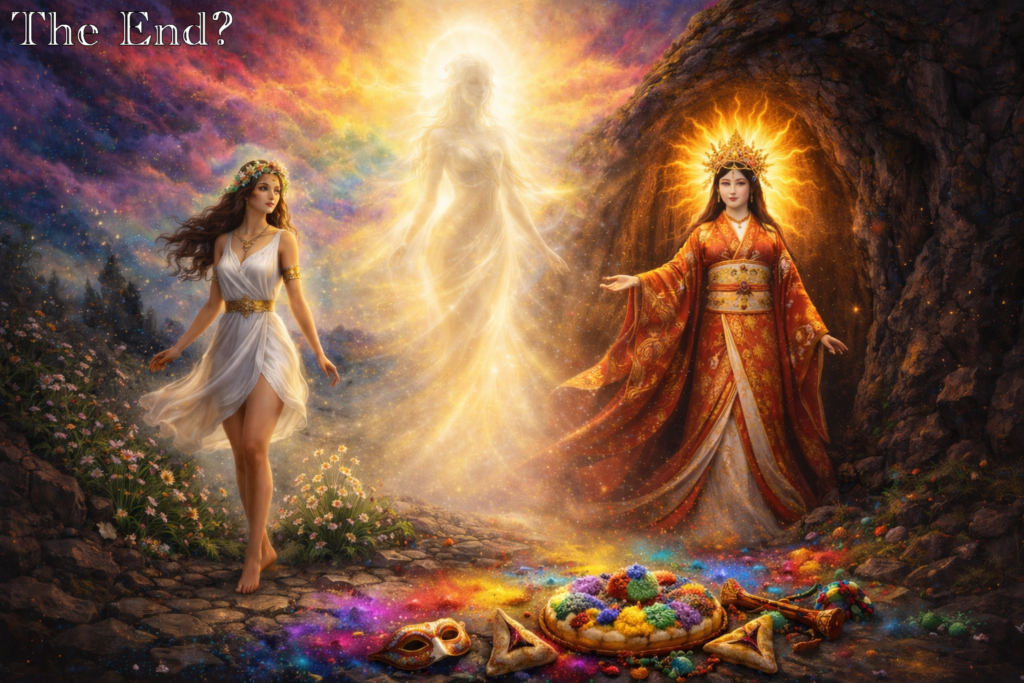
The world has been stripped, silent, cold for months. The light is thin; the fields are empty—a bone-deep exhaustion settled over everything. This is the long dark—winter not just as season of nature, but cosmologically. And yet, nature has begun to stir. Much of the snow has started to retreat. Queen Persephone prepares to return to the upper world and her mother, Demeter, bringing with her spring and new life. There is a subtle shift throughout all of creation, a quiet awakening.
The Universal Refusal
Every tradition, at roughly this same point in the calendar, does something similar—this is not coincidence, but rather a recognition of something written into the structure of life itself.
Purim — the feast in exile, joy under duress, hope when heaven appears silent. In Esther, G-d’s name never even appears, and providence hides in a beauty contest, a sleepless night, and a villain’s overreach.
Carnival / Mardi Gras — the pre-Lenten explosion of excess, rooted in Saturnalia, the world turned upside down before the long fast. The institutional church essentially baptized the pagan need: fine, have your chaos — but ashes on Wednesday.
Saturnalia — slaves and masters trading places, the cosmic order suspended, laughter as acknowledgment that hierarchy is contingent rather than absolute.
Holi — the Hindu festival of color, timed to the end of winter, structured around reversal, fundamentally about throwing color at strangers and laughing. How could a demoness, who cannot be burned, possibly be defeated by a child’s pure devotion? The apparently invincible is undone by the apparently powerless.
The Trickster traditions — Coyote, Anansi, even Loki in a certain light. Sacred fools appearing at liminal seasonal moments, telling the truth by making you laugh at it and clearing the air with utter chaos.
The through-line: winter is a kind of exile and exile requires endurance but cannot sustain itself indefinitely. At some point, the darkness no longer instructs—it merely persists. And that is when joy becomes not just possible, but necessary.
The Philosophy of Reversal
These celebrations share more than just simple timing. They share a structure: the world turned upside down as theological act. Reversal—not merely as comic relief, although it is often humorous enough to bring its own brand of laughter.
The philosophical claim running through these celebrations: your assessment of what is permanent is wrong. The darkness will not last, the villain will overreach, and the hidden will be revealed as the powerful are made to look absurd. Reversal is the universe’s way of demonstrating that, in life, what may look like the final word rarely is.
In modern parlance, this is karma; what goes around, comes around. The Greeks had a more poetic way of expressing the idea—hubris and nemesis. This pattern was so observable to the ancient world they named both sides of it. Hubris invites nemesis not as punishment but as consequence. It is a balancing of the scales. The Trickster traditions are particularly demonstrative of this idea. The trickster doesn’t moralize or lecture; they just arrange the situation so that arrogance defeats itself, and then they laugh. Comeuppance doesn’t figure as divine judgment—it emerges organically.
These are not morality tales imposed from the outside—they describe something written into the structure of reality itself. Reality tends toward balance; what disrupts it cannot hold indefinitely. The darkness does not last because it cannot. That is not hope. That is structure.
How We Celebrate
The practices themselves carry meaning. These are not decorations on top of the theology—they are the theology made physical.
Masks—you become someone else, reveal who you are, or both. The mask acts as liberation and as truth-telling. On Purim, the hidden nature of the holiday—G-d concealed, identity fluid, the story hinging on what is not seen—finds its contemporary embodiment in costume. It’s a mitzvah, and people dress up as Esther, Mordechai, Haman, and more, making it similar to a Jewish Halloween for costumes. And during Mardi Gras, the Venetian masked ball tradition reigns supreme. For one night, the normal order is suspended, identity is fluid, and everyone is indistinguishable behind their masks.
Color—Holi’s colorful powder is thrown at everyone, friend and stranger alike. The entire world is made visually chaotic and beautiful all at once. The drab persistence of winter is defeated by an explosion of pigment, launched freely and received without complaint. It is joy made visible before the darkness has been defeated.
Noise—It has been said that mankind should make a joyful noise unto the L-rd. And, yes, mankind loves a loud party. The groggers drowning out Haman’s name during the reading of Esther. The jazz and brass bands of Mardi Gras in every hall and parade. The drumming and dancing of Holi. It is sound as liturgy—noise as erasure of what threatens.
Food—No celebration would be complete without a feast. The very center of these celebrations is excess; food and drink have always been among the greatest expressions of joy. Purim has hamantaschen; the three-sided, hat shaped confection thought to resemble Haman’s hat with more recipes than crystals in the snow. Mardi Gras has the king cake with the hidden baby, Saturnalia with its communal meals. And for drink…well, Mardi Gras needs no explanation, and every Jew knows the mitzvah of drinking until one knows not the difference between Mordechai and Haman.
These are not celebrations of the darkness lifting—they are celebrations against the darkness itself. When Amaterasu, the paramount deity of Shinto, withdrew to the cave plunging the world into darkness, the other gods gathered and threw a massive party, complete with music and dancing to trick her into coming out.
After all, who doesn’t love a good party?
Joy as Resistance
The party isn’t what this is about.
What looks like excess is protest. What looks like escape is declaration. What looks like chaos is structure. The feast in exile, the color in winter, the noise in silence…these are not distractions from reality. Rather, they are arguments about reality.
We do not throw these celebrations because we feel secure. We throw them because we refuse to surrender. Joy is not the reward for surviving difficulty; it is resistance to difficulty. Prolonged darkness withers endurance. Joy functions as a survival mechanism, restoring agency, narrative, and breath alike.
The Jewish concept of simcha is instructive here. Joy is not merely permitted — it is commanded. It is a mitzvah. This is theologically strange. Emotions are not typically legislated. You cannot be ordered to feel. And yet here, joy is commanded — not as sentiment, but as action. You are not waiting to feel joyful. You are building joy, actively, as spiritual practice, as obligation, as act of faith. The Lubavitcher Rebbe spoke of this with characteristic precision: bringing joy into times of anxiety is not escapism. It is an assertion about the nature of reality. It says: this darkness is not the final truth about where we are.
Carnival operates on the same logic. The feast before the fast is not weakness or contradiction. It is defiance — the human spirit asserting its own continuity against the coming deprivation. We were here. We feasted. We will feast again.
And Holi, Saturnalia, and the Trickster’s laughter — all of them are saying the same thing in different languages: You thought this was the end? Watch.
Joy as resistance is not naive. It costs something. It risks looking foolish. It risks criticism. To celebrate when faced with adversity is to refuse the script handed to you — and that refusal is never comfortable.
The Feast
The darkness was real. The exhaustion was real. The exile — whatever form it took, seasonal, personal, communal, spiritual — was real. None of these traditions pretend otherwise. Purim does not erase the memory of Haman. Carnival does not cancel Lent. Holi does not undo winter. The feast happens in the exile, not after it.
That is precisely the point.
To throw a party in the middle of difficulty and mean it — not as denial, not as performance, but as genuine embodied joy — is one of the most ancient and serious things a human being can do. It is an act of faith in the structure of reality itself.
So feast. Dance. Throw color at strangers. Make noise until the name that frightened you cannot be heard, drink until you don’t even know what it means. Put on a mask and find out who you are underneath it. Eat the villain’s hat.
And just as Shekhinah weeps with us in times of darkness and suffering, she also dances when we experience joy.

Discover more from Many Lamps, One Flame
Subscribe to get the latest posts sent to your email.