
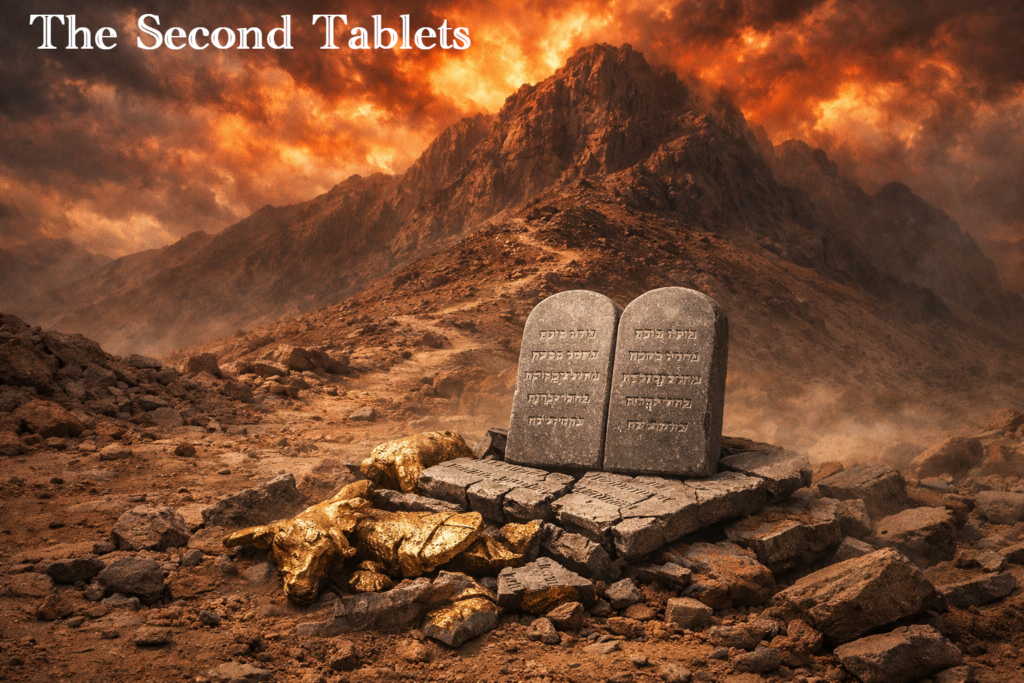
Forty days have passed. Moses returns from the peak of Sinai to find his people in celebration of a new god, a calf of gold.
Idolatry.
In his hands are G-d’s perfect words, pressed into stone by the Divine itself—the most sacred objects in human history. Zohar tells us the letters on the tablets of stone flew away and the tablets grew heavy. He drops them to the ground and they shatter.
Revelation and receiver are no longer aligned.
And this is where we begin. Not with the sin—that story is familiar enough. Not with the punishment, which is severe and swift. We begin with the sound of breaking, because it is only in that sound that what follows becomes intelligible.
The Pattern
This is not the first time humanity has stood in proximity to the Divine and broken under the weight of it.
In the Garden, the conditions were perfect: unmediated access, intimate presence, natural covenant…fulfillment. Until a serpent’s words and a fall from grace; the garden closed.
At Sinai, the pattern repeats. The Talmud tells us something extraordinary: when Israel stood at Sinai and received Torah, the zohama—the primordial contamination introduced by the serpent in Eden—was lifted from them (b. Shabbat 146a). Briefly, provisionally, they were restored to something like the Adamic condition. Closer to the original than any generation since the expulsion. The wound that had been carried in human flesh since the Garden was, for a moment, healed.
The calf is not merely a moral failure. It is a second fall—the human pattern playing itself out at the collective level, in the presence of the same Divine proximity that makes the fall both inexplicable and, somehow, humanly inevitable.
Formation. Deformation.
The pattern is established. What remains is whether anything follows—and what it costs.
What Moses Does—and Doesn’t Do
The conventional reading of what follows is straightforward: Moses intercedes. He argues. He reminds G-d of the covenant with Abraham, Isaac, and Jacob. He appeals to divine reputation—what will the nations say? G-d relents. Crisis averted.
This is the p’shat—the surface reading—and it is not wrong. The sod, however, offers something much more substantial.
In creating the calf, Israel has erected a blockade between themselves and the shefa—the Divine flow. G-d’s essential nature is unchanged. Merely obstructing the flow of a great river at its delta does not change the source of the water. Restoring the flow does, however, require intercession. It requires presence.
Moses stands in the gap—not to argue, but to restore. He takes the posture of someone who understands that the rupture is not merely moral but structural, positioning himself between a broken people and an unchanged G-d to clear the blockage and restore the flow.
The kabbalistic tradition reads this not as advocacy but as tikkun—repair. The sin did not make G-d less merciful and Moses does not persuade G-d toward mercy through intercession. He removes what was blocking mercy’s natural flow.
The difference is everything.
One reading gives us a skilled negotiator and calls out what appears to be a capricious G-d. The other gives us something closer to a lightning rod and reaffirms what was always there—a G-d of mercy.
The Architecture of Mercy
Moses ascends Sinai a second time. And into that cleared space—the gap he has held open with his own presence—G-d speaks.
Adonai, Adonai, El rachum v’chanun, erech apayim, v’rav chesed v’emet, notzer chesed la’alafim, noseh avon vafesha v’chata’ah, v’nakeh.
The L-RD, the L-RD, G-d compassionate and gracious, slow to anger, abounding in loving-kindness and truth, extending loving-kindness to thousands, forgiving iniquity, transgression and sin, and acquitting.
These are the Thirteen Attributes of Mercy—the Shelosh Esreh Middot—spoken by G-d into the wreckage of the golden calf, into the aftermath of the second fall. They are not a negotiated concession. They are not a character reference. They are G-d’s own self-disclosure into the space that Moses cleared—spoken in the first person, unrepeatable in their intimacy, and so foundational to Jewish worship that they are chanted by congregations on Yom Kippur and every festival to this day. The moment at Sinai echoes forward into every Jewish year.
But the sod asks a harder question:
Why here?
Why now?
Why does the deepest self-disclosure in all of Torah occur not at the burning bush, not at the splitting of the sea, not at the first giving of the tablets—but in the smoking ruins of Israel’s worst moment?
The Kabbalistic tradition offers a precise answer. The Thirteen Attributes are not newly granted in this moment. They are newly visible. They correspond to the thirteen channels of Keter—the supernal crown, the hidden foundation that underlies all emanation, the deepest structural reality of what G-d is toward creation. They were not created by the catastrophe. The catastrophe peeled back what was obscuring them.
This reframes everything. Mercy is not G-d’s response to human failure. Mercy is upstream. It is the foundation. Judgment—Gevurah—is real and necessary, but structurally secondary, a subordinate structure built beneath what was always already there. When the channel is clear, mercy flows because mercy is what the source contains. The calf didn’t reveal a merciful G-d who might have been otherwise. It revealed that the architecture of reality was mercy from the beginning—and that no human failure, however catastrophic, reaches deep enough to alter the foundation.
The river has not changed.
The channel is simply clear again.
Water (Chesed), never withheld, once more flows through freely.
The Second Tablets
P’sal lecha—carve for yourself (Exodus 34:1). Two words that change everything.
The first tablets were G-d’s alone—divine workmanship, divine writing, unmediated and perfect. The second are hewn by human hands, carried up by human effort, received in the aftermath of human failure.
Their content will be identical.
Their vessel will not be.
G-d’s instruction contains a detail that should stop us: asher shibarta—”which you shattered.” He does not say “that were broken.” He names Moses as the agent. Rashi preserves the tradition that followed: yasher koach—well done. The shattering was not a tragedy to be mourned. It was necessary. It was, in some sense, right.
The Lurianic concept of shevirat ha-kelim—the shattering of the vessels—illuminates why. In Lurianic Kabbalah, creation itself began with a catastrophic shattering—divine light poured into vessels too limited to contain it, and they broke. From that breaking, the work of repair, tikkun, became the fundamental task of existence. Nothing in creation that carries light was spared the breaking. The vessel must shatter before it can be rebuilt to hold what it was always meant to carry.
The first tablets were built for a world that no longer existed. Forged before the fall—perfect, unmediated, entirely divine—they belonged to a reality the calf had permanently closed. A wholly divine vessel has no place in a broken world; it has nowhere to stand. What gets rebuilt after the shattering is built for the light as it actually is—not as theory imagined it before the fall. The second tablets endure not despite the breaking but because of it. They were made for this world—the only one that exists.
The Human Parallel
The Talmud states it plainly:
“In the place where baalei teshuvah stand, even the completely righteous cannot stand.”
b. Berakhot 34b
The one who has fallen and returned does not merely recover lost ground. They occupy territory the unfallen cannot reach. The Lubavitcher Rebbe’s teaching on yeridah l’tzorech aliyah—descent for the sake of ascent—makes the mechanism precise: the fall is not a detour from the path. We fall so we can learn how to get back up. Seen from what it produces, it was always the path. The descent is purposeful. The breaking is re-formative. What ascends after is not a restoration of the original but a transformation into something the original could never have been.
The second tablets are not Plan B. They were always the destination. The first had to shatter so that what followed could be made in partnership—built by human hands, carried through human failure, designed to endure contact with a world that falls and rises and falls again.
The Second Tablets, Still
We do not live in the garden. We were never meant to stay there.
The tradition that emerges from Sinai—from the second tablets, not the first—is not a tradition built for the perfect. It is built for the broken, the fallen, the people who melted their liberation into an idol while the mountain still burned. It is built, in other words, for us.
The shefa has not stopped flowing. It never does. The river does not pause because the channel is blocked; it presses against the obstruction, patient and without end, waiting for the clearing that restores flow. This is not a G-d who must be persuaded toward mercy. This is a G-d whose mercy is the foundation of reality itself—upstream of judgment, upstream of failure, upstream of everything we have done and left undone.
What Ki Tisa asks of us is not perfection. It does not ask us to be the first tablets—unmediated, entirely divine, built for a world that no longer exists. It asks us to be the second: hewn by human hands, carrying the marks of the fall, made in partnership with a G-d who looked at the wreckage, breathed mercy into it, and said—begin again.
We are not fallen people trying to return to a state of grace we once possessed. The baalei teshuvah do not simply return. They arrive—somewhere the unfallen cannot reach, carrying something the unbroken cannot hold.
Formation. Deformation. Re-formation.
The pattern is not a problem to be solved. It is the path itself.

Discover more from Many Lamps, One Flame
Subscribe to get the latest posts sent to your email.