
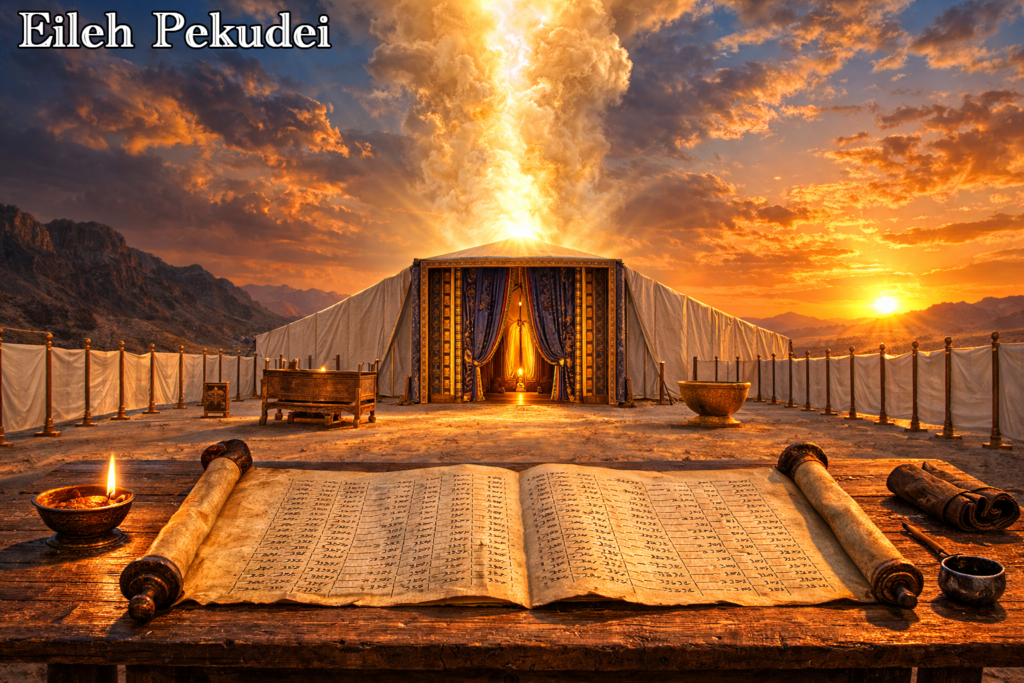
The final parashah of Exodus opens not with drama but with a ledger.
Eileh pekudei ha-Mishkan—these are the accountings of the Mishkan. What follows is precise: 29 talents and 730 shekels of gold. 100 talents and 1,775 shekels of silver. 70 talents and 2,400 shekels of bronze. Every ounce of material gathered from the willing hearts of Israel, catalogued, attributed, accounted for. Nothing concealed. Nothing approximate. Nothing left unexamined.
And only after this accounting is complete does the glory descend.
This sequence is not incidental. It is the logic of Pekudei—and of something far older and more demanding than bookkeeping.
What Pekudei Means
The Hebrew root p-k-d (פקד) will not be reduced to a single meaning. It means to count, yes—but also to visit, to attend to, to appoint, to remember, to call to account. When G‑d “poked” someone in Torah, the consequences were never administrative. Sarah conceives. Joseph’s bones are remembered and carried out of Egypt. The people are mustered before battle. Divine pekidah is penetrating, transformative attention—the kind that changes what it touches. The tradition has a name for this quality of knowing: Da’at. Not the accumulation of information, but the intimate, direct knowing that alters the one who receives it. Pekidah, at its deepest register, is Da’at in action.
Moses’ accounting of the Mishkan materials carries this same weight. The midrash notes that the people had begun to whisper—suspecting Moses of enriching himself from the nediv lev, the willing-hearted gifts of Israel. His response was not indignation. It was transparency. He produced a complete public ledger of every material received and every use to which it was put.
But the deeper point is not Moses’ integrity. It is what the act of accounting reveals about completion itself. The Mishkan could not be declared finished while any portion remained unexamined. The work is sealed not by the last board being set in place but by the honest reckoning that follows. You cannot close a chapter while its ledger is still open.
Cheshbon HaNefesh
The tradition of cheshbon hanefesh—the accounting of the soul—draws directly from this model. The term itself is taken from commerce: cheshbon is the bill, the ledger, the reckoning between parties. Applied to the interior life, it becomes something more demanding than guilt and something more honest than optimism.
Moshe Chaim Luzzatto, in Mesillat Yesharim (Path of the Just), frames the practice precisely: a person must examine their actions, their motivations, what they have been given and what they have done with it. Not in a spirit of self-flagellation—the medieval Christian practice of inflicting physical punishment upon oneself as penance, a distortion of contrition into theater—but with the same rigorous specificity Moses brought to the Mishkan ledger. Not “I have been distracted lately,” but an honest naming of what has been blocking the channels. Not “I could do better,” but a clear-eyed inventory of where the shefa—the divine flow—has been obstructed and why.
This series has traced the building of the interior dwelling across five portions. Terumah established the structure itself—the Ark at center, the Holy of Holies, the precise materials and their interior meaning, the qualities that must be cultivated before the dwelling can be built at all. Tetzaveh taught the discipline of service within it: the priestly garments, the eternal flame, the daily rhythm of maintenance—and critically, the Parochet, the veil that marks the threshold between the holy and the holy of holies, permeable to the prepared and impenetrable to the presumptuous. Ki Tisa confronted the shattering—shevirat ha-kelim at the human level, the vessel broken by failure, and the startling revelation that mercy is not G‑d’s concession to failure but the foundation of reality itself, upstream of judgment, upstream of everything. The one who returns through teshuvah does not merely recover lost ground—they arrive somewhere the unfallen cannot reach. Vayakhel showed what becomes possible when orientation is restored, the channels cleared, the heart opened: the Divine flows through the properly aligned person. Bezalel did not build the Mishkan from his own genius. He became the vessel through which the letters—the very instruments of creation—moved into form. The building was not his achievement. He was the instrument.
Pekudei is the seal on all of it. The accounting that makes completion real.
The shefa cannot flow through blocked channels. This is not metaphor—it is the operational principle of Kabbalistic understanding of the divine flow through the sefirotic tree. Chesed pours from above; it reaches Malkhut only if the channels between the sefirot are clear. When they are blocked—by unexamined wounds, by habitual avoidance, by the calcified patterns of a life unlived—the flow is impeded. Not stopped entirely. But reduced to what can squeeze through the obstruction. And what arrives below carries the distortion of what stood in its way.
The cheshbon hanefesh does not clear the channels by dwelling in them. It clears them by naming them honestly, examining what they contain, and making the specific accounting that genuine completion requires. You cannot declare yourself “done” with a chapter of your life while unexamined material from it still sits in the channels—while you are still carrying what should have been set down. The Israelites could not have followed the cloud burdened with the full weight of Egypt. Neither can we follow the movement of the Presence while dragging the unlived, the unexamined, the unresolved behind us. The accounting must be made. The ledger must be closed. The burden must be released before the journey can begin.
The Precision of Honesty
Notice what Moses does not do. He does not produce a general summary. He does not say “most of the gold was used for the sacred vessels” or “the silver went toward the sockets and hooks as directed.” He accounts for every talent, every shekel. The precision is the practice.
Vague accounting is not accounting. It is avoidance wearing the garments of reflection. The interior cheshbonthat asks only “have I been a good person?” or “am I generally on the right path?” performs the gesture of self-examination without its substance. The question that has weight is the specific one: What was I given in this season of my life? What did I do with it? Where did I spend what should have been offered elsewhere? What remained unconstructed because I withheld what the work required?
These are not comfortable questions. But the Mishkan was not built for comfort. It was built for habitation—for the Presence to take up residence in a vessel prepared to receive it. And the vessel is only truly prepared when the accounting is honest.
The Glory Descends
The accounting complete, Moses blesses the people. The work is finished. And then:
The cloud covered the Tent of Meeting, and the glory of G‑d filled the Mishkan. (Exodus 40:34)
Vayechal Moshe et ha-melacha—Moses completed the work. The verb is the same root used in Genesis 2:2: vayechal Elohim—G‑d completed the work of creation. This echo is not accidental. The completion of the Mishkan participates in the same act as the completion of the world. When Israel builds the dwelling rightly, from open hearts, through honest hands, with a full accounting of what was given and what was used—they re-enact creation. They align the lower world with the upper. And the Presence descends.
Not as reward. As fulfillment. The vessel that has been honestly built and honestly examined becomes what it was always meant to be. The channels that have been cleared carry what they were designed to carry. The Presence does not force entry into an unexamined life. It dwells where it is genuinely welcomed—in the interior space that has been cleared, examined, offered.
When the Cloud Moves
But Pekudei does not end with the glory filling the Mishkan. It ends with the cloud moving.
When the cloud lifted from over the Mishkan, the children of Israel would set out on their journeys. But if the cloud did not lift, they did not set out until the day it lifted. (Exodus 40:36–37)
The completed Mishkan does not become a monument. The dwelling prepared with such precision, examined with such honesty, filled with such glory—is not a destination. It is the vessel by which the Presence travels with the people into whatever comes next. Lift or settle. Move or remain. The cloud governs, and the people respond.
Israel did not build the Mishkan so they could remain at Sinai. They built it so the Presence could accompany them into the wilderness—into the years of wandering, the failures and renewals, the long journey toward the land they had been promised. The Mishkan is portable not because it was convenient to carry but because the Presence was never meant to be stationary.
Neither are we.
And the same is true of the interior dwelling. The cheshbon hanefesh is not an end in itself. The formation, de-formation, and re-formation that this series has traced is not directed toward a state of achieved holiness one can inhabit permanently. It is directed toward responsiveness. Toward the capacity to follow.
When the channels are clear, the shefa flows. When the shefa flows, it moves. And the person whose interior dwelling is genuinely prepared does not direct that movement—they participate in it. They learn to read the lifting of the cloud and the settling of it. They discern when to remain and when to set out. They have learned, through the long discipline of honest accounting and open-hearted offering, to orient themselves not by their own agenda but by the movement of the Presence they have made room to receive.
This is what Leviticus—Vayikra—will ask next. Not how to build the dwelling or how to perform the accounting, but how to live in the company of the Presence that has taken up residence. The priestly service, the sacrificial system, the laws of purity—all of it is the answer to the question Pekudei raises: now that the Presence travels with you, how do you conduct yourself in its company?
Pekudei is the hinge. The accounting closes Exodus. The cloud moving opens everything after.
Make the accounting. Close the ledger. Clear the channels. And when the cloud lifts—
Move.
This is how a sacred life is realized.

Discover more from Many Lamps, One Flame
Subscribe to get the latest posts sent to your email.