
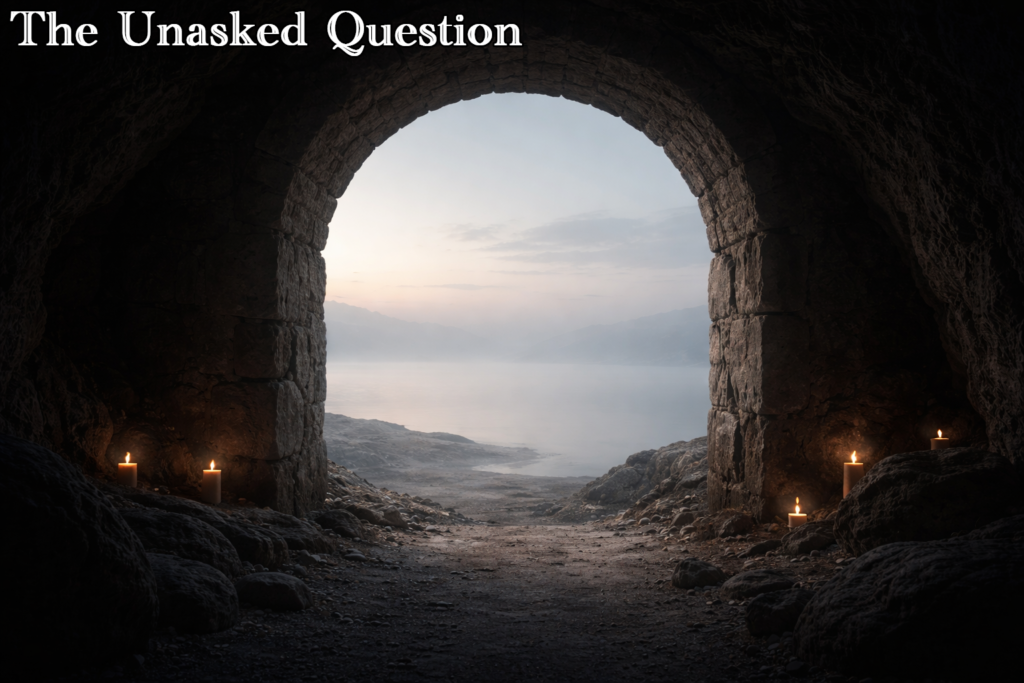
A friend was recently pondering a question she couldn’t answer.
What is the question for which my life is the answer?
She turned it over for days. Most people would. It has the shape of a riddle but the weight of something more serious—the kind of question that, once heard, refuses to leave. She brought it to someone whose first instinct was not to answer it, but to notice what the question was actually doing.
It was pointing somewhere. Somewhere most of us cannot see clearly—not because the direction is hidden, but because the noise is too total to permit the kind of seeing it requires.
That noise is where we must begin.
The Roar
The mundane is not the enemy. This bears saying plainly, because the contemplative traditions can give the impression that ordinary life is the obstacle—that bills and bodies and relationships and obligations stand between us and something more important happening elsewhere. They do not. They are simply the default condition of human existence. Unavoidable. Legitimate. Relentless.
But we live in the loudest moment in human history. The clamor is no longer merely external. It has been internalized—the endless self-narration, the ego’s compulsive commentary on every passing moment, the accumulated static of a life lived at speed. Most people carry the roar inside them even when the room is quiet. Silence the phone, close the door, sit down—and discover that the loudest sound was never coming from outside.
Most people have forgotten there is anything beneath it. They have mistaken the roar for the whole of reality.
The ones who have not forgotten are the ones who have heard, at least once, something else. A frequency so faint it is nearly imperceptible. A signal so quiet that the slightest distraction drowns it completely.
The tradition has a name for it.
The Still Small Voice
(1 Kings 19:1-13) The prophet Elijah arrives at Horeb at his most depleted. He has called down fire from heaven, outrun chariots, witnessed the prophets of Baal destroyed. And now he is hiding in a cave, asking G‑d to let him die. It is enough. The man who commanded the heavens is finished.
G‑d asks him: What are you doing here, Elijah? What follows is not rebuke. It is instruction in method.
Go out and stand on the mountain, G‑d says. And then—a wind so violent it splits rock. Then an earthquake. Then fire. G‑d is not in the wind. G‑d is not in the earthquake. G‑d is not in the fire.
After the fire: kol demamah dakah. The still small voice. The thin sound of silence.
A word about the whisper itself.
Kol demamah dakah is translated “still small voice” — but the Hebrew resists that rendering. It is closer to the sound of thin silence. Not a voice. Not sound in any ordinary sense. The tradition reached for the nearest available language and knew it was falling short.
This matters because the seeking described here is not the seeking of something audible. The silence does not speak in words. What arrives — when it arrives — is better described as a quality of presence. A direct apprehension that bypasses the usual channels entirely.
Language is built for the roar. It borrows—voice, whisper, light, breath—and hopes the reader understands the word is pointing beyond itself.
The wind, the earthquake, the fire are the frequencies Elijah has been operating in—power, performance, visible display. And G‑d is not there. G‑d is in what remains when all of that has exhausted itself.
Note what Elijah does before the whisper arrives. He wraps his face in his mantle. He stills himself. The external conditions and the interior surrender happen together. The silence is not merely a place. It is a condition—held outside and within simultaneously.
The question is not whether the whisper is still speaking. It is whether we have found the conditions to hear it.
The Witness of the Traditions
Every serious contemplative tradition in human history arrived, independently, at the same conclusion. This is not coincidence. It is discovery—different explorers mapping the same territory through different instruments, returning with accounts that, beneath the surface differences, describe the same terrain.
The Desert Fathers fled to the wilderness not from cowardice but from clarity. They understood what the city could not provide—not because the Divine was absent from the city, but because the city’s noise made perception impossible. Abba Arsenius, one of the earliest and most revered of the desert monks, heard a voice before his withdrawal: Flee, be silent, pray always. The sequence is not accidental. Flee first. Then stillness becomes possible. Then prayer.
Jesus withdrew repeatedly to solitary places—before choosing his disciples, after the feeding of the five thousand, in the night hours before his arrest. The Gospels present this not as eccentricity but as necessity. The one who could silence a storm with a word apparently still required conditions of solitude himself. Whatever became available to him in those hours was not available in the midst of the crowd—even a crowd that loved him.
Rabbi Nachman of Breslov walked into the forest. Not to escape, but to speak—hitbodedut, spontaneous prayer in solitude, stripped of liturgical scaffolding, conducted in whatever language came naturally. He prescribed it for his Hasidim as essential practice. The forest was not metaphor. The removal from ordinary context was the point. Something became available there that the synagogue, for all its irreplaceable value, could not always provide.
Buddhist śamatha—stillness—is the necessary foundation for vipassāna, insight. You cannot see clearly from an agitated surface. A pond stirred into turbulence reflects nothing accurately. The same water, stilled, becomes a mirror. The practice of stillness is not the destination. It is the preparation of the instrument through which seeing becomes possible.
And then there is samādhi—the state toward which sustained contemplative practice points. Not unconsciousness. Not blankness. Heightened, unified awareness in which the boundary between observer and observed dissolves. The interior clamor quiets completely. What remains is pure presence. This is the deeper layer: the silence being sought is not merely the absence of external noise. It is the quieting of the self that generates its own. Until that interior noise subsides, external silence is only a quieter room in which to think the same loud thoughts.
The Unmooring
There are moments—they cannot be scheduled or produced—when the scaffolding of ordinary reality comes down.
Not through spiritual achievement. Often through its opposite: crisis, illness, exhaustion, grief, the breaking of what had been holding the familiar world in its familiar shape. The mechanisms that construct the continuous sense of solid, bounded, coherent experience temporarily fail. What had seemed permanent reveals itself as constructed. What had seemed like the whole of reality reveals itself as a layer.
What remains in that space is not nothing.
Those who have passed through such moments—and returned, carrying whatever could be carried back—tend to describe the same thing in different words. A stillness beneath the disruption. A presence that was not generated by the crisis and was not disturbed by it. Something that had apparently been there all along, inaudible beneath the ordinary noise, now briefly perceptible in the sudden quiet the catastrophe created.
The mystics were mapping this territory. The contemplative disciplines exist to approach it without requiring the catastrophe—to create, through sustained practice, the interior conditions that crisis sometimes produces involuntarily.
The whisper does not begin when the noise stops. It was always there. The noise simply ends.
The Discipline
The silence cannot be stumbled into and kept. The water gets murkier over time. The mundane reasserts itself—not maliciously, simply inevitably. Life asks, and we answer. Days accumulate. The interior noise rebuilds.
This is not failure. It is the human condition.
Which is why every tradition that takes this seriously insists on practice rather than state. Not the achievement of permanent clarity, but the repeated return to conditions where clarity becomes possible. The discipline exists precisely because the default is drift. Seeking the silence is not a single accomplishment. It is a direction maintained against constant pressure—a return made again and again across a life.
The interior noise is the harder obstacle. Most people, seeking quiet, remove external distraction and discover the self-narration is still deafening. The ego generates its own interference. The preconceived notions of the visible do not dissolve simply because the environment quiets. They are the lens through which we see—which means we do not notice them any more than we notice our own corneas.
This is the work that prayer and fasting and contemplative practice are designed to address—not as ends in themselves, but as preparation of the instrument. The clearing, the emptying, the progressive quieting of what generates the interference. None of it produces the whisper. The whisper was already there. What the discipline produces is the capacity, slowly and imperfectly cultivated, to hear it.
What the Silence Is For
Return now to the question that started this.
What is the question for which my life is the answer?
The kol demamah dakah is the whisper one finds the silence to hear. But what is it saying?
It is asking the question.
The question for which your particular, specific, unrepeatable existence is the answer was asked in a frequency so quiet that the ordinary roar drowns it completely. You cannot hear what was asked of you—what your life, with all its specific textures and turns, is the fitting response to—until you have found the silence beneath the noise. And even then, not clearly. Enough to know something is there. Enough to orient toward it. Not enough to transcribe it.
Here is what can honestly be said of it:
The question for which my life is the answer is something that could only be asked by that which we cannot assign meaning to. The Ein Sof, the eternal, the Divine—call it what you will. Whether you believe that G‑d created each of us to serve a purpose, or put your faith in destiny, or even believe that a collection of seemingly random, independent events aligned to form each of us—it is still a question beyond our ability to frame.
The question is transcendent by definition—because if we could frame it, we’d already be standing outside our own existence looking at it. We can’t. We are inside the answer, trying to read the question from within it.
You can’t answer it. You can only be it. Perhaps someday, in another level of reality, we may be able to ask the question to answer the inquiry—but for now, it is simply not within the purview of our state.
This is not resignation. It is orientation. The silence is not empty. It is where the question lives—asked once, in a frequency beyond our mechanisms to fully receive, answered by the fact of our existence without our ever fully knowing what was asked.
The seeking is not futile. It is the most human thing there is.
All things become visible to the man who sheds his preconceived notions of the visible.

Discover more from Many Lamps, One Flame
Subscribe to get the latest posts sent to your email.