
This shall be the law of the metzora on the day of his cleansing: He shall be brought to the priest.
—Leviticus 14:2
The metzora has been standing at the edge of the camp for an unspecified period of time. He is not simply sick. The tradition is precise about this. He is the person whose corrupted speech—speech that displaced the nefesh ha-medaberet, the speaking-soul faculty that gives human language its distinctive dignity—registered itself outward onto the skin in the form of tzara’at. The body wrote what the soul had done. He has been held at the threshold ever since, in the state Torah calls tumah—not impurity in the sanitary sense, but a specific spiritual condition: the signature of threshold experience, the state that arises wherever the boundary between life and its absence becomes porous. He is neither fully inside nor fully outside. He is in between.
Now the skin has cleared. And Torah prescribes something genuinely strange for what happens next.
What the Body Already Knows
The criterion for return is not behavioral. The priest does not interrogate the metzora about remorse or restitution, does not evaluate whether his speech has reformed, does not assess his spiritual state through any direct examination of the soul. He looks at the skin. Has the tzara’at cleared? That is the only question.
The body does not lie because it cannot. Nefesh—the soul-faculty most intimately bonded to the physical self, the soul as embodied and operative in the world—nefesh has already written its resolution onto the skin. The clearing of the tzara’at means nefesh has reconstituted. The vessel that had become a klipah—a husk, a blocked channel that received divine energy but could not transmit it—has restored itself to proper function. The speaking soul has returned to its rightful place.
But neshamah—the soul-faculty of moral and spiritual consciousness, the level at which genuine transformation occurs—does not move in lockstep with nefesh. The soul-levels are not a single instrument that resolves all at once. Nefesh reconstitutes first, at the level of the body. Neshamah follows—if it follows. The priest reads the body because nefesh has already written its answer there. What the ritual that follows must accomplish is something different: the ratification, at the neshamah level, of what nefesh has already done. The purification is not remediation. The healing has already happened. The ritual is the question of whether neshamah has kept pace.
One Creature, Made Visible in Its Duality
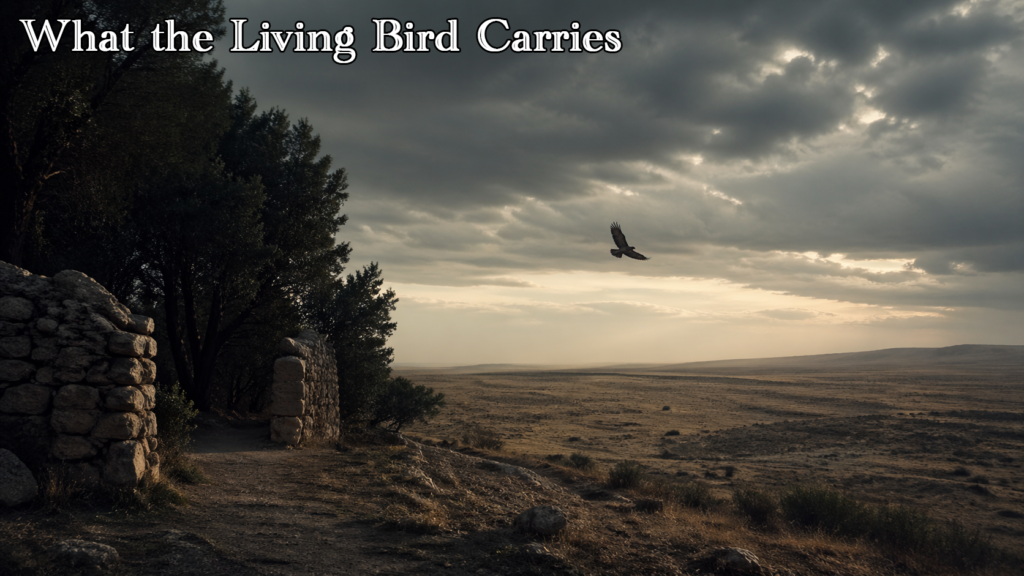
The two-bird ritual of Leviticus 14 is structurally unlike anything else in the sacrificial system. The priest takes two living, clean birds. He takes cedar wood, crimson thread, and hyssop—bound together as a single unit. He takes an earthen vessel and fills it with living water, water drawn from a spring, water that moves. Over the living water, he slaughters the first bird. The blood falls into the vessel, disperses into the current. The living bird, the cedar, the hyssop, and the crimson thread are dipped together into the blood of the dead bird—into the vessel where blood and living water have now become one substance. The priest sprinkles this mixture seven times on the person who has stood at the boundary. Seven times. The full span of the lower world, reached in sequence. Then he releases the living bird into the open field. It flies. It carries the blood of its dead twin, the blood that was sprinkled on the one returning, out over the face of the open country. Torah does not watch where it goes.
This is not a korban in the standard sense. There is no altar. The blood does not go to the sanctuary. The entire ritual happens outside the sanctuary, at the boundary. The priest comes out to the person; the person does not yet come in.
The Zohar at III, 53b identifies the two birds with precision: they correspond to Netsach and Hod, the twin sefirot whose activities are, respectively, speaking and feeling. Netsach is the sefirah of values, purpose, law, and the capacity to make words that transmit—the sefirah of teaching, of daber, of articulating what is real. Hod is the sefirah of emotional motivation, gratitude, the felt dimension of divine presence that gives speech its weight and accountability. Together they are the two pillars, the legs of the divine body, the channels through which shefa moves into action and word in the world. When the metzora’s speech became lashon hara—Netsach operating without Hod, words without grounding, transmission without gratitude—both departed from him. The speaking faculty severed from the feeling faculty: that is the precise sefirot-anatomy of corrupted speech. The two birds are not two separate creatures but one thing made visible in its duality. What must die is the corrupted Netsach—the word-making faculty as it functioned in service of the sitra achra. What is released is the Hod-portion belonging to the domain below, carrying the blood of what died, so that genuine Netsach can return above, reunited with Hod, the two pillars restored to their proper function. The blood marks both because the substance is continuous: death and life share the same origin. The tradition’s choice of birds is not incidental. Birds chatter. They are the creature defined by unceasing, undiscriminating speech—made of the same substance as what they carry. And the priest who ratifies the return is Aaron—and Aaron is Hod. The sefirah of emotional discernment, of felt presence, of gratitude examines the sefirah of speaking to determine whether Netsach has reconstituted itself. Hod reads what Netsach wrote on the skin.
Cedar to Tiferet, crimson yarn to Gevurah, hyssop to Yesod—the full sefirot-structure the affliction disrupted, restored in sequence. The seven sprinklings reach every level of the lower world. When the Zohar says all return to settle upon him, it means precisely this: the sefirot that departed when the speech corrupted, coming home.
Origin and Destination
The corrupted speech that displaced the nefesh ha-medaberet did not originate in a vacuum. The Zohar’s framework is that speech operating as lashon hara—harmful speech, the unnecessary true word that destroys—flows along channels that belong to the sitra achra. The sitra achra—literally “the other side”—is the kabbalistic name for the domain of forces that stand in structural opposition to the flow of divine light. Not a place of punishment. Not a rival deity. Not a personification of human weakness. It is a real domain within the structure of creation itself, present not as afterlife geography but as a force operative within the world, within history, within the soul: the realm of the klipot, the broken vessels and blocked channels, the forms that receive energy but cannot transmit it. Where tikkun moves toward repair and flow, the sitra achra moves toward accumulation and blockage. It has jurisdiction. It does not have a location.
The corrupted speech belonged partly to that domain. The living bird carries that portion where it belongs.
The Talmud in Arachin 16b offers something that sits alongside this without resolving it too quickly. The rabbis observe that during the isolation period, the metzora occupies the same category as a mourner: head uncovered, upper lip covered, calling out tamei, tamei. That double-calling is almost always read as a warning—stay away. The rabbis read it differently. The metzora is mourning his own condition. The calling is grief. He is not warning the community. He is sitting with what he has lost: the proper function of his own speaking soul, his capacity to be a transmitting vessel rather than a blocking one. The isolation was not quarantine. It was a period of grief that the tradition hoped would become teshuvah.
The Wilderness and Its Jurisdiction
The bird is released al pnei hasadeh—over the face of the open field—and Torah goes silent. The Mishnah in Negaim 14:1 establishes that the release must be into open country, where return is structurally prevented. The Talmud does not chase the bird into the wilderness. The tradition, deliberately, looks away.
But the wilderness is not scenery. In Torah’s cosmology, midbar is not simply uninhabited terrain. It is the domain where human order—kedushah, structure, the bounded community under covenant—gives way to something older and less formed. The sitra achra has jurisdiction there. The wilderness is the natural habitat of the klipot, the realm where the shards from shevirat ha-kelim—the shattering of the vessels—accumulated when they fell beyond the reach of shefa, divine abundance. Azazel lives there. The tradition places demons in ruins and waste places, in the spaces where kedushah has thinned to nothing. The wilderness is not empty. It is full of what was never properly formed.
This is where the bird goes. Not into nothing. Into the territory of what receives what cannot remain inside the boundary.
The Wager the Ritual Makes
The sitra achra is not a void. The Zohar’s logic—which reaches its fullest expression in the se’ir la’azazel, the scapegoat ritual of Acharei Mot—is that the Other Side receives its portion as a kind of shochad, a bribe, so that it will be occupied with what it has been given and leave the holy domain alone. But a bribe feeds the recipient. It does not neutralize them. The sitra achra digests what it receives. It does not disappear because it has been satisfied.
We are stewards of creation. What we dispatch does not simply cease. The wilderness accumulates what is sent into it, and the domain of the sitra achra is not infinitely absorbent. Corruption sent outward does not remain there indefinitely. It builds. And what builds eventually returns—through the thinning of communal boundaries, through the fracturing of structures that were never rebuilt from the inside, through the recurrence of what was never genuinely resolved. The tradition recorded this. Recurrent tzara’at appears in the text. The skin that clears without the soul that transforms sends something live into a domain that will eventually return it.
This is the wager the ritual makes on behalf of the metzora. If the isolation period produced genuine teshuvah—if the mourning at the boundary became real transformation, if the neshamah kept pace with what nefeshhad already accomplished—then what the bird carries into the wilderness is already empty. A husk. The sitra achra receives the shell of something already resolved, and there is nothing live in it to grow. But if the isolation produced only time served—if the skin cleared because nefesh reconstituted while neshamahremained unchanged—then what flies into that open field is still charged. The transaction is real in form and hollow in substance. The community cannot know which it is. The priest cannot verify it. Only the metzoraknows.
The Mark on the Living Bird
The living bird does not fly away clean. It carries blood—the blood of the dead bird, the blood that was sprinkled seven times on the metzora. It carries the history of what happened outward into the field. The metzora who returns to the camp is not the person who left it. He stood at the boundary. His skin cleared. His voice, if it speaks now with the discipline that the isolation was meant to produce, speaks through a channel that has been restored—or through one that was never truly reconstituted, only emptied of its visible symptom. The community cannot tell the difference. The priest could not either. The gates open. The metzora alone.
The individual dispatch mechanism has a structural limit. One person’s release into the wilderness cannot address the accumulated weight of every dispatch that was ritual without transformation—every bird that carried something still charged into the domain of the Other Side, every transaction that was formally complete and substantively hollow. That weight accumulates. It does not resolve itself.
What Metzora opens, Acharei Mot must answer. The scapegoat bearing the sins of Israel into the wilderness on Yom Kippur is not a separate institution. It is the communal reckoning with everything the individual dispatches left unfinished—the sum of the wagers that did not pay off, returning now as a weight that no single metzora can carry alone. The mechanism is the same. The stakes are larger. And the question of whether the teshuvah was real has become a question that the entire community must answer together.

Discover more from Many Lamps, One Flame
Subscribe to get the latest posts sent to your email.