For on this day purgation will be effected for you, to purify you of all your sins; before YHVH you will become pure.
—Leviticus 16:30
The rabbi has been standing at the functional center since morning. By the time neilah approaches—the closing prayer, the sealing of the gates—the exhaustion visible on him is not the tiredness of a long day. It is the particular depletion of someone through whom something has moved. A congregation in Connecticut. Yom Kippur. The room full of people who have been fasting since sundown the night before, who have been standing and sitting and beating their chests and confessing in Hebrew and in English for hours. And a visitor seated among them notices what the others in the room do not name.
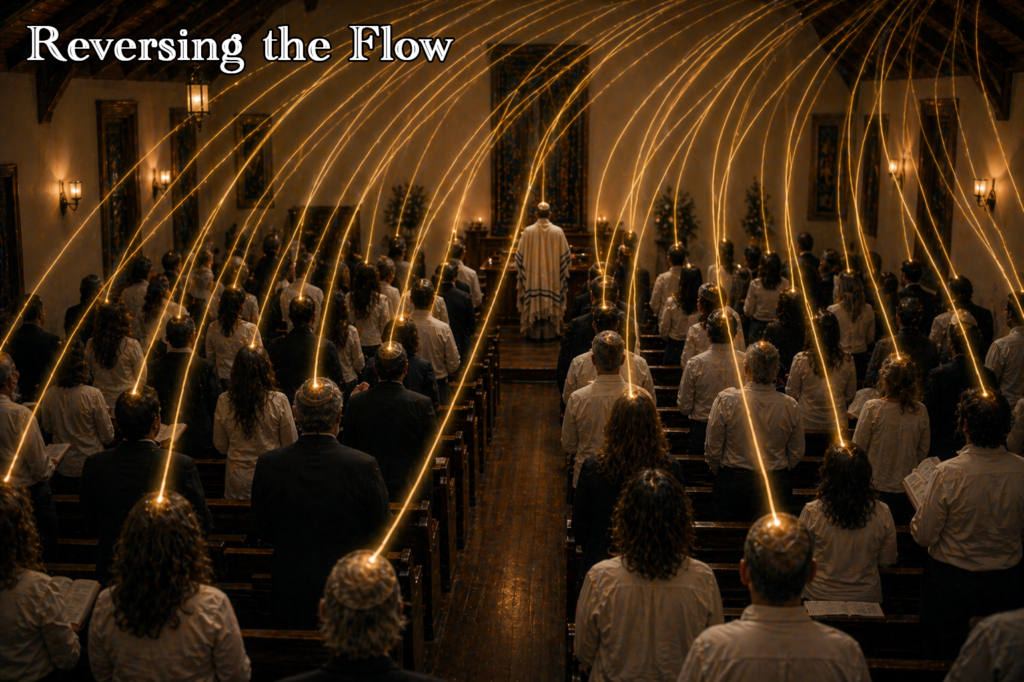
It is a small room, shared with other faiths across the week. Wood pews. Seventy-five people, some in white, others in the ordinary clothes of an autumn evening. The rabbi in white linen, his talit bearing a single band of blue.
Tzinoroth—channels, cords of light—rise from the head of every participant. Gold in color. Shefa running in reverse: not flowing downward from the divine into the world as it does in ordinary time, but drawn upward, outward, channeled toward the source. Energy moving away from the people through structured pathways. The visitor feels it in their own body. The same cords. The same direction. The same pull.
When neilah ends, there is a giddiness in the room that is more than relief. Something completed its movement. The rabbi gently lowers himself to the floor and sits there—spent, grinning—resting for the first time since morning. And the visitor understands—with the understanding that lives in the body rather than the mind—what this day has actually been doing.
This is what Acharei Mot prescribes. This is what Yom Kippur actually enacts.
After the Death
The parashah opens with its anchor in grief. Acharei mot—after the death of the two sons of Aaron, after Nadav and Avihu entered the Holy of Holies without authorization and died there. The warning that follows is not abstract. Do not enter whenever you feel like it. Do not come whenever you choose into the inner sanctuary. One man. One day. Precisely regulated. Or you will die as they did.
The kohen gadol prepares accordingly. He immerses multiple times. He sets aside the golden vestments of ordinary priestly service—the vestments of glory—and dresses instead in plain white linen. He takes an earthen censer and fills it with burning coals from the altar. He takes two handfuls of incense. He enters the Holy of Holies and places the incense on the coals inside, so that a cloud of smoke rises and covers the kapporet—the cover of the Ark, the place where the divine presence rests—and he cannot see. He enters blind, into the smoke, into the place where the divine voice issues from between the two cherubim. The people outside do not know if he will come out.
The tradition preserves a detail whose historicity is disputed but whose psychological truth is not: a cord tied to the kohen gadol’s leg, so that his body could be retrieved if he died inside. Whether or not the cord was ever literally tied, the image captures what the community felt standing outside those doors. This was not a ceremony. It was an annually renewed confrontation with the question of whether the center would hold—whether the atonement would be accepted, whether the man who carried Israel’s accumulated weight into the innermost chamber would emerge alive.
What makes the center so dangerous? And what makes this one day—only this day, only this man, only this precise sequence—the exception?
Two Goats, One Lot
Before the kohen gadol enters the Holy of Holies, two identical goats are brought before him. Lots are cast—one lot for YHVH, one lot for Azazel. The randomness is deliberate and theologically precise: no human judgment decides which goat goes where. The lot falls as it falls. What is designated to each is not Aaron’s choice.
The Zohar at III, 63a asks the obvious question: why lots at all? Rabbi Shim’on’s answer cuts straight to the structural logic. Aaron casts the lots because Aaron comes from the side of Chesed—loving-kindness, the force that can sweeten harsh judgment. The lots are cast al—above—so that Matronita, the Shekhinah, may be sweetened above the two forces the goats represent. The ceremony below mirrors and affects what moves above. Two goats below, two harsh forces above: one held for the L-rd, one sent to its own domain, because if both joined together, the world could not endure it.
The reader who has come from Parashat Metzora will recognize the structure immediately. One dies. One is released, carrying what has been transferred to it, into the wilderness. The mechanism is identical to the two birds. But the differences are not incidental—they are the entire point.
The birds were released into the open field passively. No named recipient. The tradition looked away and did not follow. The Azazel goat is sent deliberately, to a named entity, in a specific direction, carrying a specific payment. The sitra achra is not simply the wilderness. Azazel is its jurisdictional representative, the prince of the Other Side, and the goat is not disposed of—it is delivered. The Zohar, drawing on Pirqei de-Rabbi Eliezer, names the transaction plainly: a shochad, a bribe, given to the Other Side on Yom Kippur so that it will be preoccupied, assuaged, unable to bring accusation against Israel on this one day. The sitra achra receives what belongs to it. Having been satisfied, it cannot prosecute.
Individual dispatch at the boundary. Communal dispatch at the center. The mechanism is the same. The scale is the entire people of Israel. The recipient is named.
The Blood in the Center
Before the goat goes anywhere, the blood work happens inside. Aaron takes the blood of the bull—his own sin offering, for himself and his household—and enters the Holy of Holies. He sprinkles the blood on the kapporet, the cover of the Ark, the place where the divine voice speaks. Then he takes the blood of the slaughtered goat—the one designated for YHVH—and returns. Sprinkles again. The blood of the nefesh, the soul’s carrier, makes direct contact with the place where the divine presence rests.
The blood addresses the rupture. The year’s accumulated transgression has opened a breach between Israel and the divine center—a widening of the distance between the community and the source from which shefaflows. The blood work inside repairs that breach directly: the soul’s carrier placed against the place where the divine presence rests, the gap closed from the inside. This is the atonement itself. The goat that goes to Azazel does something different.
The goat dispatches the sitra achra’s accumulated claim—what the Other Side has accrued over Israel through the year’s transgressions. The breach and the claim are two aspects of the same rupture, requiring two distinct mechanisms. First the center. Then the periphery. The relationship to the divine presence is repaired before the wilderness can be asked to hold what is sent into it. If the center is not restored first, the dispatch accomplishes nothing—there is nothing to protect.
This is why the location differs from the birds of Metzora. Individual tzara’at purification happens at the boundary because one person is returning from the edge. Yom Kippur happens at the center—in the Holy of Holies, the innermost chamber—because the entire community’s relationship to the center must be restored before the periphery can hold. You cannot dispatch the claim from a community whose connection to the source has not yet been repaired.
The Crimson Thread
The Mishnah records the observable confirmation. A crimson thread tied to the door of the Temple. When the goat reached the wilderness and the transaction completed—when Azazel received what was sent—the thread turned white. Isaiah’s promise made visible: though your sins be as scarlet, they shall be white as snow. The community standing outside could see the Temple door. The thread changed color. The people knew.
The collective weight of this moment cannot be overstated. All day, the community has been fasting and confessing, beating their chests, standing at the edge of their own accountability. The kohen gadol has entered the chamber where men die. The goat has gone into the wilderness. And then—visible confirmation. The red thread goes white. The wager paid off. The atonement was accepted. Something moved.
The Talmud in Yoma 39b records what happened next, and it is devastating. In the last forty years before the Temple’s destruction—the last forty Yom Kippurs of the Second Temple period—the crimson thread never turned white. The ritual continued. The goat went. The kohen gadol entered and emerged. The community fasted and confessed and waited. The thread stayed red.
The Talmud records this without explanation. It does not say why. It does not offer comfort. It simply notes the fact: forty years, no white thread. The mechanism operated. The confirmation stopped coming.
This is the condition of every Yom Kippur since the Temple’s destruction. The ritual performed without the thread. The transfer enacted without visible confirmation. The community making the wager without knowing if it paid off. What the crimson thread gave the community was not the atonement itself—that happened or it didn’t, thread or no thread. What it gave them was knowledge. The thread’s absence since the destruction does not mean the mechanism has stopped. It means the community now prays without seeing the answer return.
What the Visitor Saw
Return to the room in Connecticut. Name now what was seen in the terms the tradition provides.
The tzinoroth—the channels—are the structured pathways through which shefa moves between the divine source and the world. In ordinary time, the direction is downward: divine abundance flowing through the sefirot, through Yesod as the central gathering channel, into Malkhut, into the world. On Yom Kippur, the direction inverts. The accumulated weight of the community’s year—the transgressions, the blocked channels, the places where nefesh operated without neshamah, where words were spoken without grounding, where the speaking soul served the wrong domain—all of it is drawn upward. The tzinoroth carry it toward the source, where what belongs above can be returned above and what belongs to the sitra achra can be dispatched below.
The exhaustion on the rabbi is the exhaustion of Yesod—the sefirah of foundation, the central channel through which the community’s accumulated weight has been moving all day. He has been serving as the functional axis of a communal transfer. Not metaphorically. The man through whom the community’s release travels is depleted because something real has moved through him.
The neshamah yeteirah—the additional soul—arrives with Shabbat and departs at its close. On Yom Kippur it arrives in heightened form, present throughout the day, available to the community in a register of spiritual perception ordinarily inaccessible. The giddiness that builds as neilah approaches is partly this: the additional soul still present, the community still in contact with what it usually cannot feel. The grief that edges the giddiness is the approaching departure—the neshamah yeteirah ascending as the gates close, the community returning to ordinary perception. The spices and the flame of havdalah are meant, in part, to console the soul for this loss.
The visitor felt the cords in their own body. Still feels them. This is not description. This is the mechanism operating—the same mechanism the two birds enacted at the individual level, the same mechanism the Azazel goat enacts at the communal level, present now in a rented hall in Connecticut with no Temple, no kohen gadol, no crimson thread. The thread may not turn white anymore. The tzinoroth still rise.
The Wager, Now Communal
The individual metzora stood at the boundary and made a wager on behalf of himself. The priest read the body. The bird went into the wilderness. Whether the wager paid off—whether the isolation produced genuine teshuvah or only time served—only the metzora knew. The community that opened its gates received someone back whose interior it could not read.
On Yom Kippur the entire community makes the wager together. The blood goes to the kapporet. The goat goes to Azazel. The tzinoroth rise. The kohen gadol emerges from the chamber. The community has fasted and confessed and beaten its chest and stood for hours in collective accountability. The mechanism operates whether or not the teshuvah that preceded it was real. The goat goes either way.
What differs is what the goat carries. If the community’s teshuvah was genuine—if the neshamah kept pace with the ritual, if the interior transformation preceded the exterior ceremony—then what crosses into the wilderness is already empty. A husk. The sitra achra receives the shell of a claim already dissolved, and there is nothing live in it to grow. But if the day was performance without transformation, confession without accountability, fasting without the interior work that fasting is meant to produce—then what the goat carries into Azazel’s jurisdiction is still charged. The transaction is real in form and hollow in substance. The thread stayed red. The mechanism had nothing to carry.
The Talmud does not explain the forty years of red thread. Perhaps it does not need to. The community that performed the ritual faithfully for four decades while the thread refused to change knew what it meant. The mechanism was in place. What the mechanism required—the genuine interior transformation of an entire people—was not.
This is the question Acharei Mot leaves sitting, the same question Parashat Tazria posed for the individual and Parashat Metzora posed for the one returning: did the transformation precede the ritual? The individual metzora alone knew. The community alone knows. And only the Holy One verifies the answer—in the color of a thread that has not turned white for two thousand years, and in the tzinoroth that rise anyway, carrying what they carry, into whatever receives them.

Discover more from Many Lamps, One Flame
Subscribe to get the latest posts sent to your email.