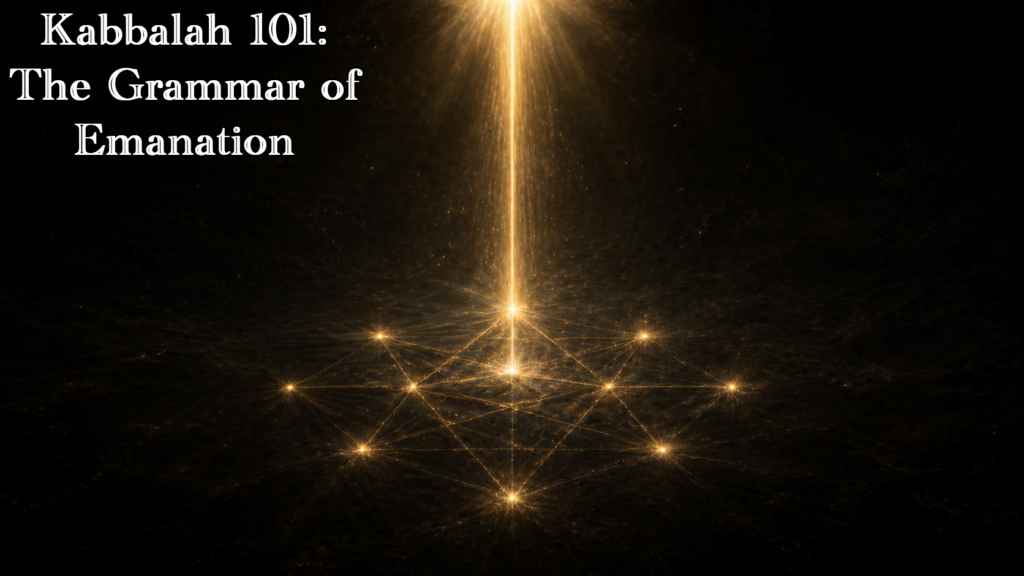
There is a diagram that appears on the walls of synagogues, in the margins of medieval manuscripts, in the notebooks of mystics, and increasingly on the screens of people who encountered it through a passing reference and found themselves unable to stop thinking about it. It is called the Tree of Life. It consists of ten points connected by twenty-two paths, arranged in three columns, and it has been used for centuries to describe—something.
It is not a picture of the Divine. It is not a hierarchy of spiritual power, a chart of the cosmos, a map of the afterlife, or a system of magical correspondence—despite what much of popular culture has made of it. It is something at once simpler and more demanding than any of those things: a two-dimensional representation, for three-dimensional eyes, of a reality that exceeds every dimension available to us. It expresses, in the most precise symbolic language human thought has been able to produce, a small portion of what that reality is, was, and will be.
Specifically: it maps emanation. How the Infinite makes itself available to the finite. How the finite is made in that image. And how the finite is called to receive what flows through it and transmit that current into the world through deed, thought, and co-creation.
Those familiar with Kabbalah: An Orientation have already met the tradition’s basic contours—what it is, what it is not, and why it matters. This piece goes one level deeper: into the grammar itself. The sefirot. The pillars. The flow. And the practice that the map demands of those who learn to read it.
Before the Beginning: Ein Sof and Tzimtzum
Before the Tree, there is what the Tree points toward: Ein Sof—without end, the Infinite, the Source that has no boundary, no limit, no outside. Not a being among beings but the ground of all being, prior to every name and every concept. Every tradition has encountered this territory: Brahman in the Hindu framework, the Tao in the Chinese, the Godhead beyond the personal divine in the Christian mystical tradition, the dharmakaya in Buddhism. The name matters less than the recognition: what underlies creation is not a larger version of anything we can point to but the condition of possibility for everything that exists.
The problem: if Ein Sof fills everything, there is no space for anything else. For creation to exist—for anything other than the Infinite to be real—a space must be made. This is the insight that Isaac Luria brought to the center of kabbalistic thought in the sixteenth century: tzimtzum—contraction. Before creation, the Infinite withdrew, contracted, made a space—chalal, the void, the cleared cosmic space in which finite existence becomes possible. Into that clearing, a single ray of light was extended—the kav, the thread or channel through which divine emanation would flow and through which the structure of the Tree of Life would begin to take shape.
Tzimtzum is not abandonment. It is the precondition of relationship. The Infinite contracts not to leave creation alone but to make room for it—to create the space in which something other than the Infinite can exist and, in existing, enter into genuine relationship with its source. This is an act of love at the very foundation of being. The space between the Infinite and the finite is not a void of absence. It is the space of encounter.
From tzimtzum follows shevirat ha-kelim—the shattering of the vessels. The initial rush of divine light through the kav was too intense for the vessels formed to receive it. They shattered. The shards fell, and with them fell sparks of divine light, now trapped in klipot—husks, forms that receive energy but terminate transmission rather than passing it forward. The world as we find it is full of these trapped sparks. The task of human existence, in the Lurianic framework, is tikkun—repair. The raising of the scattered sparks. The restoration of proper transmission. Every human act either opens a channel or closes one.
The Four Worlds: Dimensions of Emanation
The current of divine emanation does not move in a single undifferentiated stream. It descends through four distinct worlds—four dimensions of reality, each a level of the same emanation, each further from the source and closer to the world of human embodied experience.
Atzilut—Emanation. The world of pure divinity, where the sefirot exist in their undifferentiated closeness to Ein Sof. Not yet creation. Pure divine quality, undivided and unmediated.
Beriah—Creation. The world of intellect and thought, where the upper triad of the Tree operates. The divine thought before it becomes feeling or action.
Yetzirah—Formation. The world of emotion and feeling, where the middle and lower triads of the Tree operate. The world of relational dynamics, of the heart’s orientation toward the Source or away from it. This is where the structural work of tikkun primarily occurs.
Asiyah—Action. The world of the physical, of matter, of human embodied existence. Where Malkhut meets the world we actually inhabit. Where deed and speech and intention land in time and space.
The flow of shefa—divine abundance—moves through all four worlds, from the pure divinity of Atzilut through the intellectual Beriah through the emotional Yetzirah into the physical Asiyah. We live primarily in Asiyahbut participate in all four through deed, speech, thought, and intention. This is why every human act matters: it operates in Asiyah but its effects ripple upward through all four worlds. The repair is real. The blockage is real. The choice of which direction to move is made here, in the world of action, and it resonates across every dimension.
The Tree: A Living Structure
The ten sefirot are not ten separate entities or ten ranked aspects of the Divine lined up for inspection. They are channels of emanation and receiving—a living structure that maps a portion of the divine emanation as it makes itself available to creation, and maps the human capacity to receive and transmit that emanation in turn. B’tzelem Elohim—created in the image—means the sefirot describe us as surely as they describe their source. We are not separate from the structure. We are the structure in embodied form.
Keter—the crown. The unknowable source of emanation, the will before thought, the point where the kav of light first touches the structure. Not a sefirah in the ordinary sense but the origin of all the others. Pure potential. The Ancient of Days. In the Zohar’s color symbolism, no color—not darkness but the absence of any limiting color, the color of everything before it becomes anything. Keter does not act. It emanates.
From Keter flow the upper triad—the world of thought, operating in Beriah.
Chokhmah—wisdom. The primordial flash of insight, the sudden illumination before it can be articulated, the right brain, the father, the yod of the divine name. Not wisdom as accumulated knowledge but wisdom as the lightning bolt of genuine seeing—the moment of recognition before thought becomes language. Its activity is contemplation and seeing.
Binah—understanding, intelligence. The womb that receives the flash of Chokhmah and develops it into something that can be known, communicated, and transmitted. The left brain, the mother, the palace, the upper sea, the first heh of the divine name. Where Chokhmah illuminates suddenly, Binah sustains and gestates. Binah is also teshuvah—return—because it is the sefirah of the deep processing that genuine repentance requires. Its activities are learning, thinking, remembering, and emanating.
Between Chokhmah and Binah, at their meeting point: Da’at—the hidden sefirah, not counted among the ten—the eleventh when it appears, absent when it does not—but present when the upper two are in genuine relationship. Da’at is not information. It is not the accumulation of facts or the mastery of a subject. It is knowledge that transforms—direct contact between the knower and the known that changes what the knower is. The knowing of Genesis when Adam knew Eve. The knowing Hosea mourns when he says my people are destroyed for lack of knowledge. The knowing Jesus names in I never knew you. When wisdom and understanding are brought into genuine relationship, Da’at emerges. When they are separated—when insight has no womb to develop it, or understanding has no illumination to receive—Da’at is absent. The grammar is known but the language has not been spoken.
The middle triad—the world of feeling, operating in Yetzirah.
Chesed—loving-kindness. The right arm, Abraham, the impulse to give without limit, to expand, to include. White, water, south. The sefirah of altruism and conscience—the quality that, left without counterbalance, would give everything away until nothing remains. Its activity is giving, sympathizing, expanding.
Gevurah—strength, power, boundaries. The left arm, Isaac, the impulse to limit, to judge, to contain. Red, fire, north. The sefirah of discipline and restraint—the quality that, left without counterbalance, becomes harsh judgment, constriction, the ego asserting itself at the expense of everything else. Without Gevurah, Chesed has no form. Without Chesed, Gevurah collapses into severity. Its activities are governing, establishing boundaries, restraining.
Tiferet—beauty, harmony, balance, holiness. The heart of the Tree, the torso, Jacob, the sun. The vav of the divine name. Tiferet is where Chesed and Gevurah meet and are held in the tension that produces genuine beauty—not the absence of conflict but the dynamic equilibrium of opposites properly related. It is the sefirah of rachamim, compassion—neither the unlimited giving of Chesed nor the strict boundary of Gevurah, but the wise and loving response to what is actually needed. Its activities are balancing, harmonizing, forgiving, and making holy.
The lower triad—the world of action, descending toward Asiyah.
Netsach—values, principles, purpose, mission, law, ethics, meaningfulness. The right leg, Moses, Rebecca, Eliezer. The sefirah that draws down and articulates the wisdom and understanding of the upper triad into the language of lived human obligation—the capacity to translate received revelation into articulated word, into principle, into law. At its center is the Hebrew root dalet-bet-resh: davar, the word or thing that gives substance to an idea, and daber, the act of speaking it into existence. Netsach does not generate revelation—it receives it from above and finds the words. Its activities are engaging in Torah, teaching, speaking, hearing, and feeding and being fed.
Hod—emotional motivation, gratefulness. The left leg, Aaron, Sarah. Hod is the motivating emotional current that makes Netsach possible. One cannot sustain principles without the motivation to fulfill them; mission without emotional grounding has no legs to walk on. Where Netsach articulates, Hod moves—toward gratitude, toward joy, toward the felt sense of purpose that makes the work of transmission worthwhile. But as a left-pillar sefirah, Hod is susceptible to the yetzer ha-ra through the negative register of emotion: anger, jealousy, arrogance, frustration can pull Hod out of balance and corrupt the Netsach it is meant to sustain. Its activities are kissing, crying, rejoicing, thanking, smelling, blessing, and walking toward revelation.
Yesod—foundation, the all. The channel, Joseph, the tzaddik. The covenant, the rainbow. Yesod is where Netsach and Hod converge and their combined energy flows toward Malkhut and into the world. It is the sefirah of life force, healing, the righteous act. The tzaddik—the righteous one—is the one through whom the current moves cleanly, without blockage or distortion. Its activities are unifying, nurturing, life-giving, peace-making, redeeming.
Malkhut—kingdom. The Shekhinah. The feet and the mouth in prayer, the moon, King David, Rachel. Royal blue—the color of the tzitzit. The second heh of the divine name. Malkhut is where the current of emanation arrives in the world of human experience. It is the sefirah of feeling divine presence, of prayer, of co-creation—the place where the Infinite, having moved through every level of the Tree, meets creation face to face.
The Three Pillars
The ten sefirot are arranged in three columns, and the relationship between the columns is as important as the sefirot themselves.
The right pillar—Chokhmah, Chesed, Netsach—is the pillar of expansion, of giving, of the orientation toward the Source. It is the pillar of yetzer ha-tov—the good impulse, the orientation toward the divine, toward kedushah, toward transmission. Love flowing outward, wisdom illuminating, revelation articulated and transmitted.
The left pillar—Binah, Gevurah, Hod—is the pillar of contraction, of boundary, of the orientation toward the immediate and self-preserving. It is the pillar of yetzer ha-ra—not evil in the simple sense, but the impulse toward the earthly, the ego, the self-maintaining. The rabbis are explicit: without the yetzer ha-ra, no one would build a house, marry, have children, or engage in commerce. It is the engine of life in the world. The problem is not its existence but its domination when it operates without the counterbalance of the right pillar, bending slowly toward the sitra achra—the Other Side—not through malice but through the accumulated weight of accommodation.
The middle pillar—Keter, Tiferet, Yesod, Malkhut, with Da’at at its upper reach—is the path of integration. It is the pillar of balance, of the tzaddik, of tikkun. Walking the middle pillar means holding both impulses in the dynamic equilibrium that Tiferet embodies and Da’at seals—neither surrendering to the yetzer ha-ra’s pull toward the left nor pretending the left pillar does not exist, but bringing both into the integration that makes the soul a channel rather than a vessel that merely accumulates.
Shefa and Shekhinah: A Crucial Distinction
Two concepts that every student of Kabbalah eventually has to disentangle, because they are related but not the same.
Shefa is the flow—the divine abundance that moves through the sefirot from Ein Sof downward, through the four worlds, through every level of the Tree, into Malkhut and from Malkhut into the world of human experience. Shefa is not a presence. It is a movement. It is what flows when the channels are open and what is blocked when the klipot accumulate. Human action—deed, thought, speech, intention—opens or closes the channels through which shefa moves. The tikkun work is fundamentally about shefa: restoring the current that shevirat ha-kelim interrupted, raising the scattered sparks, clearing the blockages that the klipot represent.
Shekhinah is different in kind. The Shekhinah is the divine presence itself—Malkhut as the place where the Infinite’s immanence dwells in the world, rests in the community, accompanies the people in exile. Where shefa flows, Shekhinah dwells. Where shefa is dynamic—movement, energy, the river—Shekhinah is relational: presence, indwelling, the sense of being with rather than moving through.
Shefa is what flows. Shekhinah is who dwells. Both are aspects of divine presence in the world. But confusing them leads to a misunderstanding of how the system works—and of why human action matters so profoundly within it. Shefa can move through a channel even when the one who serves as channel is not consciously aware of the Shekhinah’s presence. The Shekhinah can dwell in a community even when the shefa is partially blocked. They are related but distinct: the river and the one who lives beside it.
The Klipot: What Blocks the Flow
Klipot—husks, shells—are the shards that fell when the vessels shattered. In the kabbalistic framework, they are not simply evil in the moral sense. They are structures that receive energy but terminate transmission—forms that hold without flowing, vessels that take in shefa but do not pass it forward. The candle that absorbs heat without giving light. The soul that receives without transmitting, the community that takes without giving, the structure that accumulates without releasing.
The klipot are the structural signature of the yetzer ha-ra operating without counterbalance. Assimilation generates klipot: the soul that dissolves its distinctive kedushah into the surrounding culture has become a form that receives the shape of its environment without transmitting anything of its own. Every act that receives without transmitting, every channel that takes without giving, every vessel that holds without flowing—these are klipot in their functional form. The tikkun work is the restoration of transmission through what has become a husk: the raising of the spark trapped inside the shell, back into the stream of shefa from which it was separated.
Avodah: The Map Becomes a Path
The Tree of Life is not an object to be admired. It is a terrain to be walked. The name for this walking is avodah—the work, the service, the practice. Not technique. Not the accumulation of esoteric knowledge. The deliberate alignment of deed, speech, and intention with the current of shefa through the channels of the Tree.
Every human act either opens a channel or closes one. This is not a metaphor. The alignment of action—mitzvot, ethical behavior, the practices that maintain the structure of the covenant—opens the channels of the right pillar and the middle pillar. Intention—kavanah, the deliberate orientation of consciousness toward what is actually being done—brings Da’at to the act, the transforming knowledge that makes deed more than performance. Speech—dibur—transmits what has been received: Netsach doing its work, the speaking soul functioning as it was designed to function.
The avodah of the sefirot is not the cultivation of mystical experience for its own sake. It is the cultivation of the human person as a functioning channel—a person through whom shefa can move cleanly from the Source through the Tree through the soul into the world. This is what it means to be created in the image: not to resemble the Divine in appearance but to function as the Divine functions—receiving and transmitting, being a channel of shefa rather than a terminal point of accumulation.
The tradition has a word for the specific character work that avodah requires: Mussar—moral discipline, the deliberate cultivation of the character traits, the middot, that correspond to the sefirot. Chesed as a lived quality of generosity. Gevurah as a practiced discipline of restraint. Tiferet as the ongoing work of holding them in balance. Each sefirah has its corresponding middah, and the cultivation of middot is the human practice that avodah points toward. This is rich enough territory to deserve its own exploration—and it will receive one.
The Grammar in Other Languages
A student of Kabbalah who reads deeply in other traditions eventually has an experience of recognition—not the comfortable recognition of finding one’s own ideas confirmed, but the unsettling recognition of finding the same structure operating in a completely different vocabulary.
The Sufi tradition’s lata’if—the subtle centers of the heart through which divine light moves and is received—maps the same territory as the sefirot, approached from a different angle. The Hindu chakra system describes energy centers mapped onto the body, moving from earth to crown, that follow the same logic of ascending and descending emanation. Pseudo-Dionysius the Areopagite’s Christian mystical theology of divine attributes—goodness, being, life, wisdom—operates in the same territory as Keter through Chokhmah. The Buddhist trikaya doctrine—the three bodies of the Buddha, from the infinite dharmakaya through the sambhogakayato the nirmanakaya of manifestation in the world—echoes the movement of Ein Sof through the sefirot to Malkhut.
These are not the same thing. The differences matter and should not be flattened. But the convergence is not accidental. When any tradition goes deep enough into the nature of the Infinite and its relationship to the finite, it encounters the same territory. The Tree of Life is the most precisely articulated map of that territory that any tradition has produced. This is why it is worth learning to read—not as the exclusive property of one people, but as a gift to anyone willing to take the grammar seriously.
A Word of Warning
The tradition has a consistent pattern of self-destruction when its ethical grounding is removed. The Sabbatean catastrophe of the seventeenth century—a false messianic movement that inverted the tradition’s ethics in the name of mystical liberation—demonstrated what happens when kabbalistic power is sought without kabbalistic obligation. The New Age appropriations of the twentieth century demonstrated the same principle in miniature: symbols extracted from their ethical context become aesthetic rather than transformative, and the seeker who pursues mystical experience without the discipline of avodah finds only a more elaborate version of the wide road.
The warning is built into the structure itself. Kabbalah without tikkun obligation becomes power-seeking. Power-seeking is left-pillar excess—Gevurah without Chesed, the ego asserting itself at the expense of everything else, the yetzer ha-ra operating without counterbalance. And left-pillar excess, sustained long enough, collapses into the sitra achra: not through dramatic moral failure but through the accumulated weight of taking without giving, receiving without transmitting, holding without flowing. The klipah is always the end of the road that begins with power-seeking. The map is not neutral. It rewards those who walk it with integrity and does not protect those who do not.
The living tradition has always had to fight on two fronts: against ossification, which kills the system by freezing it into formalism without spirit, and against antinomian distortion, which dissolves the system by removing the ethical ground beneath it. The recovery underway today walks between those two dangers, returning to the sources with seriousness and offering what is found there as a living practice rather than a museum piece.
Where the Study Lives Now
Serious scholars and teachers have returned to the primary sources—the Zohar, the Lurianic corpus, the Bahir, the medieval commentators—and are working to restore the tradition as living practice rather than esoteric curiosity. Among them is Dr. Jay McCrensky of the Contemporary Kabbalah Institute, whose fifty years of Zoharic study and teaching have produced a working vocabulary precise enough to be used and accessible enough to be transformative. His teachings underlie much of the kabbalistic framing in these essays.
For those who want to go deeper: the Kabbalah Study Companion offers a structured entry into the primary concepts, including the CKI Kabbalistic Symbolism Glossary that underlies the sefirot definitions in this piece. And the essays gathered here at Many Lamps, One Flame continue to apply the grammar to the texts—Gospel, Torah, and the wider interfaith tradition—week by week, in the hope that the map becomes a living path rather than an object of curiosity.
The Tree is not a picture of the Divine. It is a grammar of relationship—between the Infinite and the finite, between the soul and its own impulses, between the individual and the community and the world. Every serious tradition has encountered this territory. The Tree is the most precise map we have. And the practice—the tikkun work of deed, thought, and co-creation—is what happens when the map becomes a living path.

Discover more from Many Lamps, One Flame
Subscribe to get the latest posts sent to your email.