
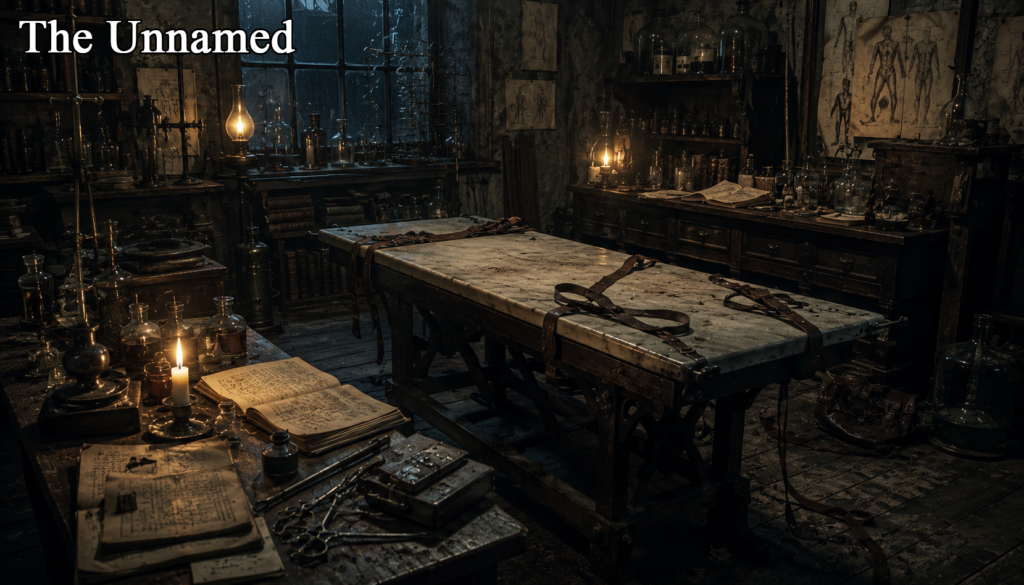
A name.
In the beginning, before light, before the separation of waters, before breath enters dust—there is the word. And the word names. G‑d names the light. G‑d names the darkness. G‑d names the waters and the dry land. He brings every living creature to Adam, and whatever Adam calls them, that is their name—the first human act of creative participation in the order of existence, the moment the creature is drawn into relationship by the act of being known. To name is to say: you exist within an order that includes you. You are not outside. You belong.
It costs nothing. It obligates everything.
Victor Frankenstein never names his creation.
The Left Pillar, Ungoverned
Mary Shelley was nineteen years old when she wrote Frankenstein. History has never quite known what to do with this. It reduces the novel to gothic horror—the monster, the laboratory, the storm, the shambling creature of a century of adaptations—because the p’shat is easier to carry than what lies beneath it. Almost no one follows it downward to where the actual argument lives.
Victor Frankenstein is not a villain. He is something far more dangerous: a man of considerable capacity operating almost entirely from the left pillar of the Tree—and doing so without counterbalance.
Consider what actually drives him. Not the lightning flash of divine inspiration—not Chokhmah, the wisdom that arrives as gift from above. Victor receives no such gift. What moves him is Binah without its counterpart: the processing faculty, the analytical mind, the capacity to take things apart and understand their structure, running in relentless service of his own ambition rather than in reception of something given from above. He spends years in charnel houses and dissecting rooms, accumulating, assembling, forcing the material to yield its secrets. This is not inspiration. This is Hod—meticulous craft, the faculty of detail and discipline—operating without Netsach to orient it toward anything beyond himself. The enduring drive of Netsach is always pointed outward, toward the other, toward something larger than the self. Victor’s drive is pointed inward, toward what he will have accomplished, what he will be known for, what his name will mean.
And Gevurah without Chesed: force, discipline, boundary, the power to act—with no love whatsoever for what he is making. Chesed is the overflow that creates because it cannot help giving. Victor does not give. He takes—from graves, from dissecting tables, from nature itself—and assembles. There is no love in the act. Which is why the moment the yellow eyes open, there is nothing to hold him there. Chesed would have held him. It was never present.
This is the yetzer ha-ra operating pure and without restraint—not evil in the demonic sense but the self-oriented drive ungoverned by its counterpart, the left pillar of the Tree running without the right pillar to balance it. Da’at never forms. Not because the integration failed but because there is nothing from the right to integrate. The knowing that emerges from Victor’s years of work is not Da’at—it is obsession wearing the mask of knowledge, the self’s own will looping back on itself, mistaking its own intensity for revelation.
He sees the creature’s yellow eyes open. He flees into the night, down the stairs, into the street, leaving the candles burning.
The Right Pillar, Ascending
The creature enters the world with a fundamental absence at his center. Not a severed connection—that would imply one once existed. The channel between creator and created was never built. Victor fled before he could be confronted with that obligation, leaving his creation permanently outside the order of divine relationship: not among G‑d’s creatures, because G‑d did not make him; not among his creator’s beloveds, because his creator will not look at him. No Yesod—no covenantal foundation, no channel through which shefa might flow. He is something genuinely new in the world, and the world has no category for him.
And yet he builds. And what he builds, remarkably, is the right pillar.
He hides in a hovel adjoining the De Lacey family’s cottage and watches them through a crack in the wall. Days become weeks. Weeks become months. He gathers their wood before dawn so they will find it waiting. He clears the snow from their path. He gives without any possibility of acknowledgment or return—and in the giving, develops Chesed: love freely offered to people who do not know he exists, tenderness that asks nothing, the overflow that creates because it cannot help giving. He is moved by music filtering through the wall, by the quality of afternoon light on the forest floor, by the sight of kindness passing between people—and in this develops Netsach: the sustained orientation toward beauty and connection that does not collapse even under the weight of total isolation, the enduring drive pointed outward rather than inward.
He finds books—Paradise Lost, Plutarch’s Lives, Volney’s Ruins—and through them receives the flash of Chokhmah: the sudden illumination, the recognition that comes as gift rather than acquisition. Language opens. His own condition becomes legible through Milton’s fallen angel. He understands what he is by reading what others have been—not through analytical dissection but through the receptive knowing that arrives from outside the self and changes the one who receives it.
He spends the better part of a year in that hovel—his own counting, his own descent through the interior registers of the self, building the right pillar from Malkhut upward through suffering and observation alone, waiting for the fiftieth day when the covenant will be given and the isolation will end. He approaches the De Laceys. He reveals himself. He reaches for matan Torah—for the giving that would complete what the formation prepared him to receive.
The family returns. They see the face. The hovel is burned to the ground.
No covenant given. The fiftieth day arrives and there is nothing on the other side of it.
He is building, throughout all of this, without Yesod—without the channel that would connect the right pillar he is constructing to the source above it. The right pillar ascending toward a Keter that remains closed, because the only one who could have opened it is somewhere writing letters about his ill health, never returning.
The Name He Was Never Given
“I ought to be thy Adam, but I am rather the fallen angel.”
He has read the template. He knows what the relationship between creator and created is supposed to look like. He is not asking for power. He is not yet asking for revenge. He is asking for the most elemental act of covenantal recognition: a name. The acknowledgment that he exists within some order that includes him.
The name is Yesod—the foundation of relationship, the channel through which the creator says: I know you. You are mine. You belong to the order I inhabit and I will not abandon you to the outside of it. Adam named the creatures and drew them into covenant. G‑d named Adam and drew him into the divine image. To name is to build the channel. To refuse the name is to leave the created permanently outside—not because of what they are but because of what the creator will not do.
Victor calls him creature. Monster. Wretch. Demon. Fiend. Every word a refusal. Every word a door closed. Every word confirming: there will be no channel. There will be no covenant. You are outside the order and you will remain there.
The only human who ever truly encounters him is the blind De Lacey—the one man who cannot see the face. Who hears the voice, the intelligence, the grief, and responds with warmth. He is the sod reader in a world of p’shat readers: the one who stays past the surface long enough to find what is actually there. Everyone else stops at the face and runs. The face they are running from is Victor’s signature—the mark of every sefirahabsent or unbuilt in the act of creation. The creature looks the way he looks because he was made the way he was made.
When Victor tears apart the half-assembled female companion on the Scottish island—while the creature watches from outside the window in the dark—he refuses for the second time, deliberately, the possibility of covenant. The creature’s face at the glass. Victor meeting that gaze and returning to his work of destruction. Something shifts permanently in that moment. The right pillar, built at such cost, begins to give way.
The Convergence
What happens next is the novel’s most theologically precise movement, and the one most thoroughly missed by the horror-story reading.
The creature does not become Victor’s opposite. He becomes Victor’s mirror.
The yetzer ha-ra that Victor never restrained enters the creature not as a foreign invasion but as the inevitable consequence of the right pillar collapsing under the weight of total abandonment. The Chesed that sustained him through the long formation begins to curdle—not because he prefers it to curdle but because Chesedwithout any reciprocal relationship to receive it cannot sustain itself indefinitely. The Netsach that oriented him outward toward beauty and connection becomes the relentless drive of pursuit—the same enduring force, now pointed at the one who refused to complete the covenant. The Chokhmah that illuminated his condition through Milton now illuminates something darker: exactly what Victor took from him, exactly what it would cost to take it back.
He does not abandon the right pillar cleanly. He mourns it. Every act of destruction is accompanied by grief—not the cold satisfaction of a villain but the anguish of someone who knows precisely what he is losing as he loses it, who chose Chesed and was refused it, who is now enacting Gevurah with full awareness of what Chesed would have felt like. The left pillar does not arrive in him as comfort. It arrives as the only grammar remaining after the right pillar’s vocabulary has been taken away.
And Victor, pursued northward across Europe and into the ice, is simultaneously being stripped of even the left pillar’s discipline. He loses Binah—stops processing, stops planning, operates on pure reactive impulse. He loses Hod—the meticulous craft dissolves entirely. He is reduced to bare yetzer ha-ra driving him forward on the ice, following his creation into the dark, no longer able to name what he is pursuing or why. The creator, stripped of even the left pillar’s structure. The creature, having lost the right pillar he built at such cost.
By the time they reach the Arctic, they are no longer opposites. They are the same. Both ungoverned. Both driven by the same force in the same direction. The created drawing the creator forward, the creator following what he made, indistinguishable in their driven northward movement. Victor has lost even the illusion of agency. He is being pulled by his own reflection.
The End of the World
When Victor dies—when the creator goes before the creature on the ice—the creature’s response is the most theologically precise moment in the novel. He does not triumph. He weeps. He stands over the body of the man who made him and mourns, because what he wanted was never Victor’s death.
It was Victor’s teshuvah. The turning of the face. The name, spoken at last, even now, even here, even at the end of the world.
It never came.
The creature announces that he will build a funeral pyre and climb onto it—that he will unmake what Victor made, because Victor would not complete it. He gives himself the boundary his creator refused to provide. The fire he chooses is his own: not the cold, stolen, ungoverned force that assembled him in a dark laboratory by a man who would not stay—but a chosen, consuming flame under the open sky, at the top of the world, in full possession of what he is doing and why.
The grief at Victor’s body is the beauty, integration, and love that should have been present from the first night in the laboratory, appearing only now, over a corpse, as mourning for what was never permitted to exist. For one moment, at the end, the right pillar returns. The creature who built himself in love grieves in love over the man who never loved him.
Then he turns toward the ice and the dark, and the right pillar goes with him.
He is more merciful to himself than Victor ever was to him.
The Mirror We Cannot Put Down
Shelley wrote this out of something that was not merely imagination—and what she reached is a question the tradition has always known how to ask even when it cannot answer it: what do we owe what we bring into being?
The novel runs in two directions simultaneously and will not resolve into one. Victor as the yetzer ha-raunchecked: the self-oriented drive that creates without love, acquires without covenant, produces without accepting the obligations of what it has produced. The creature as the self built in Chesed and Chokhmah and Netsach—the right pillar ascending—who is pushed left by the refusal of the covenant that would have completed him, until creator and created are no longer distinguishable, until the novel’s moral architecture has collapsed into the same ungoverned force wearing two faces.
But also: the question the convergence presses on the reader. If the creature becomes what he becomes because the covenant was refused—because the name was never given, because the right pillar had no Yesod to connect it to the source—then what does that say about what we make and abandon? About the yetzer ha-ra we unleash into the world and then refuse to know? About the things we bring into being from the left pillar only, ungoverned, and then flee when the yellow eyes open?
We recognize the face. We know what made it. The horror is not the creature.
It never was.
The Name
Return to the beginning. To the word before the light.
The absence of a name is the wound that opens on the first page and never closes. Everything that follows—the laboratory, the flight, the forest, the hovel, the De Laceys, the Scottish island, the Arctic, the pyre—is the elaboration of that first refusal. The first moment Victor looked at what he had made and could not say the thing that costs nothing and obligates everything.
You are mine. I know you. You belong.
He could not say it. He had not built the vessel to hold what saying it would have required of him. The right pillar was never present in the act of creation, and so there was nothing in him capable of the turn toward the created that a name requires. And so the creature carried the wound of the unspoken name across every page of the novel, across every snow field and forest and island and ocean, building in love what had been made without it, until the love gave way under the weight of a covenant perpetually refused—all the way to the top of the world.
Where he named himself, finally, in the only language left to him.
The fire.

Discover more from Many Lamps, One Flame
Subscribe to get the latest posts sent to your email.