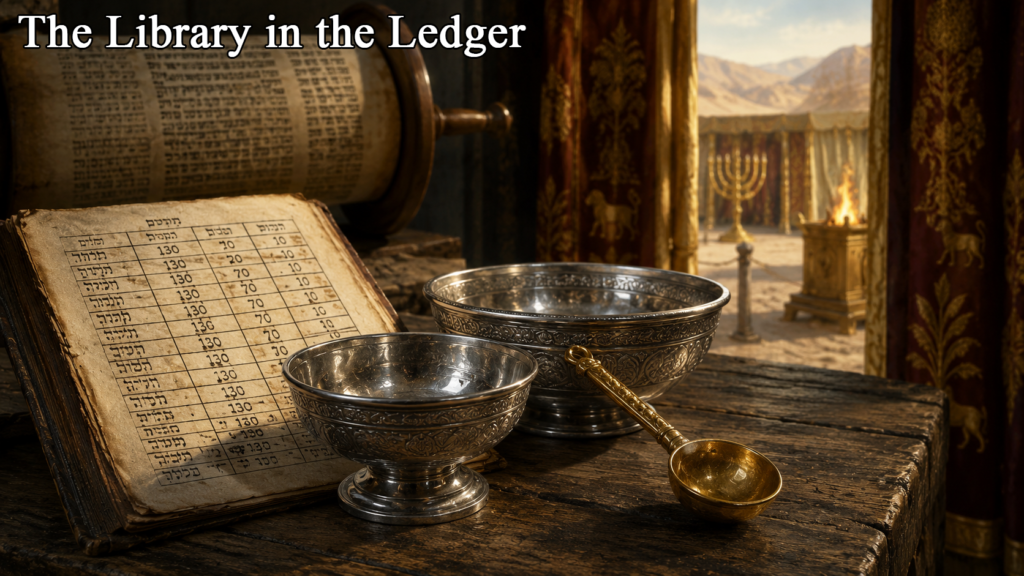
On the first day, Naḥshon son of Amminadab of the tribe of Judah presented his offering: one silver bowl weighing 130 shekels and one silver basin of 70 shekels by the sanctuary weight, both filled with choice flour with oil mixed in, for a grain offering; one gold ladle of 10 shekels, filled with incense…
—Numbers 7:12–14
Seventy-two. That is how many verses Torah devotes to what appears, on first encounter, to be a simple inventory. Twelve tribal princes. Twelve identical offerings. One entry per prince, recorded in full, with no abbreviation, no shorthand, no editorial mercy toward the reader who has already read the same list eleven times. The silver bowl. The silver basin. The golden ladle. The bulls and rams and goats. Twelve times, word for word, the text refuses to say and so did the rest of them. Anyone who has read through Numbers 7 in a single sitting has felt the weight of that refusal.
The conventional explanation is liturgical—each prince deserved his moment, each tribe its full accounting. This is not wrong, but it is incomplete. Torah does not waste words. If the text gives you verse after verse of apparent repetition, the repetition is doing something. The question is what.
Begin with the number itself. Seventy-two is not arbitrary. In the Kabbalistic tradition, the seventy-two Names of G‑d are derived from three consecutive verses in Exodus 14—the verses describing the splitting of the sea—each exactly seventy-two letters long. The first verse is read forward, the second backward, the third forward again, yielding seventy-two vertical triplets of letters—a method the tradition calls boustrophedon. Each triplet is one of the seventy-two Names of divine force. Seventy-two is also associated with chesed—loving-kindness—in certain gematria reckonings. And chesed is precisely what a korban is: not sacrifice in the sense of appeasement, but voluntary approach. Drawing near in love. The number of verses the twelvefold offering occupies is, encoded in plain sight, the number of the Names through which G‑d meets those who approach.
What Gematria Is
Before going further, a word about method. Gematria—the interpretive practice of reading numerical values embedded in Hebrew words and texts—is a coherent hermeneutical tradition with roots stretching back to the earliest rabbinic literature, built on the recognition that Hebrew letters carry fixed numerical values and that these values are part of the text’s meaning, not incidental to it. The same tradition that produced the Talmud, the Zohar, and Maimonides read gematria as a genuine layer of Torah’s meaning—not its only layer, but a real one.
The operative assumption is simple: Torah was composed with infinite intentionality. Nothing in it is accidental, including the weight of a silver bowl. When the Midrash asks why an offering weighed 130 shekels, it is not asking a rhetorical question. It expects an answer. And in Bamidbar Rabbah 13, the rabbis provide one—not for one detail, but for every detail, across all twelve offerings. What looks like a ledger is, on close reading, a library. The catalogue is the argument.
The Silver Bowl: Adam and the First Reconstitution
The Hebrew phrase for one silver bowl—ke’arat kesef achat—has a gematria value of 930. Adam lived 930 years. This is not coincidence; the Midrash names it. The silver bowl held by each tribal prince encodes the first human life, the first expulsion, the first catastrophe of the created order.
But the bowl’s weight adds the next layer. It is 130 shekels. Adam was 130 years old when Seth was born—after the expulsion from Eden, after Cain murdered Abel, after the line of human continuity had been severed once. Seth is the reconstitution. He is the son through whom humanity begins again after its first destruction. When Adam was 130, the world started over.
Every prince who brought that silver bowl to the newly dedicated Mishkan was carrying, in its weight, the entire arc from creation to catastrophe to renewed beginning. The Mishkan dedication, the Midrash is suggesting, is itself a Seth-moment: the divine Presence, which withdrew when Adam and Eve were expelled, now returning to dwell among the people. As Ohr Somayach’s commentary on the portion puts it, the message of the offering’s symbolic history is that with the inauguration of the Mishkan, the divine Presence rested on the world once again. The bowl does not merely represent Adam. It represents the pattern Torah encodes in Adam—that the world begins again after rupture, if the approach is made correctly.
The Silver Basin: Seventy Faces
The silver basin weighed 70 shekels. Bamidbar Rabbah 13:15 asks the question directly: why 70? The answer is that G‑d has seventy faces—meaning that the divine reality, encountered through seventy different peoples, is inexhaustible. The number seventy is the number of the nations enumerated in Genesis 10—the Table of Nations, the full enumeration of humanity after Babel. It is the number of souls who descended to Egypt with Jacob. It is the number of elders appointed at Sinai. In the Jewish cosmological imagination, seventy means all of it, fully—the complete scope of humanity under the complete structure of creation.
Seven and ten. Completion times totality. Seven is the rhythm built into the fabric of existence—the seven days, the seven lower sefirot from Chesed through Malkhut, the sabbatical cycle embedded in land and time. Ten is the complete set—the ten sefirot in their totality, the ten utterances of creation, the ten commandments. When you multiply completion by totality, you get seventy: the number that means the world in its full extent has been accounted for.
The silver basin, then, is not a tribal vessel. It is a cosmic one. The tribal prince who brings it is not representing his tribe to G‑d. He is representing Israel’s covenantal relationship to the totality of humanity—all seventy nations, all seventy faces of the divine reality they encounter according to their own portion. The Mishkan dedication is not an internal ceremony. It is an address to the world.
The Golden Ladle: Torah in Ten
The golden ladle—kaf—weighed 10 shekels and was filled with incense. The Midrash reads this vessel on multiple registers at once. Kaf means both spoon and palm of the hand—Torah was given directly, hand to hand. The gold evokes Torah itself, elsewhere in the tradition likened to gold. The weight of ten corresponds to the Ten Commandments. And the incense—ketoret—the Midrash reads as an encoding of the 613 mitzvot. In one small vessel, the entire covenant is offered back: the hand that receives, the ten that command, the six hundred thirteen that elaborate.
Seventy-Two and the Names of the Sea
Return now to the number of verses. Seventy-two. The three verses of Exodus 14:19–21—the splitting of the sea—are each exactly seventy-two letters long. Read in boustrophedon, they yield the seventy-two Names of divine force through which G‑d acts in the world. These Names are not decorative. In Kabbalistic understanding they are the channels through which shefa—divine abundance—flows into creation. They are the sea parting.
The sea-splitting and the Mishkan dedication are not unrelated events. Both are moments when the boundary between divine and human becomes traversable. At the sea, Israel passed through on dry land; the barrier that should have stopped them opened. At the Mishkan’s dedication, G‑d descended into the structure the people had built; the distance that should have remained between Creator and created collapsed into dwelling. Torah gives the dedication seventy-two verses—the same number the tradition associates with the Names through which the sea was opened—as though to suggest that the Mishkan dedication belongs to the same order of event. The approach has been made correctly. The boundary yields.
Nachshon ben Aminadav, whose name the Midrash derives from nachshol—the wave—brings the first offering. He is the man who, according to the tradition, walked into the sea before it split. His kavanah at the Mishkan is already legible in his history: he is the one who moved before the miracle confirmed that moving was safe. The first day of the dedication carries that theology. The approach precedes the opening.
Twelve Days, Twelve Approaches
Why twelve consecutive days rather than a single communal ceremony? The Midrash’s answer, borne out across Bamidbar Rabbah 13–14, is that each tribe brought the same offering with entirely different kavanah—different interior orientation, different symbolic intention. Judah’s silver bowl encoded Adam and royal sovereignty. Issachar’s encoded Torah scholarship. Zevulun’s encoded the sea and the commerce that sustains learning. Each prince arrived, independently, at the same offering. Each understood it differently. Each was correct.
This is the Midrash’s structural miracle: identical external form, radically differentiated interior meaning. And Torah honors both levels simultaneously by refusing to collapse them. One entry per tribe. No abbreviation. Because you cannot read Nachshon’s offering and assume you have read Netanel’s. The vessels are the same weight. What they carry is not.
The twelve days are not administrative scheduling. They are Torah’s insistence that approach cannot be rushed, cannot be aggregated, cannot be reduced to its external form without losing the thing that makes it an offering rather than a delivery. The korban—the drawing near—is not the silver. It is what the silver carries.
The Library the Modern Reader Walks Past
There is a specific failure mode in the contemporary encounter with liturgy and religious form: the reduction of the vessel to itself. The prayer becomes the words. The ritual becomes the action. The offering becomes the bowl. What has been lost is the literacy that allows the form to be read—the capacity to ask what the weight of a silver basin means, to understand that 70 is not a number but a theology, that 130 shekels is not a measurement but a memory.
Torah repeats the offering seventy-two times in part as a rebuke to this reduction. It is forcing the reader to sit with the form long enough that the question becomes unavoidable: if these twelve offerings are identical, why am I reading each one? The reader who asks that question is ready to read the library. The reader who skips to the end has mistaken the ledger for the point.
The tradition’s answer—Bamidbar Rabbah’s answer, Rashi’s answer, the Lubavitcher Rebbe’s answer—is that the numbers are the theology. The 930 of Adam’s life encoded in a silver phrase. The 130 years before Seth encoded in its weight. The 70 nations encoded in a basin. The 613 mitzvot encoded in incense. The 10 commandments encoded in a ladle’s weight. The 72 Names of the sea encoded in the count of verses. None of this is ornamentation. All of it is argument—made in the only language that can hold it, the language of number, which does not drift, does not soften, does not lose precision across millennia of transmission.
What the Count Was Always Counting
The silver bowl is 930. The world began, was shattered, continued. The basin is 70. The world in its full extent, all its faces of encounter with the divine, held in a vessel brought to the threshold of the Presence. The ladle is 10 and 613. The covenant in its structure and its full elaboration, offered back to the One who gave it. The verses are 72. The Names through which the sea was split, the Names through which the Presence descends, enumerated once for each tribe that brought its unrepeatable approach to the identical silver.
The reader who arrives at Numbers 7 expecting a ledger will leave with one. The reader who arrives knowing that Torah does not waste words will find, behind every bowl and basin and incense-filled ladle, a library assembled across the full span of human history—from Adam’s 130th year to the moment Nachshon walked into the wave—waiting to be read by anyone willing to ask why the number is what it is.

Discover more from Many Lamps, One Flame
Subscribe to get the latest posts sent to your email.