
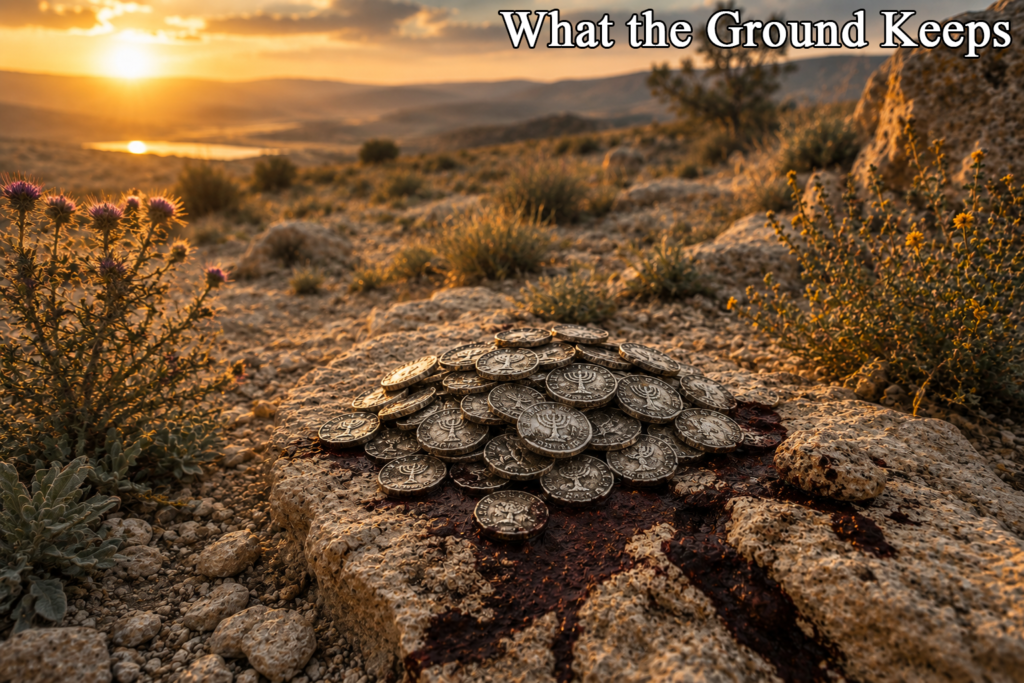
You shall not pollute the land in which you live; for blood pollutes the land, and the land can have no expiation for the blood shed on it, except by the blood of the one who shed it. — Numbers 35:33
The Torah is, among other things, a book of redemptions. The firstborn son is redeemed with silver. A beast set aside for the altar can, under conditions, be exchanged. A field sold in hard years returns to the family that lost it. A man who dedicates his own worth to the Sanctuary pays an assessed valuation and is released. Almost everything in it can be bought back, commuted, converted—loss turned again into possession by the right payment. Almost everything. Near the end of the book, in the laws of the manslayer and the cities of refuge, the Torah names the one thing that cannot.
The Redeemer
The word for buying back is go’el, and it runs through the whole system like a single thread. When a man falls into poverty and sells the ancestral land, Leviticus commands that his nearest kinsman—his go’el—come and redeem it, restoring the holding to the line that lost it. The same word covers the ransoming of a relative sold into servitude, and it stands behind the figure of Boaz in the book of Ruth, the go’el who redeems both a widow and her field and knits a broken family back into its inheritance. It rises, finally, to the highest register: Isaiahcalls G-d Himself the Redeemer of Israel, the One who buys His people back from exile. In every case the redeemer is a converter. He finds a loss—land, liberty, lineage, a whole people scattered—and turns it back into what it was: the field changes hands back to the family that lost it, the bondsman walks out free. Redemption, in the Torah’s grammar, is the art of exchange: the thing gone is restored by a price paid.
The Blood That Will Not Convert
Then, in our portion, the same word turns and shows another face. The go’el hadam—the blood-redeemer—is the kinsman of a person unlawfully killed, and his office is not purchase but pursuit. At the center of the law that governs him sits a verse that breaks the whole economy the word has been building. “You may not accept a ransom”—lo tikchu kofer—“for the life of a murderer.” Kofer is the ordinary word for the payment that redeems, the sum that buys a life clear. Everywhere else it is permitted, often required. Here alone it is forbidden. Blood is the one currency that does not convert. No price clears it; no payment restores what was taken.
The refusal extends even to the one who killed by accident. He flees to a city of refuge and remains there for a set term; and the Torah forbids buying his way out early—no ransom to shorten the exile, no fee to return him to his land before the time is served. Even unintended bloodshed cannot be commuted to a payment.
Why can a life not be compensated—why does blood demand satisfaction and refuse a price? The oldest account of killing answers. When the first murder is done, G-d tells Cain that “the voice of your brother’s blood cries out to Me from the ground”—that the earth has “opened its mouth to receive your brother’s blood from your hand.” The blood does not vanish into the soil; the soil takes it in and holds it, and the ground itself becomes the plaintiff. Before there is any court, there is a witness that cannot be paid off, because the debt is not owed to the survivors, who might be bought. It is owed to the land, which has swallowed the blood and will not give it back.
The Land That Cannot Be Bribed
Our portion says this outright, and it says it with a strange verb. “You shall not pollute the land”—lo tachanifu—“for blood pollutes the land.” The root is ch-n-f, and its plainest sense is exactly that: to defile, to foul, to make a place unclean. The Psalmist uses the same word for the same crime—“the land was polluted with blood,” va-techenaf ha’aretz ba-damim—almost the identical phrase. Bloodshed does not merely break a law; it stains the ground it is spilled on.
But the root has a second life worth hearing. In Scripture the chanef is the godless man, the one whose reverence is a front—the profane priest and prophet who keep the forms while the inside has rotted through. In the language of the sages the same root comes to name flattery itself, chanufah: the smooth word laid over a false thing. The senses share a spine. What is chanef has been made false—a surface that no longer answers to what lies beneath it. This is what the forbidden ransom would have been—a chanufah in silver: money laid over blood so the surface reads as settled while nothing beneath it has changed. A person can flatter himself that blood, once spilled, may be smoothed over—paid off, quieted by the passage of time, buried under the ordinary business of living. The Torah says the ground is not so easily deceived. It cannot be bribed and it cannot be waited out. One thing alone answers the blood it holds, and it is not silver—it cannot be minted—it can only be paid in kind.
Then the stakes rise a final degree. “You shall not defile the land in which you live, in the midst of which I Myself dwell.” The land that holds the blood is the same land the Presence inhabits. To foul it is not only to wrong the dead. It is to defile the ground G-d has chosen to live upon.
The Tribe That Owns Nothing
If the land is where the Presence dwells, then within it the account of blood cannot be settled the way property is settled—and the vengeance that runs on property must, somewhere, be able to stop. And here the portion does something easy to read straight past. The cities of refuge, where the accidental killer escapes the blood-redeemer and waits out his term, are not free-standing towns. They are drawn from the forty-eight cities given to the Levites—the one tribe that receives no territorial inheritance at all. Levi is landless by design, scattered in pockets through every other tribe’s portion: present everywhere, holding nowhere.
Follow the logic before the theology. The claim of the blood-redeemer runs through land and lineage—a family’s claim, pressed by a kinsman, over ground a death has stained. The go’el hadam acts on behalf of a stake. And the single place a man can flee that claim is the territory of the tribe with no stake to press: no inheritance to defend, no ancestral field that blood could foul, no place in the economy of land and vengeance at all. Refuge is entrusted to the tribe that possesses nothing. Levi’s portion, the Torah says elsewhere, was never land but G-d Himself—the L-rd is his inheritance. The tribe that holds no property cannot convert blood into property, because it has nothing in the account to be paid. Its cities are the one ground in Israel that stands outside the economy of exchange entirely—and so the one ground on which the claim of blood can be set down. The manslayer flees the redeemer’s claim and crosses, at the border of a Levite city, out of the world of land and lineage the claim is made of. He is safe not because the debt is forgiven, but because here there is no coin it could be paid in.
The Ground That Remembers
Numbers has spent its length counting and apportioning—heads numbered, camps ordered, boundaries surveyed, the land parceled out in advance. It ends by naming the limit of all that arithmetic. The land the people are about to enter is not, in the end, a possession to be tallied and traded. It is a party to the covenant. It receives what is done upon it and keeps the account; it holds the blood it is given and cannot be paid to forget. The ground is not a ledger but living soil, and what is buried in living soil does not stay buried. To live on it is not to own it but to answer to it—to walk on ground that remembers, in the presence of the One who dwells there as well.
A people can be counted, and a country can be measured. What has been spilled into the earth can be neither counted nor measured nor bought back. It can only be answered—and where it is not, the blood does not rest. It takes root. From the stained ground a many-limbed tree rises, carrying the unrequited blood upward and spreading a canopy that thickens until it blots out the sun, and the light fails over a land that would not settle its account. Only when the matter is prosecuted and the blood satisfied does the tree stop darkening the sky. Then the same branches that shut out the light hold it as shade, and the ground that drank the blood grows nourishing again beneath them.

Discover more from Many Lamps, One Flame
Subscribe to get the latest posts sent to your email.