
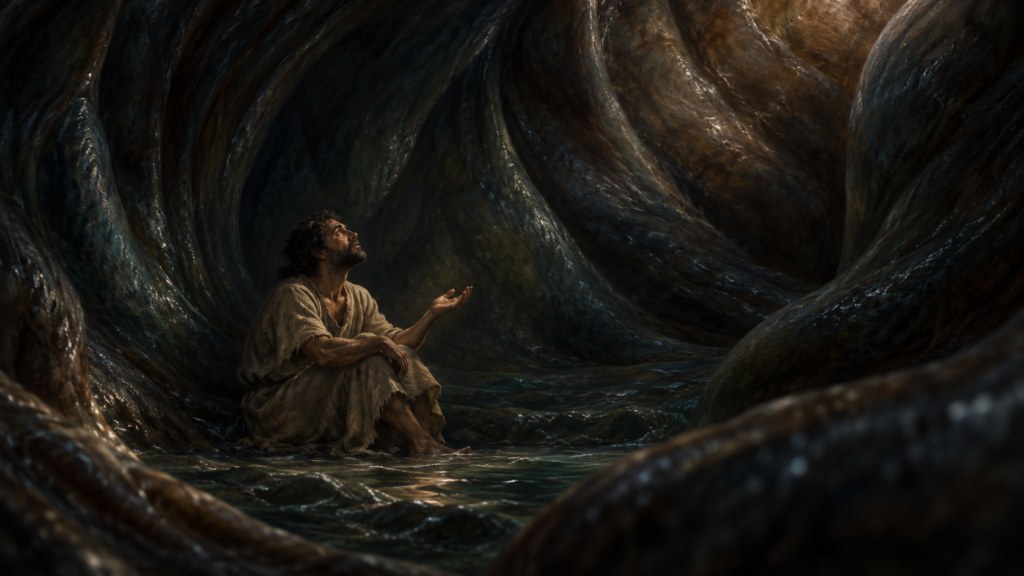
I cried to God out of my distress, and He answered me: from inside the grave I cried, and You heard my voice.
— Jonah 2:3, in Aryeh Kaplan’s rendering, where the book is headed Haftorah for Mincha of Yom Kippur
A man is sealed inside something. From in there he says two things at once: he names the place, and he speaks to G-d. And he reports, in the same breath, that he was heard in it.
Kaplan does not write the belly of Sheol. He writes from inside the grave.
What He Already Knew
The book withholds Jonah’s reason for running until the last chapter, and then he supplies it himself. This is why I fled to Tarshish; for I knew that You are a gracious and merciful G-d, slow to anger, of great kindness, and relenting of evil.
He ran because he knew.
He had the content and had it accurately. What a person recites on the Days of Awe, Jonah could recite standing in his own country before any of this began, and the reciting sent him to the coast. The knowledge was not idle. It was working the whole time, and it was working in the wrong direction.
There is a name in Kabbalah for what was missing, and it is worth putting on the table before the story goes any further. Chochmah is wisdom—insight, imagination, the flash of seeing. Binah is understanding, the faculty that takes what has been seen and works it through until it can be held. Da’at is the joining of the two: knowing that has been integrated, that stands in relation to what it knows, that changes the one who holds it. Knowledge that has become the direction a life faces rather than a thing carried.
Jonah is the case that puts the distinction under pressure. He knows the attributes. Nothing about his knowledge is deficient. And it has not become the direction he faces.
Watch how the first chapter says it. Jonah rose up to flee to Tarshish from before G-d. He went down to Jaffa and found a ship bound for Tarshish; so he paid the fare, and went down into it, to go with them to Tarshish away from G-d’s presence. The phrase stands twice in a single verse, once on either side of the two descents, and a third time when the sailors work out what is happening: the men knew that he was fleeing from G-d’s presence. The text will not let it go. Everything Jonah does in that verse is aimed at a position, and the position is defined entirely by what he is putting behind him.
The Soul That Would Not Wake
The Zohar, at Vayakhel 2:198b–199b, takes this somewhere the plain sense does not go. Rabbi Abba turns the whole of it toward a single life. “Jonah, descending into the ship, is the human soul descending into this world to enter a human body.”
The name carries it. Yonah ordinarily means dove; Rabbi Abba hears a second word inside it and reads the name through the verb of wronging in Leviticus 25:17, lo tonu, you shall not cheat one another. “As soon as she joins the body, she is yonah, cheated, in this world.” A descent of that kind can be given a purpose, the soul sent down because there is work that cannot be done anywhere but inside a body. Rabbi Abba is not making that argument here. He is saying she is wronged.
From there the sea stops being weather. The storm, in his reading, is the Decree of Judgment, “which stands constantly before the blessed Holy One, demanding a person’s punishment”—not weather sent against a man but a standing claim that has finally reached him. The hold where Jonah lies down and falls asleep is a sickbed. And what Rabbi Abba says about that sickbed is the hardest line in the passage: “Even though a person is lying in his sickbed, the soul is not aroused to return to his Lord to redeem his sins.”
Then the captain comes down, and in this reading the captain is the good impulse. Arise, call upon your G-d. Rabbi Abba expands it: “This is no time to sleep, for you are being brought to judgment for all that you have done in this world. Repent of your sins.”
The sailors are praying. Each of them cries out to his own god, and before the chapter ends they will fear the L-rd greatly and offer sacrifice and make vows. No prayer from Jonah is recorded aboard that ship.
What he does instead is answer their questions. I am a Hebrew; and I fear G-d, the Lord of heaven, who made the sea and the dry land. It is true, and he says it while in flight from the One he is describing. A man can profess reverence for the maker of the sea and the dry land from the deck of a ship he boarded to get away from Him. Only later, when they ask what to do, does he tell them to pick him up and throw him into the sea, for he knows the storm is upon them because of him. He understands his own implication exactly and accepts responsibility for it.
At the Roots of the Mountains
He does not describe what happens to him after that. He describes what closes around him.
You cast me into the deep, into the midst of the seas; and the floods rolled around me; all Your billows and Your waves swept over me. The waters are not anonymous. They are Your billows, Your waves. Even at the point of being thrown away, he is speaking to someone.
The waters surrounded me, even to the soul; the depth rolled around me, the weeds were wrapped about my head. I went down to the roots of the mountains; the earth with its bars was about me forever.
Take those clauses one at a time and they accumulate in a single direction. Surrounded. Rolled around. Wrapped about the head. Down to the roots of the mountains. Bars closing behind him, and the word he uses for how long is forever. Each phrase is a further boundary. What is happening to him is that he is being enclosed.
That work belongs to Gevurah, which is also called Din: strength, governance, limitation, restraint, the drawing of boundaries. Rabbi Abba has already arrived at the same place from the other side, naming the storm as the Decree of Judgment before any of this was said. The man being enclosed and the reading of the enclosure agree about what is doing it.
And the mountains are not only geography. In Kabbalah the mountains stand for Chesed, Gevurah and Tiferet—for the Avot, Abraham and Isaac and Jacob. Jonah goes down to where they root. Whatever a man might ordinarily stand on, he has gone down to where it is founded.
Formation had given him a calling and the knowledge to understand it. What the descent does is take away everything that was holding the shape.
I Remembered
The turn arrives in a clause that is easy to read past.
When I fainted I remembered God; and my prayer reached You, in Your holy Temple.
B’hit’atef alai nafshi, as the nefesh fails: et YHVH zacharti—I remembered the L-rd.
He remembers the G-d he already knew, the one whose attributes he could recite in his own country before he bought passage. What that knowing now asks of him is a different question, and the book will spend two more chapters on it. But the motion here is remembrance, and remembrance in Kabbalah is not incidental.
Binah is understanding, and it is also the womb, the upper sea, the site of re-birth—and teshuvah, return. Its activities are understanding, contemplating, remembering, repenting. What Jonah does at the bottom is perform the act of the sefirah that is return.
And notice where Rabbi Abba has to go to prove the enclosure is a grave. “Jonah was in the belly of the fish. The belly of the fish is the belly of Sheol. How do we know? As is written: From the belly of Sheol I cried out—he was in the belly of the fish and called it the belly of Sheol.” The verse that establishes the place as the grave is the verse in which the man speaks to G-d from inside it. The naming and the addressing occupy one sentence, and the sentence carries its own answer: You heard my voice.
Elsewhere in the same prayer the direction of his attention has already turned. I said, I am cast out from before Your sight—which is the very position he paid a fare to reach, now spoken as a grief—yet I will look again upon Your holy Temple. He is still sealed in. The bars are still closed. But the man who ran from before G-d’s presence is facing the sanctuary and saying so, and his prayer arrives there before his body arrives anywhere.
On the ship he named G-d accurately and went on his way. Here reverence begins to take the form of humility: he addresses the One he knows without commanding what the answer must be.
This is the return, and it happens in the descent. Not after it, not because of its ending, not as a reward for having endured it. Down at the roots of the mountains, with the boundaries shut, what he knew comes into relation with the One he knew it about.
Given Back
He does not climb out. Then God spoke to the fish, and it vomited Jonah out upon the dry land. G-d speaks to the fish, and the fish releases him.
Rabbi Abba reads that release as the resurrection of the dead, and he does not make it comfortable. The three days in the fish are “the three days that a person lies in the grave, when his belly bursts.” From three days on, the man is judged in his eyes and his hands and his feet, and for thirty days soul and body are punished as one, the soul kept below and not permitted to rise. Only afterward does the soul ascend, while the body goes on decomposing in the dust, “until the time when the blessed Holy One arouses the dead.” Then the voice comes among the graves and every grave gives back what it holds. The word for what the earth casts forth is refa’im, which ordinarily means shades; he reads it against that sense. “Refa’im—what does that mean? That they have been healed as before, bone to bone; they are called refa’im, healed.”
He keeps the hard edge of it in view. “Surely the bones of the whole world will be healed in their graves, but some of them will rise and some of them will not.”
And then the detail that makes the reading stranger than a man escaping a container. “This fish, as soon as it swallowed Jonah, died. And Jonah was inside of it for three days. Afterward it was restored, and vomited Jonah out.” The thing holding him dies with him in it. The grave undergoes what the man in the grave undergoes. Rabbi Abba then says where he is going: “Similarly, the earth will awaken first, and then the earth will cast forth refa’im, the healed.”
The enclosure has to be restored before it can give anything back. Whatever was sealed shut and called forever is not only opened; it is made alive first, and then it opens. Which is why a man can say of a fish that in it are found words of healing for the whole world.
What the Knowing Still Has to Do
Then God’s word came to Jonah the second time, saying: Arise, go to the great city of Nineveh, and proclaim to it the message that I tell you.
The same errand. His ascent returns him to the commission, which is what ascent means here—the renewed orientation has now to become an action, in the place he was sent and has been avoiding. And he goes. That much has changed, and it is not nothing.
Nineveh hears, and turns, and is spared—God saw their deeds, how they turned from their evil ways—and Jonah is furious. He prays again, and the prayer is the one we began with: this is why I fled to Tarshish; for I knew that You are a gracious and merciful G-d. Then: take my life from me, for it is better for me to die than to live.
The content of what he knows has not changed. Its integration has begun and is not finished. He has descended, remembered, addressed, been given back and obeyed, and he still cannot bear the thing he always knew to be true when it arrives for somebody else. His direction has changed. His alignment is still being formed.
The book’s last words are a question, and they turn on the verb he has been using all along. Then should I not have pity on the great city of Nineveh, in which are more than a hundred and twenty thousand persons who do not know their right hand from their left hand, and also much cattle?
The right hand is Chesed and the left is Gevurah. A hundred and twenty thousand people who cannot tell lovingkindness from judgment, and their not knowing is placed before the prophet as ground for pity. It is put to a man with the opposite difficulty. He knows that G-d is compassionate. He has known it from the first chapter. And he is sitting outside the city, wishing to die over it. The book closes without recording what he said.
Three days from now the book is read aloud in the afternoon, to people in white, who have not eaten, and who have spent the day rehearsing an accounting they will one day give without a liturgy to carry them through it. They will hear a man go down, and call out from the bottom of it, and be given back, and be sent to the thing he ran from. Then the gates close, and the fast ends, and they return to the year with the knowing still to be done.
Source note: Translations draw on The Zohar: Pritzker Edition and Aryeh Kaplan’s The Living Torah. The sefirotic associations used here—the mountains with Chesed, Gevurah and Tiferet, and the right and left hands with Chesed and Gevurah—are drawn from the teachings of my mentor in Kabbalah, Dr. Jay McCrensky. Online links are provided for reference; their translations may differ from those quoted here.

Discover more from Many Lamps, One Flame
Subscribe to get the latest posts sent to your email.