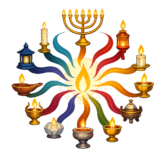
Many Lamps, One Flame is a space for exploring faith through Torah, Gospel, and contemplative tradition—a meeting ground for seekers, traditions, and honest questions.
Why This Blog Exists
In a time when traditions are often set against one another—when people are asked to choose sides rather than seek truth—this blog exists as a meeting ground. It assumes that wisdom is not the possession of any single tradition, but a flame that burns in many lamps.
The name itself reflects this: Many Lamps, One Flame. We hold different vessels. We speak different languages. We trace different paths. But the light we seek—the truth that calls us forward—is the same.
This is not syncretism. It is not an attempt to flatten traditions into vague spiritual platitude. It is the work of close reading, careful thinking, and honest questioning—undertaken with humility, accountable to the texts and traditions themselves.
This blog is a place to share that ongoing exploration—not to offer final answers, but to kindle sparks: reflections meant to remind us that though the lamps may differ, the flame at their heart is the same.
About James Nerlinger (Eliyahu)
My spiritual path has been anything but linear. It began in the Catholic tradition, with Protestant Sunday school alongside it—two distinct registers of the same faith, absorbed before I was old enough to interrogate either. The liturgical and sacramental weight of Catholicism. The scriptural directness of the Protestant tradition. Both sitting underneath everything that came after, even when I didn’t know it.
I considered taking Holy Orders. I did not. Instead I kept moving—outward, and then inward, and then somewhere I hadn’t expected to find myself.
Buddhism came next, seriously and at length. Then the New Age movement, which I entered as a devoted practitioner and eventually outgrew—not because it was wrong about everything, but because it wasn’t rigorous enough about anything. Then Hinduism, with its staggering philosophical architecture and its insistence that the infinite can be approached from an infinite number of directions—and Yoga, not as fitness but as the discipline it actually is: a systematic technology of interior formation, the body brought into alignment with what moves through it. And running alongside all of it, for years: Karate, Kung Fu, Tai Chi, the martial traditions that carry within them Shinto’s reverence for the sacred in the ordinary and Bushido’s insistence that the warrior’s path is finally a spiritual one. The I Ching. Sun Tzu. Lao Tzu. Confucius. Miyamoto Musashi’s Go Rin No Sho. The Asian traditions taught me something the Western ones had not yet given me—a philosophy of presence, of cultivated interior force, of the body as a site of spiritual formation rather than an obstacle to it.
The philosophers I have argued with for most of my adult life: Plato and Aristotle first, then Spinoza, Hegel, Schopenhauer, Nietzsche, Kierkegaard, Camus, Sartre. The Neoplatonists—Plotinus especially—whose emanationist framework would later look, in retrospect, like a road sign pointing somewhere specific. And Carl Jung, whose work on the unconscious, on archetype and individuation, on the religious function of the psyche, gave the entire restless journey a psychological grammar it had been lacking.
Then the u-turn. Or rather—the excavation.
Judaism. Torah. The rabbis: Maimonides, Nachmanides, Heschel, Buber, the Baal Shem Tov, Nachman of Breslov, the Lubavitcher Rebbe. And at the center of it all, Kabbalah—the mystical tradition that had been sitting underneath Western spirituality like a root system no one had told me about. The sefirot, the Zohar, the theology of Ein Sof and shefa and tikkun—a framework so architecturally complete that everything I had studied before suddenly found its place within it. Not replaced. Excavated. The depth that had been there all along, waiting to be reached.
The pen name followed from the work. Eliyahu—the prophet who heard G‑d not in the earthquake or the fire but in the still small voice. Ner—lamp. HaDarshan—the preacher, the seeker, the one who interprets. The lamp of the one who seeks: not to illuminate himself, but to make the path visible for whoever comes next.
I come from a warrior background, trained in discipline and discernment. That formation shows in how I approach texts—not casually, but with care; not seeking comfort, but clarity. The same precision that belongs to the warrior belongs to the reader of sacred text. You do not enter the territory carelessly. You do not leave until the work is done.
Many Lamps, One Flame is that work. It is the accumulated thinking of someone who has sat at a great many fires and noticed, across all of them, the same heat.
For more about who I am, my background, and my other work, please visit my personal/bio page at Infobin.com.
What You’ll Find Here
Weekly Torah Commentary (From the Scroll)
Close readings drawn from the Torah and tradition. These writings return to the scroll not as artifacts of the past, but as living sources of moral clarity, questioning, and renewal. Published every Friday.
Gospel Reflections (Under the Lectionary)
Weekly reflections on the Gospel proclaimed, offering interpretations approached with humility—attentive to the text, accountable to its demands, and aware of their own limits. Published every Monday.
Contemplative Essays (Reflections in the Well)
Depth, struggle, and discovery. Here lie the writings that draw from the inner depths—essays, longer poems, and contemplations that examine faith, ethics, and the human condition. Published every Wednesday.
Other Writings
- From the Ashes — Resurrection and revision. Old drafts reborn, lessons learned, reflections on failure and transformation.
- Kindling — Moments of ignition—beginnings, insights, and the first flicker of awareness. Short meditations and poetic sparks.
- The Lampstand — Illumination and gratitude—the light that follows the search. Stories of endurance, healing, revelation, and the joy of rediscovered light.
Podcast: Consent to the Night
A 12-episode audio series exploring spiritual formation through the dark night of the soul. Drawing from Christian and Jewish mystical traditions, these episodes examine what happens when familiar certainties stop working—and what emerges on the other side. Unhurried, contemplative, and meant to be listened to in order.
Companion Apps
The same engagement with Hebrew language and Jewish practice that drives this blog has also produced two mobile apps available on iOS. (Both are coming soon to Android as well.)
Hebrew Flash is a Biblical Hebrew learning app covering the full alphabet, vowel points, and vocabulary — with a live Hebrew calendar, Shabbat times, and Torah portion tracking built in. For anyone who wants to engage the language directly rather than at one remove.
Forty Nine Days is a companion for counting the Omer — the 49-day journey from Pesach to Shavuot through the seven sefirot of Kabbalah. Daily blessing in Hebrew, transliteration, and English; kabbalistic reflections for each day; and nightfall-aware reminders so you never miss a count.
A Note on the Name: Eliyahu (נר הדרשן)
I write under the name Eliyahu (נר הדרשן)—”Eliyahu, Lamp of the Interpreter.”
Eliyahu (Elijah) is the prophet who stands between heaven and earth, who calls for return and witnesses transformation. He is claimed by multiple traditions—Jewish, Christian, Islamic—and yet belongs fully to none. He appears at thresholds, in moments of decision, when the old certainties no longer hold.
נר הדרשן (Ner HaDarshan) means “Lamp of the Interpreter”—one who seeks (drash) meaning in sacred text through close reading, contemplative practice, and honest engagement. Not to possess truth, but to illuminate it. Not to claim authority, but to bear witness.
The name reflects my commitment to bridging traditions and illuminating sacred text—not by erasing difference, but by honoring it.
The Journey is Shared
Though we walk many roads, the destination is one. Here, we pause together—sharing what we’ve learned, lighting each other’s lamps, and walking on toward the same bright flame.
Whether you came from faith, philosophy, or simple curiosity, know that you are welcome at this table. The questions are hard. The answers, when they come, cost something. But the texts do not lie to those who read them carefully—and that is enough to keep working.
Let’s Connect
This is a conversation, not a monologue. If something resonates, challenges, or troubles you—reach out.
Email: eliyahu@ManyLampsOneFlame.com
Subscribe: Get weekly essays delivered to your inbox
[Subscribe Now →]
Podcast: Listen to Consent to the Night
[Apple Podcasts] [Spotify] [Amazon Music] [iHeartRadio] [RSS Feed]
Support this work:
If these reflections have been meaningful to you, consider buying me a coffee. It helps sustain the time and care that goes into each essay and episode.