
Hatred.
This is, perhaps, one of the ugliest words in the English language—its counterparts in other tongues no less so.
Hatred is, first and foremost, an inner posture. It can exist without speech or action, and it is not dependent upon violence to qualify as such. It is an entrenched enmity—often quiet, hidden, and enduring—often irrationally justified by those who engage in its darkness. It can sit silently within both pious people and righteous language.
Hatred is not the same thing as anger. Anger flares. Hatred settles. When the heart grows heavy and takes up residence in enmity, another person’s diminishment becomes emotionally satisfying. The inward delight in the defeat, humiliation, or pain of another—frequently justified by righteousness, sustained by ego, tribe, and grievance—this too is hatred’s soil.
Wherever it exists, and whatever form it takes, hatred corrodes the soul.
The Corruption of Joy
In this week’s Torah portion, B’Shalach, Israel reaches the Sea of Reeds with Pharaoh’s army at their backs. They are not merely threatened; they are cornered—
until the great sea itself parts and presents them a dry path to refuge.
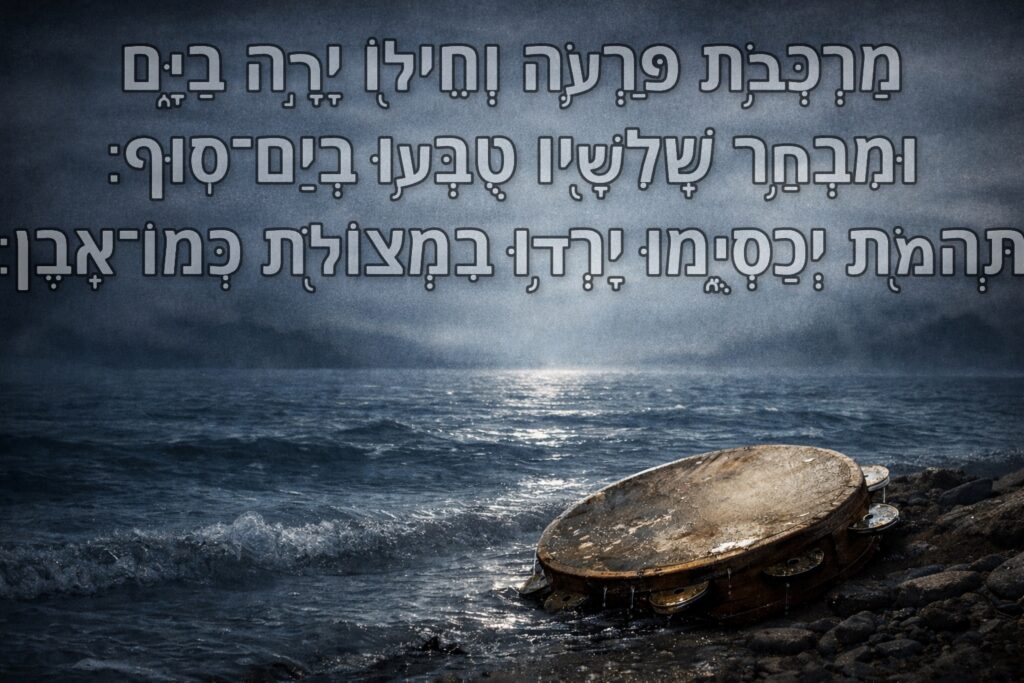
Then comes the singing. It is among the most beautiful moments in Torah—and also, for a modern reader of discernment, one of the most unsettling. Israel does not merely offer thanks. They do not simply celebrate freedom. Their song lingers not only on deliverance, but on destruction: horse and rider hurled into the sea; the enemy sinking like stone; consumed, shattered, erased.
It is a hymn of salvation, yes. But it is also—undeniably—an exultation over an enemy’s suffering.
And that distinction matters.
To revel in suffering—even the suffering of the wicked—is not gratitude. It is pleasure at harm. And whatever else we choose to call it, that pleasure is a form of hatred.
The world has never lacked conflict. It has never lacked the necessity of resistance. Scripture is not embarrassed by the reality that some evils cannot be reasoned with, only confronted. At times war must be waged; at times suffering is unavoidable.
But there is a line—thin as a strand of hair, sharp as a blade—between necessity and appetite. Between justice and indulgence. And it is at precisely that line that the soul is either refined… or corrupted.
Victory Has Its Own Temptation
The Torah is not naïve about the human heart. It knows something modern righteousness often forgets: the oppressed do not automatically become virtuous when freed. Pain does not sanctify. Injury does not purify. Deliverance alone does not heal the moral imagination.
Sometimes liberation does not kill oppression; it simply relocates it.
One of the great temptations after deliverance is not merely to live differently, but to reverse the roles. To seek not justice, but repayment. Not repair, but humiliation. Not a world without Pharaoh, but a world in which the whip has simply changed hands.
And in the moment of victory, that temptation sings.
A people becomes what it praises. If an enemy’s defeat becomes sacred music, hatred gains a foothold not merely in rage, but in ritual. The boundary between justice and cruelty begins to blur. Triumph grows self-justifying:
They sank, therefore we are righteous. They fell, therefore God favors us.
But that is the moral seed of empire—the very thing Israel was meant to escape. Pharaoh is not only a man. Pharaoh is a pattern. A posture of the soul. And a nation can walk out of Egypt while still carrying Egypt within.
The Righteous Mask
Here is one of the soul’s most subtle corruptions: the belief that hatred becomes virtuous when clothed in moral language.
The object may change; the appetite does not. The target shifts; the tactics remain. Cruelty is reborn as “justice,” and domination as “liberation.”
This is not confined to one political party, one philosophy, or one decade. Across history the righteous have often been tempted to do the very thing they condemn—only now with cleaner hands, a better story, and louder applause. They do not stem the tide of hatred. They divert it—shifting suffering from one group to another and congratulating themselves on the redirection.
Worse still, this hatred masked as righteousness often appears only when it is advantageous. Outrage flares not necessarily when suffering becomes unbearable, but when it becomes strategically useful. Many crusades are not restrained by mercy; they are restrained by inconvenience. They demand sacrifice from others while quietly exempting themselves. They shout until it costs them something—then the moral demands shrink into slogans.
This is not justice. It is temperament. Appetite. Self-interest dressed in liturgical costume.
The result is predictable: damage on both sides of the river. The hated are brutalized, and the haters rot from within. One may win the argument, win the policy, win the moment… and lose the soul.
Here, too, is Shirat HaYam: the temptation to treat deliverance as permission, to confuse righteousness with triumph, and to let the downfall of an enemy become a feast for the heart.
Fear, Anger, Hate, Suffering
It feels almost absurd to quote Yoda in a Torah reflection—and yet it may be less absurd than it seems. Modern myths are rarely created from nothing; they are stitched together from older moral cloth. Star Wars may be science fiction, but its spiritual grammar is ancient.
And the line endures because it speaks with frightening accuracy:
“Fear leads to anger, anger leads to hate, hate leads to suffering.”
Fear is the seed. Anger is the growth. Hate is the fruit. And suffering is the harvest. It must further be said that this is cyclical—for like the harvest portion set aside for the new season’s sowing, suffering becomes fear, and thus seeds the following season.
This is not merely a psychology of the individual; it is the anatomy of whole peoples. Fear unaddressed becomes grievance. Grievance becomes fury. Fury becomes permission. And once hatred gains permission, it does what it always does: it spreads beyond its stated target. It multiplies suffering beyond what justice requires.
Even when hatred believes itself righteous, it is still hatred. Even when it carries a banner, even when it speaks in the language of liberation, even when it claims sacred authority—it still produces the same harvest.
This is why triumphal celebration is not harmless catharsis. It is cultivation. It trains the soul to enjoy harm. When a soul learns to enjoy harm, it will stop asking whether it must.
Torah’s Own Restraint
And here is the crucial point: the tradition itself is not blind to this danger. It pushes back—forcefully—against the intoxication of victory.
Proverbs warns:
“Do not rejoice when your enemy falls… lest the LORD see it and disapprove.” (Proverbs 24:17–18)
The text does not say, “Do not fight.” It says: do not gloat. Do not delight in ruin. Do not allow justice to curdle into pleasure at another’s pain. Something can be necessary and still not be celebrated.
The rabbinic tradition goes further. In Megillah 10b, the sages imagine even Heaven restraining triumphalism at the sea: when the angels wish to sing as Egypt drowns, they are rebuked—“My handiwork are drowning in the sea, and you sing songs?”
That is staggering. Even when judgment is required, the soul must not feast.
A Warning Hidden in a Song
Seen in this light, Shirat HaYam becomes more than a victory anthem. It becomes a mirror.
It reflects not only what happened to Egypt, but what can happen to us. It shows how easily righteousness can be measured in the wrong currency—not by what we build, but by what we destroy; not by what we heal, but by whom we punish; not by how we free the oppressed, but by how loudly we sing when the opponent sinks.
It is one thing to oppose Pharaoh. It is another to become Pharaoh with a different banner.
The danger is not that people resist evil. The danger is that they begin to hunger for it. Hatred does not remain proportionate; it demands new fuel. The soul learns to feast—and once it learns to feast, it will find reasons to do so again.
Shirat HaYam is not only a song of triumph; it is a song that reveals us. It shows what deliverance can awaken in the human heart—not merely gratitude, but intoxication. It is here, at the edge of the sea, that the nation learns it can survive. It is also here that it risks learning something far more dangerous: how to enjoy the drowning of an enemy.
Necessity, Not Appetite
Is this a cry for pacifism? Perhaps ahimsa? An ye harm none, do what ye will?
No, not at all. At times, suffering is necessary. At times, war must be waged. Suggesting otherwise is not only naïve but a state of denial relative to the very nature of human existence.
However, one point is inescapable and must be stated plainly: to revel in the suffering of another—to celebrate the downfall of an opponent, to sing jubilantly over the defeat of one’s enemy—is a form of hatred. Perhaps not hatred as a consciously chosen ideology, but hatred as a posture of the heart: the enjoyment of another’s pain. And that is precisely what makes it dangerous.

Discover more from Many Lamps, One Flame
Subscribe to get the latest posts sent to your email.
Outstanding. Thank you
This took a lot of soul searching,
reviewing and synthesizing many
Torah portions.
You are blessed