The essays published here are reflective rather than academic. They are not arguments assembled from citations, nor position papers defended through reference. They arise from long exposure, sustained attention, and lived engagement with inherited texts, ideas, and traditions over time.
This work is the result of formation rather than compilation.
Much of what informs these reflections was not absorbed in discrete moments or isolated studies, but through a slow process of intellectual and spiritual osmosis—ideas encountered repeatedly, tested, held in tension with experience, and reshaped into something integrated and personal. What remains is not a catalog of sources, but a way of seeing that has emerged over years of engagement.
For that reason, no single essay carries footnotes or citations. The reflections are intended to stand on their own, entered slowly and without interruption.
What follows is not an exhaustive record of everything read or studied. It is an orientation—an acknowledgment of the major streams and some representative voices that have been especially formative in shaping how these essays think, listen, and speak.
Traditions in Conversation
This work draws most directly from the following broad traditions:
- Hebrew Scripture and Rabbinic Thought
Torah, Tanakh, Talmud, Midrash, halakhic literature, and Jewish mystical traditions, read with attention to formation, responsibility, and return rather than abstraction.
- Christian Scripture and Theology
The New Testament (particularly within the King James tradition), patristic reflection, medieval theology, and later Christian engagement with fulfillment, incarnation, and moral responsibility.
- Western Philosophy
Classical, medieval, and modern philosophy concerned with metaphysics, ethics, reason, and the limits of rational mastery.
- Depth Psychology
Psychological traditions that take symbol, myth, and the unconscious seriously as real forces shaping human perception and behavior.
- Eastern Philosophical Traditions
Taoist, Buddhist, Hindu, and classical Chinese texts, read comparatively and philosophically rather than devotionally, with attention to alignment, restraint, and non-coercive action.
- Mythic, Pagan, and Archetypal Traditions
Engaged as symbolic and cultural lenses that reveal recurring human patterns rather than systems of belief to be adopted.
- Modern Literary and Moral Witnesses
Writers who grapple directly with suffering, power, conscience, and the moral cost of modern systems.
Representative Voices (Non-Exhaustive)
While many thinkers and texts have shaped this work, the following figures represent modes of thought that recur throughout the essays:
- Rabbinic and Jewish Thought:
Maimonides; Rabbi Shimon bar Yochai; Abraham Joshua Heschel; later Hasidic and Chabad teachings, including the Lubavitcher Rebbe
- Christian Theology:
Augustine; Thomas Aquinas; John Milton
- Western Philosophy:
Plato; Aristotle; Descartes; Nietzsche
- Depth Psychology:
Carl Jung (especially formative)
- Dialogical and Relational Philosophy:
Martin Buber
- Eastern Thought:
Lao Tzu; Confucius; foundational Buddhist and Hindu texts
- Modern Moral and Political Witness:
Aleksandr Solzhenitsyn
These names are not presented as authorities to be followed wholesale, nor as an inventory of allegiance. They are landmarks—voices whose ways of seeing have helped shape the intellectual posture of the work.
Essay-Specific Conversations
Certain essays engage particular texts or thinkers more directly. When that is the case, those sources are noted directly and specifically within the essays themselves. Where applicable, citations—such as chapter and verse—are also provided in the text.
Readers are not expected to consult these sources in order to understand the reflections. They are offered only for those who wish to trace a particular line of thought further back.
Suggested Reading
A small selection of works that have been especially formative over time. This list is not comprehensive, nor is it ordered by importance. These texts are offered as places to linger, not tasks to complete.
Hebrew Scripture & Jewish Thought
- The Living Torah — Aryeh Kaplan
- Guide for the Perplexed — Maimonides
- The Sabbath — Abraham Joshua Heschel
- The Zohar: Pritzker Edition — translated by Daniel C. Matt
- Sefaria — General Passages & Commentary
Christian Scripture & Theology
- The New Oxford Annotated Bible (NRSV) — Especially the Gospels (John, Matthew, Mark, Luke)
- Confessions — Augustine
- Summa Theologiae (selected questions)
- Paradise Lost — John Milton
- Bible Gateway — General Passages & Commentary
Philosophy & Moral Inquiry
- Republic — Plato
- Nicomachean Ethics — Aristotle
- Thus Spoke Zarathustra — Friedrich Nietzsche
- Beyond Good and Evil — Friedrich Nietzsche
- The Gulag Archipelago — Aleksandr Solzhenitsyn
Psychology, Myth, and Dialogue
- Man and His Symbols — Carl Jung
- I and Thou — Martin Buber
Eastern Thought
- Tao Te Ching — Lao Tzu
- Bhagavad Gita — (Eknath Easwaran, trans.)
- The Dhammapada — (Eknath Easwaran, trans.)
Modern Bridges (Quietly Included)
- The Tao of Pooh — Benjamin Hoff
- The Te of Piglet — Benjamin Hoff
This reflects personal formation rather than prescription. These works were not encountered quickly, nor exhausted in a single reading. Readers are encouraged to approach them selectively, slowly, and with discernment.
Currently Reading….
This list changes periodically and reflects active study rather than settled conclusions.
- The Sabbath — Abraham Joshua Heschel
- The Prophets — Abraham Joshua Heschel
- Jesus: First Century Rabbi — Rabbi David Zaslow
A Final Note
This list is intentionally incomplete.
Influence that has been fully digested no longer announces itself loudly. What remains visible in these essays is not the breadth of material consumed, but what has been integrated—what continues to shape attention, restraint, and responsibility.
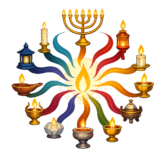
The work here belongs to no single system or tradition. It is an attempt to listen carefully across inheritance—Many Lamps, One Flame.