
Parashat Bo completes the Exodus from Egypt and begins Israel’s transformation from an enslaved population into a people of formation. While the final plagues force Pharaoh’s capitulation, the narrative quickly shifts away from Egypt and toward Israel’s preparation to leave. Time is recalibrated, ritual is instituted, memory is commanded, and departure is framed not as escape but as transition. Bo is less concerned with Egypt’s collapse than with Israel’s readiness to exist beyond it.
What the Exodus Was Really For
The Exodus is not an end unto itself. Escape from slavery is the catalyst, true, but it is not the conclusion to the story of this people. Otherwise, the story would end as soon as everyone makes it to the other side of the Sea of Reeds.
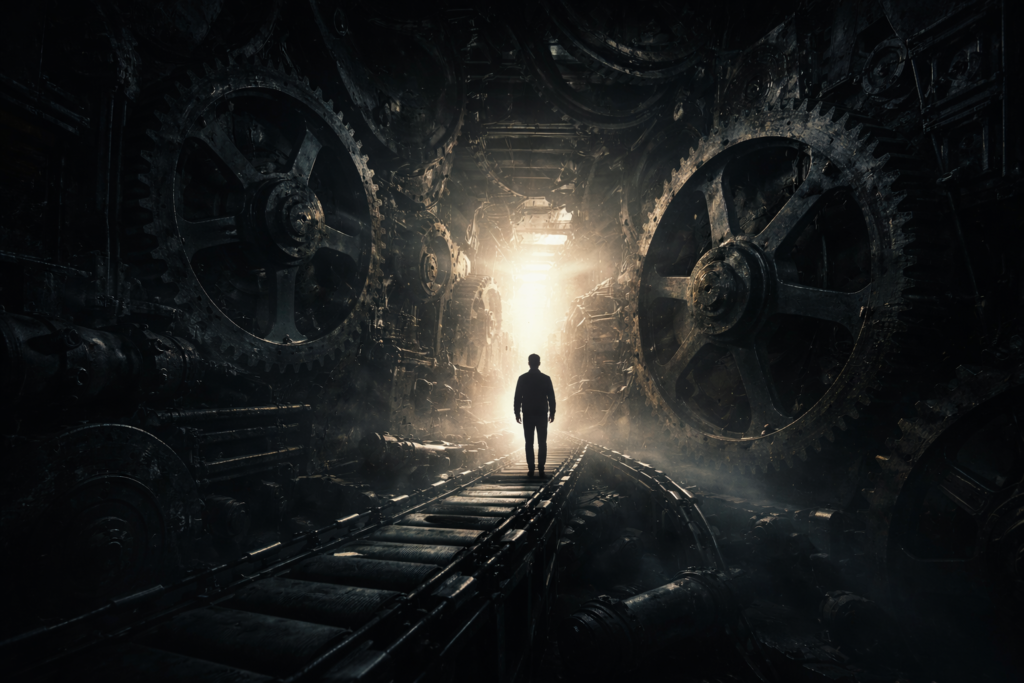
Egypt represents more than just forced labor; it is a closed system—one that assigns identity, measures worth by productivity, owns time, and dictates meaning through power.
If this sounds familiar, it should. (More on that in a moment.)
Israel leaves Egypt not to live without structure, but to live under a structure that enables growth rather than stagnation. The chains of bondage are exchanged not for mere autonomy but for purpose. This is a much deeper escape than suggested by the simplicity of the story.
What Is Gained by Leaving
The benefit of Exodus is not comfort or ease. Those familiar with the story know that this is certainly not how things turn out.
What is gained is a sense of moral agency, continuity, and direction. Israel gains the ability to order life around meaning rather than survival, fear, or accumulation. Freedom without purpose produces anxiety; purpose without freedom produces despair. Exodus holds both in tension.
In Va’era, we see a people traumatized to the point that they are choked off from their very future. This is a people so stymied, so without hope, that they cannot even hear the message of deliverance. It takes a grand act just to open their eyes to even the possibility of a path of growth.
In this sense, it is less a story of rebellion or reinvention than it is a story of emancipation from external impediment.
How Exodus Occurs in Our Lives
We all live in a box; a prison typically of our own making (although not always), with enslavement to circumstance, responsibilities, and wealth-making. Like the ancient Hebrews, we need to make exodus from the bondage of our lives and seek the expansion of the self, awakening to possibilities inaccessible within the confines of bondage.
Exodus today is not geographical—it is structural and internal. There are systems that define us, typically without our consent, and obligations both real and illusory that seem to pen us in, limiting our options. We sell time like a commodity and accept that our lives are essentially locked into a fully enclosed track with only two directions, neither of which may be where we even want to go.
These modern overseers are much quieter than those of old:
• Productivity masquerading as worth
• Wealth mistaken for security
• Identity reduced to function
• Distraction replacing reflection
Conformance is simpler, acceptable, and expected. Growth of the self is challenging to ourselves and threatening to others, especially the “establishment.”
What Happens If We Don’t Leave
The tradition is brutally honest here: staying in Egypt is not a neutral action. The same is true of stagnation in our everyday lives.
Those who do not leave remain bound—bound by fear of loss, an inability to imagine alternatives, and dependence on systems of consumption, where they themselves become the system’s primary consumable. This inevitably leads to a gradual erosion of moral clarity.
The known cage feels safer than the unknown wilderness.
Comfort calcifies; it is the very antithesis of change. The longer one waits, the greater the resistance becomes. Exodus is urgent because stagnation is lethal.
Memory as the Safeguard of Freedom
In Bo, G-d does something striking before the people have time to process what has happened: He commands them to remember it—actively, ritually, and publicly. This is not sentimentality. It is prevention.
“Those who cannot remember the past are condemned to repeat it.”
(George Santayana, The Life of Reason, 1905)
Contrary to popular rhetoric, freedom is neither free nor a natural state. It erodes. Left unattended, it utterly collapses. Memory is the mechanism that keeps liberation from decaying into myth or convenience.
Memory is a condition for reason. It is the capacity to recognize patterns, learn from experience, distinguish cause from accident, and choose differently when unfavorable circumstances recur. None of this is possible without memory.
If experience cannot be recalled, it cannot be compared.
If it cannot be compared, it cannot instruct.
If it cannot instruct, thought collapses into reaction.
As such, it is memory that allows experience to become knowledge, and collective memory is what brings wisdom.
This is why memory cannot remain abstract or passive. It must be actively maintained—revisited, articulated, and integrated into how we understand ourselves and the choices before us. Discipline prevents the erosion of freedom into impulse and chaos, preventing insight’s collapse into habit.
The Ongoing Demand of Exodus
Systems naturally seek homeostasis—a state in which all parts fit, perform their assigned function, and remain within acceptable bounds. Stability is their highest good. Growth, by contrast, is disruptive. Anything that steps out of line threatens balance. Like all living things, systems must consume to survive, and their nourishment often comes from their own components—human time, attention, labor, and compliance.
A stable system assigns roles, normalizes behavior, discourages deviation, and consumes resources. People are not incidental to this process; they are inputs. This is not malevolence, but mechanics—the nature of the beast.
The Exodus is not an act against Pharaoh alone. It is an act against the gravitational pull of every system that prefers stability—and stagnation—to growth.
Real growth, particularly spiritual growth, occurs only where that gravity is resisted—where the machinery no longer runs smoothly and the self is no longer confined to the roles it was built to serve. It is at the point of friction, not comfort, where understanding first materializes, and from there we evolve into something new.

Discover more from Many Lamps, One Flame
Subscribe to get the latest posts sent to your email.