
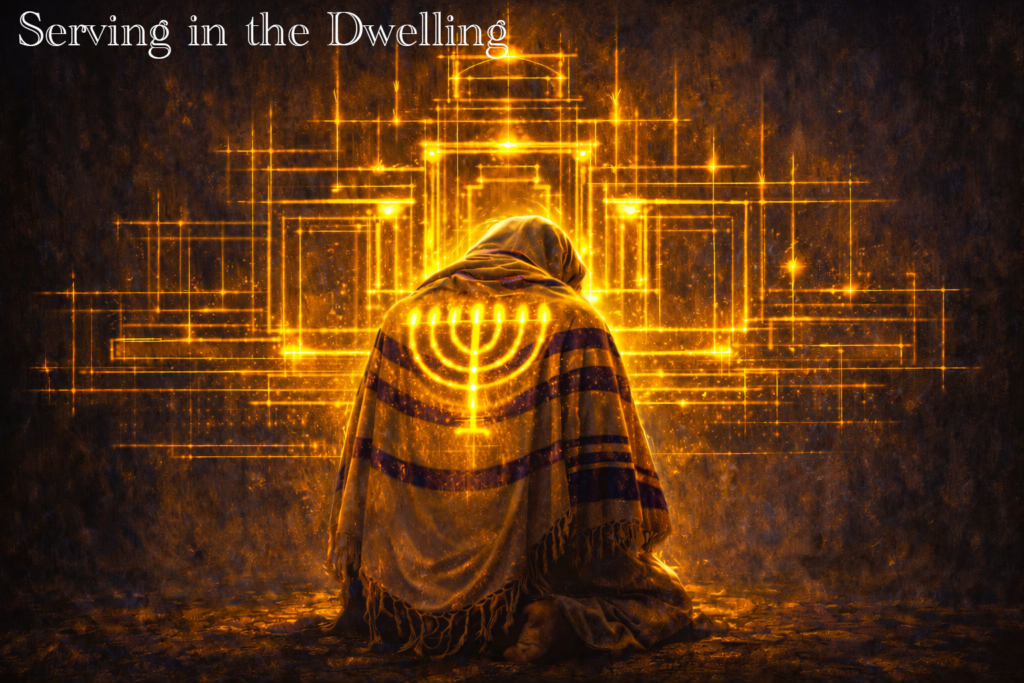
Last week, in Parashat Terumah, we examined the construction of the interior Mishkan—the dwelling place built within the human heart through precision, proper materials, and correct order. The Ark secured at center, containing the covenant. The Table and Menorah in the Holy Place. The veil marking the boundary between Holy and Holy of Holies. The altar and courtyard forming the outer spaces of preparation and service.
The structure stands. The materials are in place. The dwelling is complete.
Now what?
Parashat Tetzaveh answers this question. It details the priestly garments, the eternal flame, the twice-daily offerings, the consecration ceremony. These aren’t arbitrary additions to the Mishkan narrative. They’re the necessary next chapter: once you’ve built the dwelling with precision, how do you serve within it? What does it mean to approach the sacred space you’ve constructed? What preparation is required before you can cross the threshold marked by the Parochet?
The answer begins with garments.
The Priestly Garments: Preparation for Service
The detail lavished on the priestly garments rivals the specifications for the Mishkan itself. The ephod with its stones bearing the names of the tribes. The breastplate with twelve stones, each engraved, each specific. The Urim and Thummim resting over the heart. The robe with bells and pomegranates along its hem. The turban with its golden plate proclaiming “Holy to the Lord.”
Why does it matter what the priest wears? Because approaching the dwelling you’ve built—crossing from the outer courtyard through the Holy Place toward the veil that guards the Holy of Holies—requires more than good intentions. It requires proper preparation. Proper attire. Proper presentation of self.
The exterior garments aren’t separate from the interior work. They’re the expression of it. You don’t approach the sacred center of your own interior Mishkan casually, unprepared. You must clothe yourself appropriately. And in the interior dwelling, clothing means something different than fabric.
You must be properly oriented—interior posture directed toward the center, not scattered across competing demands. You must carry responsibility—the ephod bearing the names of the tribes means you don’t approach alone or for yourself alone, but as part of community, bearing the weight of connection to others. You must be whole—the breastplate with its twelve distinct stones properly arranged means you bring the fullness of who you are, all parts integrated, nothing hidden or left behind.
You must be humble—acknowledging you’re approaching what is greater than yourself, what you cannot command or control. You must be receptive—the Urim and Thummim over your heart represent the capacity to hear, to receive communication, not just to speak toward the Divine but to listen.
Your movement must be intentional—the bells on the hem ensure you don’t approach in stealth or presumption. What you do within the dwelling has effects, makes sound, announces presence. Your thoughts must be consecrated—the golden plate on the turban marking dedication, focus that doesn’t wander or divide.
These garments together form the proper attire for service. Without them—without proper orientation, integrated wholeness, humility, receptivity, conscious movement, dedicated mind—you’re approaching in wrong garments. Or no garments at all.
And the consequences are not gentle.
The Parochet: Protection and Permeability
Last week we identified the veil—the Parochet—as the boundary between Holy Place and Holy of Holies, between our reality and the fullness of Divine presence. But we didn’t examine what this boundary actually does, or what happens when you approach it unprepared.
The veil exists because we are not, by default, capable of withstanding direct contact with the undiluted Divine. Not because G-d is cruel, but because the gap between human consciousness and Divine presence is real. To approach unprepared is not humble aspiration. It is presumption. And throughout Scripture, the pattern repeats: presumption before the Holy is fatal.
At Sinai, the people must not touch the mountain or they die (Exodus 19:12-13). The boundary is absolute. Cross it unprepared and the result is immediate.
Uzzah reaches out to steady the Ark when the oxen stumble (2 Samuel 6:1-7). His intention seems good—preventing the holy object from falling. But he touches what he has no preparation to touch, and he’s struck dead instantly. The text is blunt: “G-d struck him down there for his error.”
There is perhaps no more tragic a story than that of Nadav and Avihu, sons of Aaron, who are lost when they approach incorrectly (Leviticus 10:1-3). We will encounter their story in the weeks ahead—a demonstration that even priests, properly consecrated, can fail if they bring unauthorized fire, if they approach without full preparation. The warning stands: the specifications are not suggestions.
The priests who enter the Holy of Holies on Yom Kippur follow exact protocols. Wrong incense, wrong timing, wrong preparation—they don’t emerge. The High Priest wore bells so those outside could hear him moving. If the sound stopped, they knew he’d approached incorrectly.
Even Moses—Moses, who speaks with G-d face to face—cannot see G-d’s face and live (Exodus 33:20-23). Only His back, and even that leaves Moses radiant in a way that terrifies the people. If Moses at the height of his preparation cannot withstand the full encounter, what makes anyone think they can approach casually?
The Parochet protects us from our own hubris. From the assumption that desire for connection equals readiness for it. From the belief that because we’ve built the interior dwelling, we’re automatically prepared to access its innermost chamber.
Without proper interior construction—without the covenant secured at center, without the qualities of resilience and incorruptibility and worked purity properly cultivated and arranged—the boundary between our reality and the Divine remains necessarily impermeable. The veil functions as a wall. When you push against it unprepared—through meditation, through spiritual practice, through sheer force of will—you hit stone.
Sometimes the impact is merely frustrating. You push and push and encounter nothing but barrier, nothing but resistance. The sense of being blocked, shut out, unable to access what you’re reaching toward.
Sometimes it’s painful. You hit the wall hard enough that it rebounds you physically. Headaches. Disorientation. The body registering what the mind refuses to acknowledge: you’re not ready. The dwelling isn’t complete. The garments aren’t properly arranged. You’re approaching in ways that would harm you if the boundary gave way.
The veil doesn’t refuse you. It protects you. It keeps you from touching what would consume you unprepared.
But notice the material: fine linen. Blue, purple, scarlet. The costly dyes, the worked fabric, the careful weaving. The veil is substantial but not solid. It separates, but its nature is permeable. When the interior Mishkan is properly constructed—when the materials are genuine, when the order is correct, when the covenant sits secure at center and everything is built outward from there—the veil functions as it was designed to function.
It becomes gossamer. Still present, still marking the boundary between Holy and Holy of Holies, but passable. Not because the boundary disappeared, but because you are now prepared to cross it. The qualities you’ve cultivated, the precision with which you’ve built, the proper garments you’ve clothed yourself with—all of this makes you capable of passing through what would otherwise consume you unprepared.
The veil doesn’t vanish. You don’t overcome it through force or determination. You become ready for it. And readiness transforms impenetrable stone into permeable fabric, a boundary that can be crossed because you have done the work that makes crossing survivable.
This is the function of the Parochet. Not obstacle but threshold. Not barrier but doorway. The difference between wall and passage depends entirely on whether you’ve built the dwelling properly and clothed yourself appropriately before approaching.
Daily Practice and Ongoing Service
But Tetzaveh doesn’t only warn. It also instructs. Once the dwelling is built and you’re properly prepared to serve within it, what maintains that dwelling? What keeps the interior Mishkan inhabitable?
The portion commands: bring pure olive oil for the light, to kindle the lamp continually. The ner tamid—the eternal flame. Morning and evening, Aaron arranges the lamps before the Lord. The light must never go out.
Morning and evening, he burns incense on the golden altar before the veil. Morning and evening, the daily offerings are made in the courtyard. Twice daily. Every day. Regular rhythm that structures service within the dwelling.
The eternal flame isn’t eternal because it burns without maintenance. It’s eternal because it is maintained. The Menorah you’ve been formed to bear—hammered like gold into proper shape—requires fuel. Pure olive oil—not just any oil, but oil from the first pressing of hand-picked olives, beaten rather than mechanically pressed to avoid bitterness. Only a small amount of the clearest oil rises from this process. The yield is minimal. The labor intensive. This isn’t commodity fuel purchased cheaply. It’s the result of deliberate, costly extraction. In the interior Mishkan, this represents the refined practices that maintain illumination: not casual habits or convenient shortcuts, but practices carefully extracted, purified, dedicated specifically to keeping the light burning.
Morning and evening. The rhythm that prevents gradual dimming. That catches the flame before it sputters out. That maintains orientation toward the center when daily life scatters attention across competing demands. You begin each day from the sacred—tending the light, burning incense before the veil—rather than allowing the sacred to be squeezed in after everything else has claimed your energy. You end each day by returning—realigning what has been pulled askew, restoring what has dimmed during hours of dispersed focus.
Not building the dwelling again each day. The structure is permanent. But maintaining what has been built. Tending what requires tending. Morning and evening. A rhythm sustainable across years, across decades, across a lifetime.
The Table adds weekly rhythm to the daily one. The lechem panim—bread of presence—is renewed every Shabbat. What sustained you last week must be refreshed this week. Spiritual nourishment doesn’t accumulate indefinitely. It requires regular renewal. The weekly return to receive fresh provision, to release what has been consumed and accept what is new. Without this rhythm, you find yourself living on stale bread—provision that served its purpose days ago but hasn’t been refreshed, leaving you depleted despite having eaten.
The dwelling is built. The garments prepare you. The veil protects until readiness makes passage possible. And service—maintained through daily practice, renewed through weekly rhythm, consecrated through deliberate dedication—keeps the interior Mishkan inhabitable. The light burning. The incense rising. The bread fresh. The approach proper.
Service Never Ends
Parashat Tetzaveh concludes with a promise that mirrors the one from Terumah: “And I will dwell among the children of Israel and be their G-d.”
Among them. Not in the structure. Among the people. Within them.
But now the promise is contextualized by what we’ve learned about service. The dwelling isn’t just built and then left to stand on its own. It requires tending. Morning and evening. Week after week. Year after year.
Last week, Parashat Terumah taught us how to build. The precision required. The materials needed. The order of construction. The permanent dwelling that can be established within through proper work.
This week, Parashat Tetzaveh teaches us how to serve. How to clothe ourselves appropriately. How to understand the veil’s protective function and what makes it permeable. How to avoid the fatal error of Nadav and Avihu—approaching with strange fire, insufficient preparation, wrong garments. How to maintain the light, keep the rhythm, renew the sustenance, consecrate the service.
The dwelling is built. The garments are prepared. The boundary is understood. The rhythm is established.
Now the work continues. Morning and evening. Week after week. Service within the dwelling you have carefully constructed, tending what requires tending, maintaining what would decay without attention, approaching the veil with proper preparation, crossing the boundary when readiness makes crossing possible.
The interior Mishkan is permanent once properly built. But permanent doesn’t mean self-sustaining. It means the structure holds while you perform the service required to keep it inhabitable. The light burning. The incense rising. The bread renewed. The approach proper. The garments appropriate.
Among them. Within them. The dwelling maintained through ongoing service, tended through daily practice, kept holy through consecrated attention.
The work never ends. But the work is no longer construction. It’s service. And service, performed properly within the dwelling you have built, becomes not burden but privilege. Not obligation but relationship. Not law but love.
“V’shachanti b’tocham“—I will dwell among them.
The promise holds. The Presence remains. The service continues.

Discover more from Many Lamps, One Flame
Subscribe to get the latest posts sent to your email.