
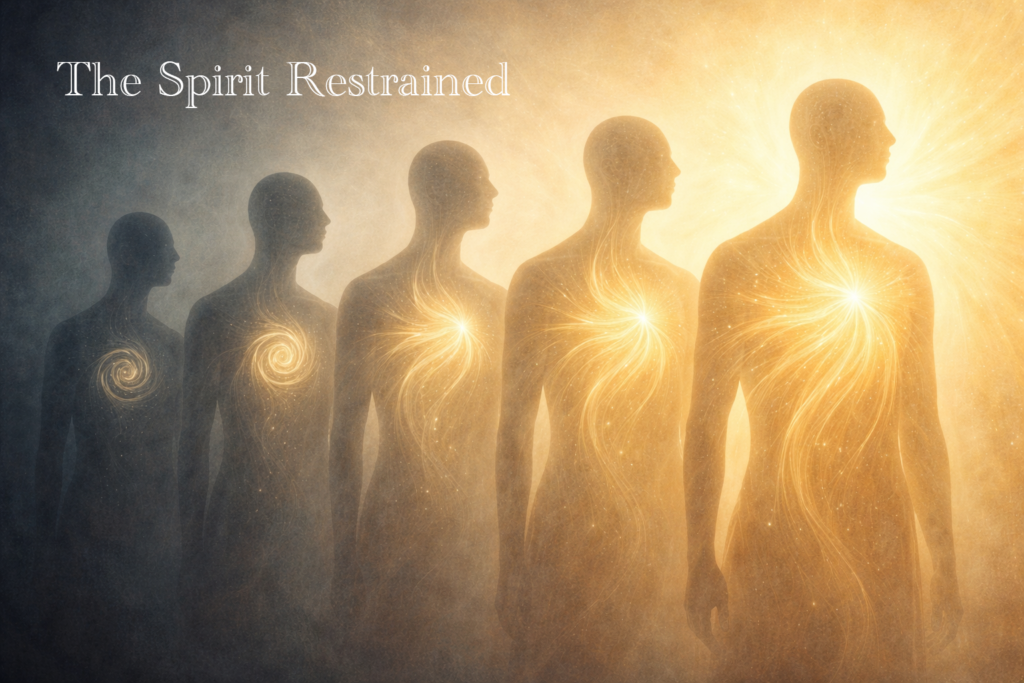
“Moses spoke thus to the children of Israel, but they did not listen to Moses because of shortness of spirit/breath, and because of harsh labor.”
This week’s Torah portion, Va’era, recounts God’s command that Moses deliver a message of impending redemption to the people of Israel. At first, Moses hesitates. He is not a public speaker; words do not always come easily to him. Nevertheless, he acquiesces and does exactly as he is commanded.
Yet when he speaks, the people do not listen.
Not because they reject him.
Not because they disbelieve his words.
Not even because they argue with him.
The text is careful and precise. It does not say they refused to hear Moses; it says they did not hear him. The Hebrew implies not defiance, but inaccessibility. They were unreachable.
We are told this was due to kotzer ruach—a narrowing, a shortness, a constriction of spirit or breath. This is not a statement about emotion or attitude. It is a statement about capacity. Their inner life had been so compressed by suffering that it could no longer expand to receive hope. They were not faithless; they were exhausted. Not resistant but collapsed inward.
They were beaten down to the point where even words of redemption could not find a place to land. These were a people so burdened by suffering that they could not receive consolation or words of comfort (Shemot Rabbah 6:5). The midrash goes further: Moses’ words themselves increased their anguish, for they feared that even the stirrings of hope would provoke harsher decrees. As the narrative unfolds, that fear proves tragically well founded.
In our modern age, we have a name for this condition: trauma.
Trauma takes many forms, ranging from the obvious and physical to the subtle and psychological. It reaches beyond the individual into the realms of spirit, morality, and even the structures of society itself. Trauma constricts perception and possibility. It interferes with revelation, stunts growth, and stymies action—not because the will is absent, but because the capacity to respond has been crushed.
In Kabbalistic language, this constriction is described as a collapse of the vessels (kelim). The soul receives life, meaning, and revelation only insofar as it has the capacity to hold them. Trauma narrows that capacity. When the inner vessels are crushed—by fear, exhaustion, or sustained oppression—even divine light cannot be properly received without harm. The Zohar speaks of kotzer ruach not as a failure of faith, but as an absence of space: the breath cannot expand, the spirit cannot rise, and words meant to redeem instead overwhelm. Revelation offered too early, or to a shattered vessel, does not heal; it fractures further. This is why redemption must begin not with instruction, but with removal, relief, and the slow restoration of breath (Zohar II:25b–26a).
Modern psychology would refer to this condition as trauma-induced psychological constriction. It is marked by narrowed perception, emotional blunting, and a loss of future orientation. One enters survival mode, focused not on growth or choice, but on enduring from one moment to the next. Agency collapses into passivity; hope becomes a liability rather than a comfort. Shame, guilt, and withdrawal often follow—not as moral failures, but as predictable consequences of sustained harm.
This is a state of profound hopelessness, deeper than ordinary despair, in which the self is reduced to what it must do to survive. It is not the revelation of one’s true nature, but the deformation of it.
Trauma is contagious; suffering is seldom contained. It is transmitted from husband to wife, parent to child, family to family. As the Israelites suffer, Moses is sent to Pharaoh to secure their release from bondage. Pharaoh refuses, and the plagues follow. Each plague mirrors the suffering inflicted upon the Israelites, and as they unfold, the people of Egypt experience what they had imposed on others—environmental collapse, loss of bodily safety, economic devastation, and finally, the death of the firstborn. The plagues are not random. They are trauma returned along the channels of its initial transmission. Trauma begets trauma; a pattern the Torah elsewhere describes as measure-for-measure.
The early plagues do not sway Pharaoh; they harden him. This too is a familiar trauma response. Control—however illusory—replaces listening.
Healing cannot begin in the place of injury. For the people of Israel, Egypt is not merely a location; it is a system of trauma, and no amount of insight can repair such a broken and damaging environment. Redemption therefore begins with removal.
This pattern remains true in the modern world. When one experiences trauma, the first step toward healing is the restoration of safety. There must be distance from the source of harm before integration can begin. Only then can meaning be recovered—the restoration of breath—and, eventually, mastery. Never are the words “I need a breather” more literal than in the life of the traumatized.
It is worth noting that trauma does not end when the chains are removed. When suffering is shared, prolonged, and systemic, it becomes collective—absorbed not only by individuals, but by a people as a whole. Such trauma does more than wound; it shapes identity. It informs what is feared, what is trusted, what is remembered, and what is transmitted across generations.
This is the condition of the Israelites in Egypt. Their suffering is not private or episodic; it is national, prolonged, and totalizing. Nearly two centuries have passed since the time of Joseph, and a new generation is born into oppression. Children inherit survival strategies before they inherit stories. Intergenerational trauma perpetuates itself by default, passing from parent to child not primarily as narrative, but as instinct.
This intergenerational trauma has been renewed across millennia. The Jewish people may not be unique in their experience of oppression, but they are uniquely honest about it. Their foundational story does not end with triumph. It continues through fear, struggle, and return. Torah does not present a redeemed people immediately healed, but a wounded people learning—slowly and unevenly—to live without the structures that once confined them, growing through each new encounter with freedom.
As one would expect, healing is not an overnight process, and it comes with setbacks. Later in Exodus, as the Israelites enter the wilderness, trauma resurfaces repeatedly: fear of scarcity, longing for the familiarity of Egypt, distrust of leadership, panic in moments of uncertainty. These are not failures of character, nor marks of stubbornness; they are the predictable aftereffects of sustained collective harm.
Though it may appear otherwise, the forty years of wandering are not simply a punishment for lack of faith. They are the necessary span of time required for a traumatized people to become something other than what trauma made them. A generation shaped entirely by slavery cannot step directly into freedom without consequence. Patterns learned under oppression do not dissolve overnight.
At the same time, the wilderness provides what Egypt never could: safety without mastery, provision without exploitation, and time without quotas. It creates a space where identity can be reshaped—not erased but transformed. Shabbat restores rhythm. Manna interrupts hoarding. Law introduces structure without cruelty. These are not abstractions; they are tools of re-formation.
In short, the healing of intergenerational trauma demands generational time.
Torah informs. Torah teaches. Communities shaped by shared catastrophe—war, displacement, enslavement, persecution—do not leave those experiences behind merely by surviving them. Trauma becomes culture; memory becomes instinct; fear becomes inheritance. Without intention, trauma defines the future more powerfully than even hope.
In the story of the Exodus, Torah does not deny this reality—it confronts it. It insists that healing is possible, but not automatic. Memory must be tended carefully. Freedom requires reflection. Redemption, therefore, is not an endpoint, but a process—one that honors the wounds, and the wounded, of the past without allowing them to dictate the future.

Discover more from Many Lamps, One Flame
Subscribe to get the latest posts sent to your email.