
Today, I am thinking about scars.
I was surfing the heart transplant support groups on Facebook recently when I came across a photo of a woman celebrating her tenth “heartiversary.” She sat poised in a semi-formal gown with a plunging neckline—utterly stunning, radiant, confident. And what struck me most wasn’t the elegance of the dress or the artistry of the photograph. It was the fact that she chose to show herself exactly as she is: a heart-transplant survivor with the same long chest scar the rest of us carry. In all honesty, it was barely perceptible; I literally had to zoom into the photo just to prove to myself that it was even there. All I could see was this beautiful woman celebrating life with strength and vigor. It was inspiring, to say the least.
There’s something arresting about that degree of courage. Most people hide their scars—literal or otherwise—because the world has a bad habit of treating them as flaws. But she didn’t hide a thing. She looked straight into the lens and said, without saying a word, This happened to me, and I am still here. It was the kind of beauty forged in fire: not decorative, not fragile, but earned.
It made me stop scrolling. It made me think about my own scar, about what it cost, and what it gave back. And it reminded me that survival is not a quiet thing; it carves itself into us. Some of us cover it. Some of us reveal it. All of us live with it.
Torah and the Ancient View of Scars
Torah does not romanticize suffering, but it does treat the marks left behind as witnesses. In Hebrew, the word ’ôt (אוֹת) means “sign, mark, testimony.” It’s used for everything from covenant marks to physical reminders of deliverance.
A scar, in this framework, is not merely damaged tissue; it is a sign that something was survived. Torah’s world is one where the body remembers, and that memory is not shameful. Jewish teaching describes the self in layers—nefesh, ruach, neshama—each capable of holding its own memory of suffering and resilience. The scar on the skin is simply the outermost echo of a deeper journey.
That layered sense of wound and transformation finds one of its clearest echoes in the story of Jacob and Esau. In Genesis 32, Jacob wrestles through the night with a mysterious figure. He emerged victorious but injured—bearing a scar of this trial. He is renamed “Israel,” commonly cited to mean “one who struggles/strives with G-d” or “prevails with G-d.”
Midrash (Tanchuma, Parashat Tazria 7) teaches, “Just as a vessel which has been broken and repaired is more beloved to the master, so too are the righteous who have stumbled and risen again more beloved to the Holy One.” Talmud (Bavli Berakhot 34b) says, “In the place where ba‘alei teshuvah stand, even the completely righteous cannot stand.” We see the same theme in Zohar (I:31b), “Where a person is broken, there the Shekhinah dwells,” and Lurianic Kabbalah teaches that before creation took its final form, the primordial divine vessels could not bear the light and shattered, causing sparks to scatter through creation. The repair of these vessels—Tikkun—is the ongoing task of creation.
In short—what survives breaking is not diminished but rather elevated. The scar is not the flaw; it is the Tikkun—the sign that the vessel has been reforged and is now able to hold more light.
The Fired Seam
In the forge, it is the seam—where the metal was broken and reforged—that holds the strongest truth. It is here where weakness meets strength.
And this is where my thoughts drift eastward, to Japan.
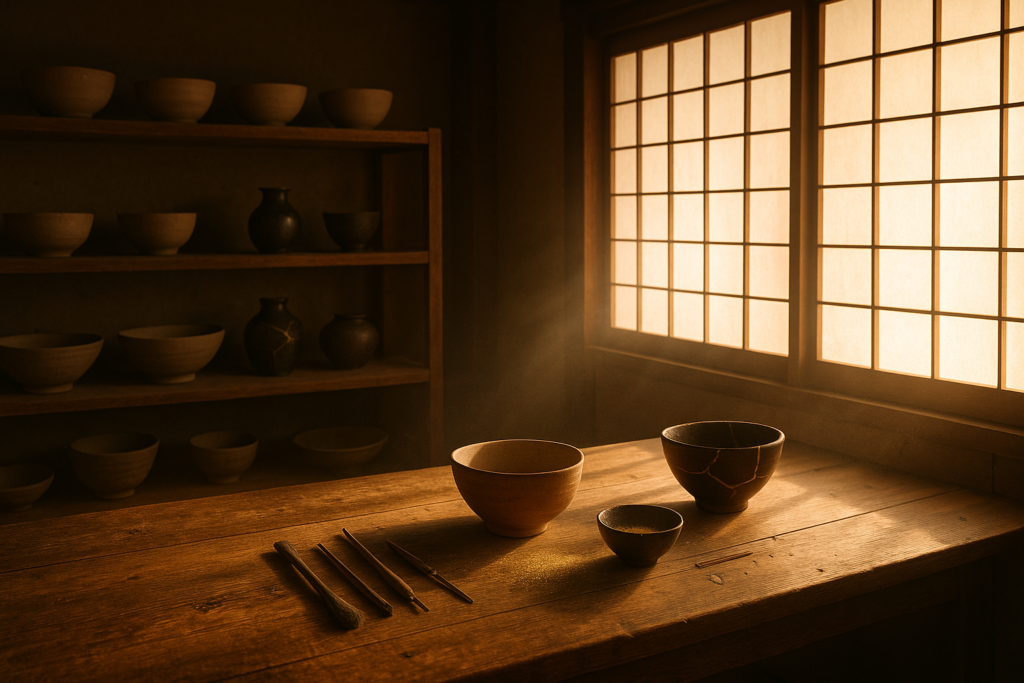
Jewish tradition is not alone in seeing beauty in what has been broken and repaired. In Japan, the art of kintsugi teaches that a shattered vessel is not restored by hiding the fractures but by filling them with gold. The break becomes the brilliance—the most cherished part of the whole.
To me, this is a useful reminder because the scar on my chest is only the most visible one. The deeper scars, the ones no one sees—the fractures in identity, the ruptured certainties, the nights where the soul is held in the fire and asked to come out different than it went in. If the teachings of our sages tell us that the repaired vessel is more beloved, the Far East tells us that the repair itself can become luminous.
Such repairs are never swift. They take time, patience, and a willingness to face the fracture itself—but in that work, something enduring and unexpectedly beautiful is born.
The New Whole
What comes next is a new thing: similar to that which preceded it, of course, but unique unto itself. No one walks through the flames and emerges unblemished.
The thing is… would we really want to come out as such?
Transformative experiences reshape us—they remodel our very essence, soul, being. We must choose how we rebuild (for the better, for the lesser), but in the end, the scars of our encounters with these moments are the lines upon which our tomorrows form. For some, it is sheer willpower that gets them through; others rely upon faith, and still others upon friends and family. The most fortunate stand upon all three pillars.
The quiet truth hidden inside every scar, visible or otherwise: we are not who we were before the breaking, and we are not meant to be. The fire tempers us; the seam reminds us. Somewhere in the uncertain space between who we were and who we are becoming, we learn to carry our days differently—more aware, more grateful, more attuned to the fragility of life. What once felt like loss and suffering evolves, in time, into revelation.
What Remains?
In the end, scars—be they carved into the flesh or the soul—remind us that we have crossed a threshold. They are a record of the moment when the world stopped making sense and demanded everything we had, perhaps more than we could ever imagine we possessed.
We do not choose to break; we seldom choose the fire. We do, however, choose what we carry forward. Grief, gratitude, anger, joy, trepidation, even a newfound reckless abandon… the moments define the trial; we define the lesson. The seams (scars) may be painful at first—often perhaps bewildering—yet they become less defining, less pronounced with time, and fade to a subtle memory of a life lived.
If I have learned anything from the sages of tradition, from the artisans of Japan, from the furnace and the forge, it is this: the scar is not the end of the story. It is the line where the story deepens. It is the place where the light gathers. And for those of us who have walked precariously close to the edge and returned, it is the quiet proof that life, in all its fierce tenderness, has not yet finished its work in us.

Discover more from Many Lamps, One Flame
Subscribe to get the latest posts sent to your email.