Christianity is, at its core, steeped in Torah. Jesus was a Jew, and he made it clear that he did not come to abolish Torah or revoke covenant, but to uphold both. His is often called “the greatest story ever told”—not because an institution claims it as such, but because no other story in human history has been more revered, despised, cherished, debated, recognized, or retold. Whether one believes him to be the divine incarnation, the Mashiach, or a Jewish teacher speaking within his own tradition is not the question here. What matters is the seriousness with which his words themselves are taken.
In this week’s appointed reading, Jesus comes from Galilee to the River Jordan.
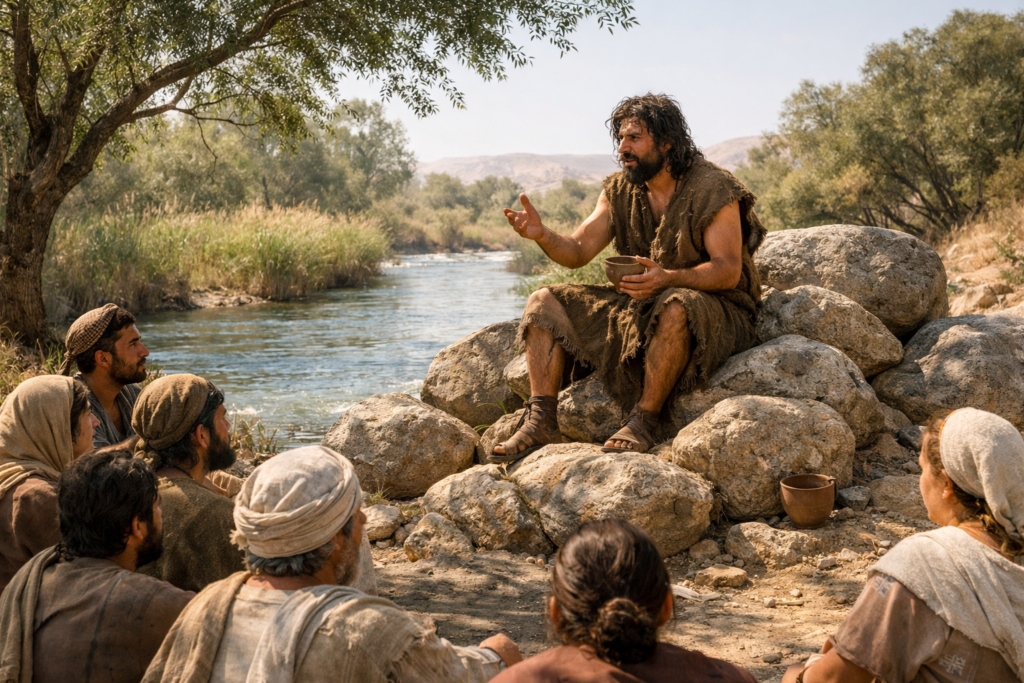
John is already there. He stands at the edge of living water—not a still pool, not a vessel drawn and contained, but a river that moves, carries, resists, and cannot be mastered. He calls people out from their towns and villages and into that current, summoning them to repentance and readiness. The crowds know why they have come. John has been clear: turn back, reorder your lives, and prepare yourselves—for something is at hand.
When Jesus approaches, John hesitates. He recognizes the imbalance and tries to refuse him. But Jesus insists, explaining only that this must be done “to fulfill all righteousness.” John relents. Jesus steps into the living water. He is immersed. As he rises, the heavens open, the Spirit descends, and a voice speaks: “This is my beloved Son, in whom I am well pleased.”
Before asking what this moment means, it is necessary to understand what John is doing—and what he is not doing.
John’s immersion is not a Christian sacrament, nor is it an attempt to cleanse some inherited metaphysical stain (original sin). Those ideas belong to later theological reflection. John’s baptism is Jewish, rooted in Torah and the prophets. It is bound up with teshuvah—a turning, a return, a reorientation of the whole person toward G-d.
But teshuvah is never a single act. It is not achieved by water alone. It involves recognition, remorse, restitution, and a sustained change in direction. Immersion in a mikveh is one moment within that larger movement—a visible crossing point in a process already underway. The water does not forgive sins. G-d does that. The water marks readiness to stand before G-d, having already begun the work of turning. (For a fuller exploration of this process, see my earlier essay on teshuvah.)
In Jewish thought, immersion is often associated with living water precisely because living water moves. It does not merely cover; it carries. It does not linger; it advances. To enter it is to accept that one will not emerge unchanged—not because the water itself is magical, but because the act signifies a willingness to be borne forward into something new.
This understanding has deep roots in the prophetic tradition. The Book of Jeremiah (Jeremiah 2:13; 17:13) speaks of G-d as the “fountain of living waters”. Ezekiel speaks of a river flowing outward from the Temple, in many directions, restoring fouled waters pure (Ezekiel 47). This is the divine flow; life as it emanates from the unknowable. Christianity later names this movement the Holy Spirit. Within Kabbalistic thought, it is understood as shefa reaching humanity through the Shekhinah, the indwelling presence of G-d. Different traditions use different language, but the intuition is the same: G-d draws near through movement, through flow, through life given and shared.
Seen this way, immersion in living water is not about erasure or escape, but alignment—acceptance. To step into the river is to place oneself within the current of what G-d is already doing—consenting to be carried forward rather than remaining still.
Yet even here, immersion alone is never enough. Water can wash the body, but it cannot cleanse a heart that refuses repentance. A person may step into the river without having truly turned inward. In such a case, the ritual remains incomplete. Repentance precedes immersion; humility makes immersion truthful. This is echoed even in secular life, where an apology may ring hollow, remorse seem insincere.
This is the moral seriousness John brings to the Jordan. His message is not gentle, but it is precise. Ritual without repentance is empty. Repentance without action is self-deception. To enter the living water is to acknowledge that the work has already begun—and that it must continue.
Which makes the next question unavoidable.
If this is what John’s baptism requires—repentance, humility, readiness—why does Jesus submit to it at all?
The Gospels do not suggest that Jesus enters the waters because he needs cleansing. Nor do they present him as compelled or coerced. He enters deliberately. He insists on it. He refuses exemption.
The answer offered by the text is not metaphysical but moral.
Jesus does not stand above the people he teaches. He stands among them. He submits himself to the same demand placed on others—the demand of humility before G-d.
This calls to mind a scene from a modern rendering of the story of Jesus, The Chosen. Jesus’ mother, Mary, pulls him away from his followers. She notices he’s grown a bit unkempt; she is his mother after all. She sits him down and washes his hair; even playfully pulling at it. It is an ordinary, intimate moment between mother and son, instantly recognizable and deeply human. There is no teaching here, no miracle, no proclamation—only care, concern, and presence. When Jesus responds to her, he does not retreat into destiny or authority; both know what is coming and his responsibility. He remains with her in that moment, acknowledging his vulnerability. “I am a man too.”
This defines Jesus; he is “one of us”, never above us. At the Jordan, he’s accepted the posture of repentance not as an admission of guilt, but as an act of alignment. He enters the living water not because he is unclean, but because righteousness does not excuse the righteous from humility.
Only after this—only after descent, only after submission—does the voice speak.
G-d’s pleasure is not presented as a reward for accomplishment. Nothing has yet been done. No miracles have occurred. No sermons have been preached. G-d is pleased because Jesus has aligned himself fully with the human condition under G-d: obedient, receptive, unexempt.
The moment at the Jordan is not about elevation, but identification.
Alignment, in this sense, is not agreement in theory but harmony in posture. It is the placing of oneself within the natural and proper order of things—G-d as source, humanity as responsible, life as lived in relation rather than assertion. Jesus does not arrive at the Jordan to distinguish himself, but to stand where others stand, to accept the same orientation toward G-d that is asked of all.
This is unity not as sameness but as congruence. Too often we push to control, manage, and direct life, seeking to set ourselves apart from the crowd—make our mark. This push–pull approach brings about discord, discontent, and dampens our receptiveness to revelation through the divine flow. Harmony does not eliminate difference; it allows difference to move together without fracture.
Righteousness is not about moral perfection so much as right relationship—being properly situated within the covenantal flow of life. To be aligned is to be ordered, in step, resisting neither the current nor the call. Jesus’ descent into the water reflects this as he places himself in harmony with the work G-d is already doing. The heavens open not because power is seized but because harmony has been restored through human life fully attuned to divine will.
In this way, the baptism does not distance Jesus from humanity; it binds him to it. He does not bypass the path others must walk. He steps into the current with them. And it is precisely this posture—humility before the divine, acceptance of G-d’s will, and refusal to claim privilege—that opens the heavens. Heaven and earth do not merge; they meet—as it is above, so it is below. This represents a moment of coherence; an affirmation of life lived in balance.
The living waters flow
What is asked is not distinction but concordance
A life aligned with the divine order
Attuned to the flow already moving through the world
Through immersion we are returned to the One

Discover more from Many Lamps, One Flame
Subscribe to get the latest posts sent to your email.
Well written. Provides a lot of clarity of the symbolism and why it matters.