In this week’s appointed reading (John 1:29–34), John the Baptist points away from himself and toward Jesus. It is a moment of recognition—a testimony to who stands before him—and very much a continuation of last week’s story.
Rather than rehashing what was already discussed just last week, I thought I’d look instead to last year’s reading in the lectionary schedule—specifically, John 2:1–11. Jesus is a guest at a wedding in Cana. As was always the case with such gatherings, it is a time of joy and celebration—an event meant to mark continuity, blessing, and communal future.
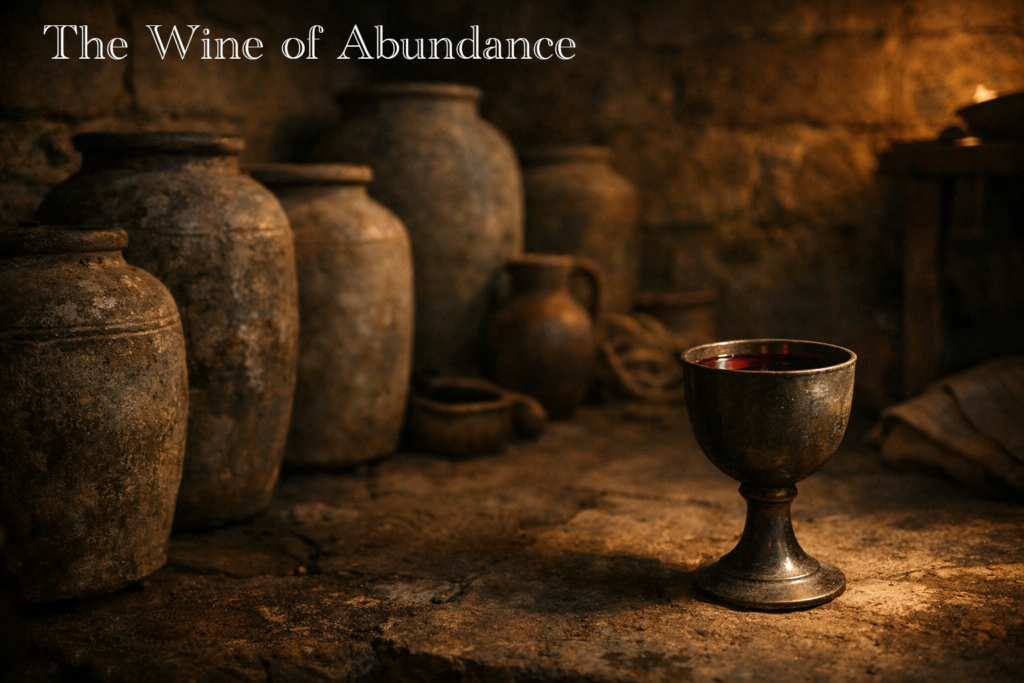
Wine stood at the center of these celebrations. In the ancient world, it was not merely a drink, but a symbol of abundance, covenant blessing, and life sustained over time. To have wine was to signal that things were going as they should; to run out was to expose the limits of that joy. Running out of wine during such a gathering was more than a social faux pas—it was a public embarrassment, a quiet rupture in what should have been a seamless celebration.
When the supply fails, Jesus is called upon to intervene. What follows is one of his better-known miracles, though it occurs before he has formally announced himself to the world. Water is transformed into wine.
John is careful with the details. The water is not stored in clay vessels, which could absorb ritual impurity, but in stone jars—vessels specifically chosen for their resistance to contamination. These were the best tools available for maintaining ritual purity. What is transformed, then, is not common water drawn from ordinary containers, but water held within the very structures designed to manage holiness.
The result is not simple adequacy, but plenty.
This transformation speaks to what becomes possible in a world touched by divine presence. Scarcity gives way to abundance. Limitation reveals its true limits. We see echoes of this later in the tradition—most famously in the feeding of the multitudes from five loaves and two fish—but here it appears quietly, without instruction, without demand, and without attribution.
Another reading appointed for this week comes from Paul’s first letter to the Corinthians (12:4–11), where he speaks of the gifts of divinity. There are many different kinds of gifts, he writes, but they all come from the same source. Wisdom, understanding, knowledge, faith, healing, miraculous powers, prophecy, discernment, the speaking of many tongues, and the interpretation of those tongues—distinct expressions, varied in form, yet unified in origin.
Jewish mystical tradition would later describe this through the language of sefirot: distinct emanations through which the unknowable interacts with and creates the world. They function as channels of divine energy, linking the transcendent Divine to the physical universe, and are often depicted as spheres on the Tree of Life. From Keter, the crown beyond comprehension, divine flow unfolds into Hochma (wisdom), Binah (understanding), and Da’at (knowledge). Divine ethics emerge through Chesed (kindness), Gevurah (strength or restraint), and Tiferet (beauty or harmony). Holiness finds expression in Netsach (endurance and principle), Hod (majesty and motivation), and Yesod (foundation, faith, and healing). All of these are ultimately grounded in Malchut—the capacity to feel the very presence of divinity. What’s more, these divine emanations are reflected in each of us: the spark of divinity within mankind.
These passages are not invoking Kabbalah as system or doctrine, nor are they offering a shared vocabulary. What they share instead is a pattern. In each case, divinity flows from the unknowable toward encounter, not by reducing itself to a single form, but by expressing itself through many. Abundance does not collapse into uniformity; it multiplies into difference.
Cana gives this pattern a body. What Paul names as gifts and Kabbalah maps as emanation appears first as wine—ordinary, communal. Divine presence often arrives quietly—without thunder, without trumpets—yet with consequences that warp reality.
And sometimes, that is how the world is changed.

Discover more from Many Lamps, One Flame
Subscribe to get the latest posts sent to your email.