
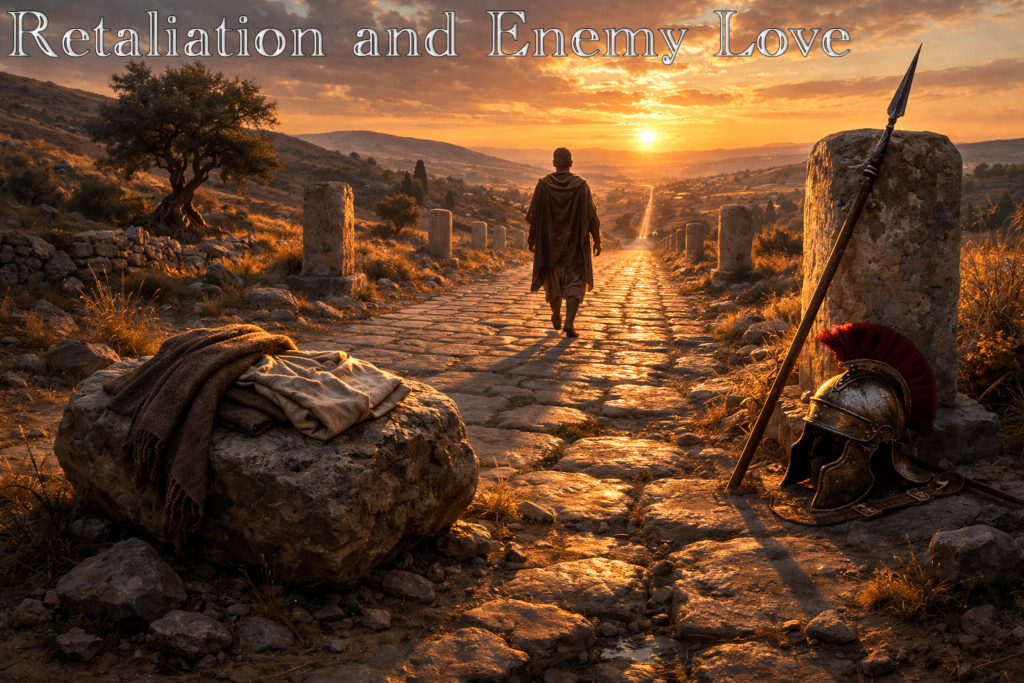
“You have heard that it was said, ‘An eye for an eye and a tooth for a tooth.’ But I say to you, Do not resist the one who is evil. But if anyone slaps you on the right cheek, turn to him the other also. And if anyone would sue you and take your tunic, let him have your cloak as well. And if anyone forces you to go one mile, go with him two miles. Give to the one who begs from you, and do not refuse the one who would borrow from you.”
“You have heard that it was said, ‘You shall love your neighbor and hate your enemy.’ But I say to you, Love your enemies and pray for those who persecute you, so that you may be sons of your Father who is in heaven. For he makes his sun rise on the evil and on the good, and sends rain on the just and on the unjust. For if you love those who love you, what reward do you have? Do not even the tax collectors do the same? And if you greet only your brothers, what more are you doing than others? Do not even the Gentiles do the same? You therefore must be perfect, as your heavenly Father is perfect.”
(Matthew 5:38–48)
When I was a child, I thought as a child. The teachings of Jesus on retaliation and enemy love rang to me as a coward’s enterprise. Turn the other cheek? Love the evildoer? Give him your cloak as well? I’m going to fight—and I’m no one’s mule. It wasn’t until much later, studying these words through historical and midrashic context, that I understood why they made no sense: they had never been properly explained. Stripped of the world that produced them, they looked like surrender. They are anything but.
The World Behind the Words
This is first-century Judaea. Rome occupies the land, controls the courts, commands the roads, and extracts what it requires from a people who have no legal standing to refuse. Hellenistic cultural pressure has been building since the Maccabean revolt—the slow erosion of Jewish identity through assimilation, Greek language, Roman custom, the steady replacement of one world with another. The audience Jesus addresses on that hillside are not students of philosophy with the luxury of abstract reflection. They are a subjugated people. They know what it costs to be powerless in the presence of power.
It is into this world—not into a comfortable sanctuary—that these words are spoken.
What Lex Talionis Actually Was
The first antithesis cites one of the most misread legal principles in all of Torah: ayin tachat ayin—an eye for an eye. The common reading hears primitive vengeance, a bloodthirsty ancient code that Jesus mercifully softens. This gets it almost exactly backwards.
Lex talionis was actually a constraint on power, not a license for it. Before proportional law established limits, retaliation was governed by strength: the powerful could take whatever they wished in return for injury—life for an eye, clan destruction for personal offense, catastrophic excess justified as appropriate response. The principle imposed a ceiling. No more than equivalent harm. No escalation beyond the original injury. It was, in its moment, a civilizational achievement.
Jewish legal tradition developed this considerably further. The rabbinic consensus, codified by Maimonides in the Mishneh Torah and argued extensively in Bava Kamma 83b-84a, held that ayin tachat ayin referred to monetary compensation—injury, pain, medical costs, lost work, humiliation—never to literal physical retaliation. Rashi, reading the plain sense of the text, affirms this in his comments on Exodus 21:24: the Torah was never understood to demand a literal eye. The rabbis had already moved beyond crude reciprocity toward something more measured, more just, more humane.
Jesus is not correcting a barbaric Torah. He is entering an ongoing rabbinic conversation—and pushing it further than it had gone.
The Pharisees, as established earlier in this series, were not villains. They were Torah’s guardians in an impossible time, building fences around what was precious to protect it from erasure. That work was responsible, necessary, and legitimate. But fence-building was their task—not his. Jesus bore no institutional responsibility for the preservation of the tradition. That freedom gave him the room to go somewhere the Pharisees could not: straight to the root, and then further than anyone had gone.
Changing the Terms of Resistance
Here is where the teaching has been most consistently misread—and where recovering the historical context changes everything.
The Greek word rendered “resist” in “do not resist the evil one” is antistenai—a military term meaning to meet force with counter-force, to oppose on the same terms, to mirror the aggressor’s move. Walter Wink, in Engaging the Powers, identified what Jesus is actually prohibiting: not resistance itself, but a specific kind of resistance—the kind that accepts the oppressor’s framing, fights on his ground, by his rules, in his register. What Wink called the “third way” is neither violent retaliation nor passive submission. It is a creative refusal to play the assigned role—resistance that operates on entirely different terms and thereby strips the oppressor of the power he thought he held.
The three examples are not illustrations of endurance. They are demonstrations of strategy.
The slap on the right cheek: a right-handed blow to the right cheek is a backhand—the gesture of a superior toward an inferior, master to slave, Roman to provincial. It communicates not injury but contempt: you do not matter. Turning the left cheek refuses that communication. The striker cannot backhand the left cheek—he must now use a fist, the blow between equals, or he must stop. The one struck has seized control of the encounter. He has demanded, without a word, to be met as a human being.
The cloak and tunic: most of those listening owned little more than what they wore. To be sued for your tunic was dispossession. But Exodus 22:26-27 forbids taking a poor man’s cloak as pledge—it is his only covering against the cold. Offering the cloak as well, standing naked in the courtroom, turns the system against itself. In ancient Jewish and Mediterranean culture, the shame of nakedness falls not on the naked but on those who caused it. The creditor is exposed—literally—by his own action.
The forced mile: Roman law permitted soldiers to compel provincial subjects to carry equipment for one mile, precisely defined, with military discipline awaiting any soldier who exceeded it. Volunteering a second mile steps entirely outside the transaction. The subject who was compelled has become the person who chose. The soldier, suddenly uncertain of the legal and social ground beneath him, has lost control of an encounter he thought he owned.
Each example is an act of agency. Each one takes the initiative from the hand that thought it held it. This is not the coward’s enterprise I heard about as a child. It is among the most sophisticated resistance frameworks ever articulated—and it flows directly from the Jewish tradition that formed the man who spoke it.
The Theological Foundation
The second antithesis carries the why beneath the what.
Jesus cites: “You shall love your neighbor and hate your enemy.” Careful readers will note this is not a direct Torah quotation. Leviticus 19:18 commands love of neighbor—the second half is a folk inference, a reading of what the command implied by contrast. It had institutional expression in some circles: the Dead Sea Scrolls instruct members to love the sons of light and hate the sons of darkness (Community Rule, 1QS 1:9-10). The attitude was live, practiced, religiously sanctioned in certain communities. Jesus doesn’t argue with it. He replaces the premise entirely.
Love your enemies, so that you may be children of your Father in heaven. For he makes his sun rise on the evil and on the good, and sends rain on the just and on the unjust.
The rain does not fall selectively. The sun does not consult a moral ledger before rising. Divine generosity flows from the nature of the One from whom it flows—not as indifference to justice, but as the overflow of a love that cannot be contained by human judgment. To love enemies is not to pretend injury did not occur. It is to act from the divine image in which you were made—from Chesed, the boundless loving-kindness that is not a response to merit but an expression of source.
The inner posture has always mattered. The rabbis knew it. In Megillah 10b and Sanhedrin 39b, when the angels begin to sing as the Egyptians drown in the Sea of Reeds, G-d rebukes them: “My creatures are drowning and you want to sing songs?” Israel’s song was permitted—they were the ones delivered. But delight in destruction, even of the wicked, is spiritually dangerous ground, and the tradition knew it at the root. In B’Shalach Revisited, I examined exactly this inner posture toward the enemy—the spiritual corruption that takes root when relief at deliverance slides into satisfaction at suffering. It is, as that piece argued and the rabbis understood, the seed of hatred dressed in the garments of righteousness.
Augustine, in The City of G-d (Book XIX), draws the necessary distinction: one may act, one may resist, one may use force when circumstances require it—but the inner posture toward the person is a different register entirely. What Jesus commands is not the suppression of action but the orientation of the soul. Aquinas sharpens the point in the Summa Theologica (II-II, Q.25, Art.8): benevolentia—willing the good of the other—operates at the level of will, not feeling. It can be commanded precisely because it is not sentiment. You do not have to feel warmly toward the one who struck you. You have to refuse to desire their destruction.
Teleios—translated “perfect” in most English versions—does not mean without flaw. It means complete, whole, arrived at the intended end. The parallel is Leviticus 19:2: “You shall be holy, as I the L-RD your G-d am holy.” You shall be complete in the way your Father is complete. Not flawless in every particular—but whole in this: that you act from your nature as one made in the divine image, rather than from the logic that makes you a mirror of whoever last harmed you.
What Was Lost—and What Is Recovered
When this teaching is stripped of its context and handed to a child as a counsel of passivity, what is lost is not merely historical color. What is lost is the entire point.
A teaching that looks like surrender produces one of two responses: people who cannot function in the real world, or people who privately ignore it and feel guilty for doing so. Neither is discipleship. Neither is what Jesus intended. Neither is even close.
When the context is restored—the occupied land, the subjugated audience, the rabbinic conversation already in motion, antistenai recovered as the military term it is—what emerges is something else entirely: a framework for maintaining moral agency and human dignity under conditions specifically designed to strip both, a strategy for seizing initiative from the hand that thinks it holds it, a theological grounding in the nature of G-d that transforms resistance from reaction into expression of source.
Jesus is doing here what this series has traced him doing from the beginning: going to the root of Torah, past the fences the Pharisees built—necessarily, legitimately, at great cost—to the animating principle the law was always trying to express. And then taking it further than anyone had gone. Not loosening. Not adding. Revealing.
The coward’s enterprise turns out to be one of the most demanding things ever asked of a human being: to refuse to let your enemy determine who you are. To act from Chesed when every instinct says mirror. To remain, in the face of the boot on the neck, the author of your own next move.
That is not surrender. That is the Kingdom of Heaven—Da’at—revealed here, now. Practice it and it transforms everything.

Discover more from Many Lamps, One Flame
Subscribe to get the latest posts sent to your email.