
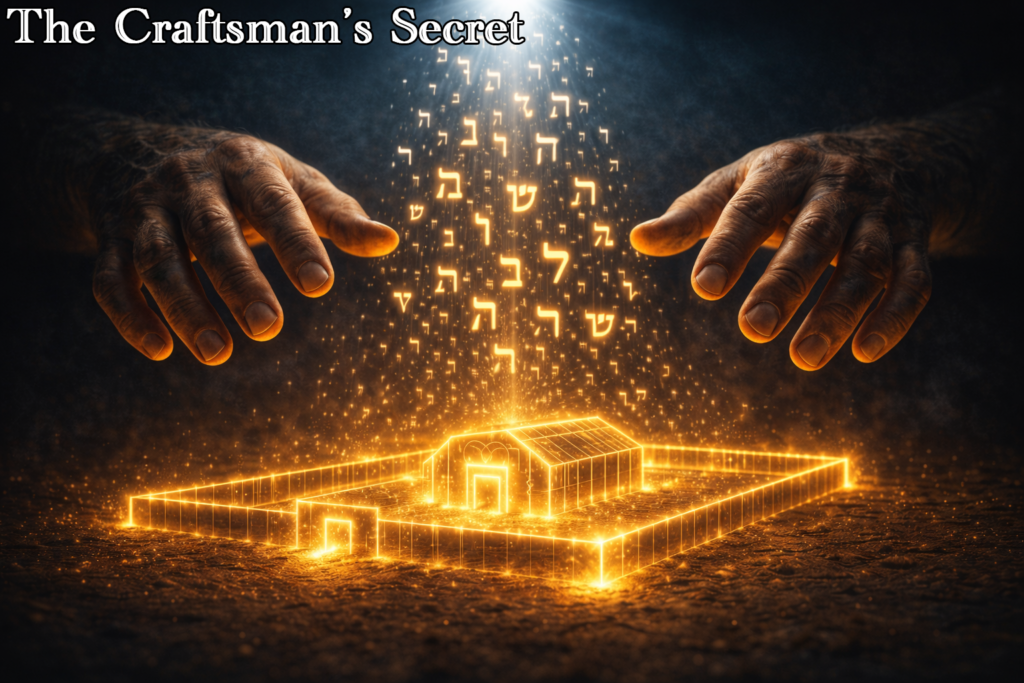
Parashat Vayakhel opens with an assembly. Moses gathers—va-yakhel—the entire community of Israel. Before a single board is cut or a thread spun, Moses does two things. He reaffirms the command to observe Shabbat—even the holy work of building G‑d’s dwelling must stop for it—and then he invites the people to bring the materials from which the Mishkan will be made.
What follows is remarkable. The people respond with nediv lev—a willing heart. They bring gold, silver, fine linen, acacia wood, spices, oil. They bring so much that Moses eventually has to tell them to stop. The craftsmen are named. Bezalel son of Uri is appointed, and the work begins.
On the surface, this looks like a construction report. Lumber, textiles, metalwork. Skilled hands gathering to build a sanctuary. But the Mishkan is not manufactured. It is made. And that distinction—which the text quietly insists upon throughout—opens into something far deeper than carpentry.
What does it mean to make something, rather than merely to produce it?
Made, Not Manufactured
We live in a world of manufactured things. The assembly line is not merely an economic arrangement; it is a philosophical one. Mass production is built on a single foundational premise: the interior state of the maker is irrelevant to the product. What matters is output, efficiency, interchangeable parts. The person behind the machine is incidental. Nothing of them passes into what they make. The object carries no trace of their attention, their intention, their humanity.
Nearly everything we own was produced by someone we will never know, in a process designed to make that unknowability irrelevant. There is no soul in the supply chain.
Craft—in the deepest sense—is different. Not merely skilled labor, not simply superior technique. In a truly made object, the maker is present in the making. There is attention, care, the particular pressure of a specific human hand. What is made carries something of who made it, and of how they approached the work. The sofer who scribes a Torah scroll does not simply copy text. He immerses in the mikveh before beginning, holds specific Kavanah—intention—for every divine name. He is forbidden to write any divine name without renewed Kavanah for each one. The scroll that emerges is inseparable from the interior condition from which it was written. It is not produced. It is made.
But even this does not fully account for what Vayakhel demands. Nediv lev—a willing, open heart—is not merely a nice disposition toward the work. It is a structural requirement. The text repeats nediv lev with insistence: every man and woman whose heart moved them, whose spirit was willing, whose heart was stirred. (Exodus 35:21-29) The word nediv carries connotations of generosity, of nobility, of free movement toward something rather than compliance with a demand.
Just as the covenant at Sinai could not be entered from a place of coercion—genuine covenant requires genuine assent—the Mishkan cannot be built from obligation. This is not incidental. It is the first principle. Before any specification is given, before Bezalel is named, before the first measurement is taken, the text establishes the condition: the dwelling G‑d can inhabit cannot be manufactured. It must be made. And it can only be made from an open heart.
The materials given freely are the outer form of an interior condition: a heart cleared of blockage, genuinely offering itself to the work.
Creation Re-Enacted
Why does this matter so much? Because the Zohar reveals what is actually being built.
In Parashat Terumah, we explored how the Mishkan functions as the interior dwelling of the human heart—the Ark at center containing the covenant, the Table and Menorah in the Holy Place, the Parochet marking the threshold between the holy and the holy of holies. In Parashat Tetzaveh, we examined what it means to serve within that dwelling—proper garments, the eternal flame, the daily rhythm of maintenance and renewal.
But the Zohar opens a deeper register. It teaches that the Mishkan was “formed and constructed being in the image of the world above and in the image of the world below” (Zohar II, 127a, Terumah). The Dwelling is not merely a place of worship. It is a cosmic mirror—a physical structure that replicates the architecture of creation itself. When Israel builds the Mishkan, they are not simply constructing a sanctuary. They are re-enacting creation.
The Zohar maps the act of creation onto the structure of the Dwelling (Zohar II, 127b, Terumah). Each of the six days of creation finds its corresponding image within the Mishkan. The world below mirrors the pattern above. The building of the Mishkan is Israel’s participation in the ongoing act of divine formation.
The correspondences are specific. Consider the menorah. Seven branches—the central shaft flanked by three on each side, all branches curving inward toward the center (Menachot 28b; Maimonides, Mishneh Torah, The Chosen Temple 3:1). This is not incidental design. The central shaft corresponds to Tiferet—the harmonizing center of the sefirotic tree, the sefirah of beauty and integrated balance. The six surrounding branches correspond to the sefirot that flank it: Chesed, Gevurah, Netzach, Hod, Yesod, and Malchut.
Notice what the branches do not do. They do not reach outward into the world. They curve inward, toward the central shaft, toward the source of light. The sefirotic map embedded in the menorah’s form is a map of orientation: all the divine attributes—kindness and strength, endurance and splendor, foundation and presence—find their center, their integration, their light in Tiferet. The menorah does not illuminate by radiating outward from multiple independent sources. It illuminates because everything flows toward and from a single center.
The Ark at the center of the Holy of Holies corresponds to Tiferet — the harmonizing heart of the divine structure, the sefirah of beauty and covenantal integration. The cherubim above the Ark, facing one another, enact the dynamic between Chesed and Gevurah held in tension. The Zohar notes that when the cherubim face one another, compassion flows; when turned away, judgment prevails (Bava Batra 99a; Zohar II, 152b, Terumah). The Parochet—the veil—marks the boundary between Tiferet and Keter, the threshold between human reach and divine depth: permeable to the prepared, impenetrable to the presumptuous.
Israel is not building a tent. They are rebuilding, in wood and gold and linen, the structure by which G‑d brought the world into being. As above. So below.
And now, so within.
Bezalel and the Letters
Which brings us to Bezalel.
The Zohar is explicit: “In the Dwelling, letters were engraved and formed fittingly. Bezalel knew how to combine the letters by which heaven and earth were created, and upon this wisdom the Dwelling was built by him” (Zohar II, 152a, Terumah).
This is not metaphor. In Jewish mystical tradition, rooted in Sefer Yetzirah, the Hebrew letters are not merely symbols for sounds. They are the instruments of creation itself—the twenty-two letters through which the Holy One formed all that exists. G‑d did not create with tools or raw materials. G‑d spoke, and what was spoken came into being. The letters are the mechanism of that speech. The Greek tradition would later call this the Logos—the divine word as the principle of creation. But the concept originates here, in Torah, in the Hebrew understanding of divine speech as the generative act from which all existence proceeds.
The Talmud preserves the same teaching from a different angle. Rabbi Yochanan asks: why is Bezalel called by that name? Because be-tsel El—he worked in the shadow of G‑d (Berakhot 55a). He was not merely skilled. He was positioned—in a specific relationship to the divine source, beneath that particular light, within that particular shadow. And the Talmud continues: Bezalel knew how to combine the letters by which heaven and earth were created. His craft was not carpentry. It was the same act of naming and forming by which the world itself came into being.
The text confirms this by specifying his qualifications. Moses tells Israel that G‑d has filled Bezalel with ruach Elohim—the divine spirit—and with Chokhmah, Binah, v’Da’at: wisdom, understanding, and knowledge. These are not merely intellectual qualities. They are the upper triad of the sefirotic tree—the three highest sefirot below Keter. Chokhmah: the flash of divine insight, the primordial point before form. Binah: the womb of understanding that receives that flash and gives it shape, the deep intelligence that processes and structures. Da’at: integrated knowing, the sefirah that bridges above and below, that transmits divine flow into lived reality.
Bezalel does not generate this capacity from himself. He receives it. He is filled—the text’s word is significant—with ruach Elohim. The divine spirit moves through him. His craft is possible because he has become a vessel: cleared, prepared, aligned. The upper triad flows through him downward into the work of his hands.
Bezalel re-enacts creation not because he is uniquely talented, but because he is uniquely open. He works in the shadow of G‑d because he has cleared enough interior space to stand there.
The Open Heart
Now the three strands converge.
The Mishkan is a cosmic mirror—the architecture of creation reproduced in physical form, each element corresponding to the divine structure by which the world came into being and is sustained. Israel is not constructing a building. They are re-enacting creation, aligning the lower world with the upper, weaving the pattern of divine reality into the fabric of human life.
Bezalel makes this possible because he channels the upper triad—Chokhmah, Binah, Da’at—downward through the sefirotic tree into manifest form. The divine creative power, which spoke the world into existence through the combination of letters, flows through him into wood and gold and linen. He does not bring G‑d’s creative act to bear on the materials. He acts as a carrier. He has cleared sufficient interior space to become the instrument through which it moves.
But none of this—not the cosmic correspondence, not Bezalel’s channeling of the divine, not the re-enactment of creation—is possible without the first condition the portion establishes. Nediv lev. The willing heart.
The people whose hearts were not open did not bring materials. The Mishkan was built from what was freely given, and nothing compelled could have touched it. The outer Mishkan, constructed from freely offered gold and linen, mirrors precisely the condition required for the inner one: a heart that has cleared its blockages, that has opened itself to the divine flow rather than obstructing it.
The Mishkan of the heart—the interior dwelling we explored in Terumah, the sacred space we learned to serve within in Tetzaveh—cannot be constructed under compulsion. It cannot be manufactured. It requires the same condition as the outer one: nediv lev. A heart moved freely toward the holy. Blockages cleared. The interior space genuinely offered.
When the heart is open in this way, the Shekhinah descends. Not because the structure is technically correct, but because the vessel has been genuinely prepared to receive her. Bezalel channeled Chokhmah, Binah, Da’at because he was open to the flow. The people’s willing hearts made the outer Mishkan possible in the same way. And the inner Mishkan—the dwelling G‑d builds within the human person—is possible in exactly the same way.
V’shachanti b’tocham—I will dwell among them. Not among the boards and curtains. Among the people whose hearts made the boards and curtains possible. Among those who cleared the way and offered freely what they had to give.
The divine presence does not force entry. It does not manufacture its dwelling from the outside. It waits—and it dwells where it is genuinely welcomed, in hearts that have opened themselves to receive what they cannot produce on their own.
The sages make the same point in a striking way. In Shemot Rabbah 33:3, God tells Israel that the offering for the Mishkan is not asked according to divine capacity but according to theirs; the dwelling arises only from what the heart freely gives.
This is what becomes possible when nediv lev is not merely a description of what the Israelites did in the wilderness, but a description of what we do now—in this moment, in this life, in the interior space we are either clearing or cluttering. The Mishkan was built once. The interior dwelling is built continuously, from the same material: a heart freely given.
As above.
So below.
So within.

Discover more from Many Lamps, One Flame
Subscribe to get the latest posts sent to your email.