
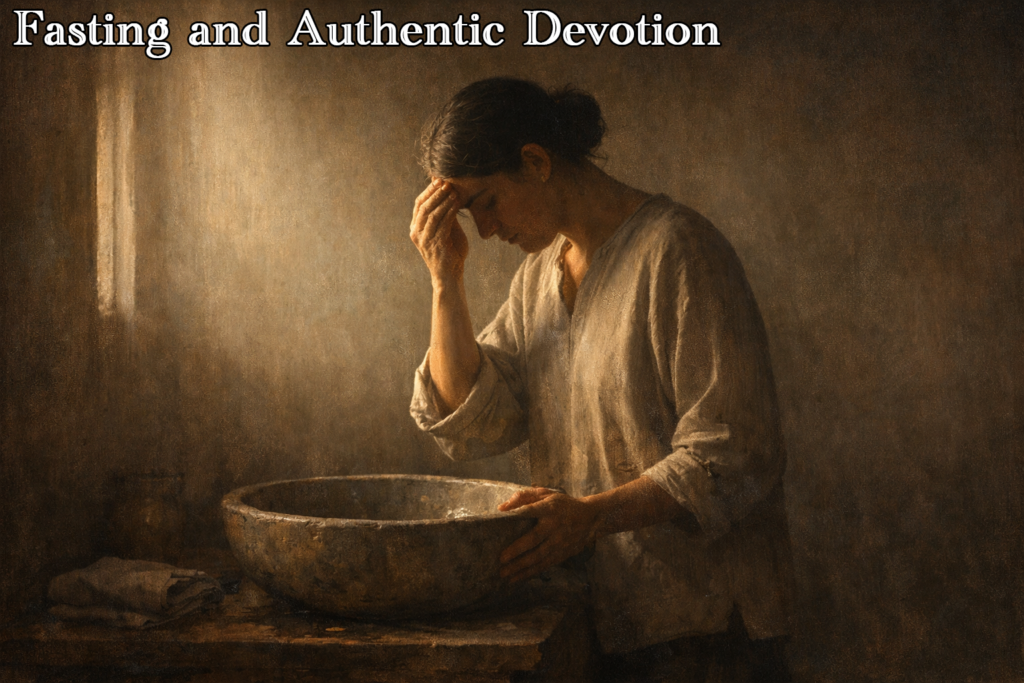
“Moreover, when you fast, do not be like the hypocrites, with a sad countenance. For they disfigure their faces that they may appear to men to be fasting. Assuredly, I say to you, they have their reward. But you, when you fast, anoint your head and wash your face, so that you do not appear to men to be fasting, but to your Father who is in the secret place; and your Father who sees in secret will reward you openly.”
Matthew 6:16–18
By the time Jesus reaches these three verses, he has already said the essential thing twice. In Matthew 6:1–4, tzedakah done for human approval earns human approval—and nothing else. In Matthew 6:5–15, tefillahoffered as performance receives performance’s reward. Now ta’anit. The teaching is identical. The Greek word is the same: apechousin—receipt given, account settled, transaction closed.
This is not repetition for emphasis. It is the completion of a triptych. Tzedakah, tefillah, ta’anit—the three central disciplines of Second Temple Jewish piety—each examined under the same lens, each found capable of the same corruption. Jesus is not attacking the practices. He is identifying the single mechanism that hollows them all out: the substitution of human audience for divine relationship.
But to understand what is being corrupted, you have to understand what fasting was actually for.
What the Fast Was Doing
Fasting in Second Temple Judaism was not principally an act of self-denial. It was an act of reorientation.
The tractate Ta’anit—the Talmud’s extended treatment of communal fasts—frames public fasting primarily as the community’s response to crisis: drought, plague, the threat of disaster. It provides the when and how. The Sages add further structure for the most important fasts—prohibitions against wearing shoes, engaging in conjugal relations, anointing and bathing. But underneath the communal structure is a theology. When the community fasts together, it signals that ordinary life has been suspended, that the body’s usual preoccupations have been set aside, and that the entire attention of the people has been redirected toward G-d. The fast does not earn divine favor. It creates the conditions for genuine encounter—the rupture in routine that makes the still, small voice audible.
Individual fasting carried the same logic inward. The body’s insistence on being fed cannot be ignored. A fast day cannot be drifted through. The hunger is a constant interruption, redirecting attention again and again to the fact that something has been surrendered, something offered. That interruption is not an inconvenience to be endured. It is the point.
The Midrashic tradition connects fasting directly to teshuvah—not as punishment but as the mechanism of return. Ordinary life accumulates its layers of distraction, self-justification, and misdirected appetite. The fast strips those layers away. What remains, when the body’s noise has been quieted, is what was always there: the soul standing before G-d, without the usual insulation.
Aquinas, working from within the Christian tradition that received this understanding, names the same structure in Summa Theologica II-II, Q. 147: fasting serves a threefold purpose—to bridle the lusts of the flesh, to raise the mind freely to the contemplation of heavenly things, and to make satisfaction for sins. His second purpose carries the theology: the mind rises freely when the body’s preoccupations are stilled. Not earned elevation. Freed elevation. The fast clears the channel.
Augustine, whom Aquinas quotes directly in that same article, renders the interior logic with compressed precision:
“Fasting cleanses the soul, raises the mind, subjects one’s flesh to the spirit, renders the heart contrite and humble, scatters the clouds of concupiscence, quenches the fire of lust, kindles the true light of chastity.”
The sequence matters. Cleansing precedes raising. The vessel must first be emptied before it can be filled. Aquinas and Augustine, arriving centuries after the rabbis, are articulating the same movement: the fast does not generate encounter with G-d. It removes what was preventing it.
The Body as Altar
The Talmud goes further than any of them.
In Berakhot 17a, Rav Sheshet recites a prayer after a fast day that illuminates the entire Jewish theology of the practice:
“Master of the Universe, it is revealed before You that when the Temple was standing, one who sinned would bring a sacrifice—and only his fat and his blood were offered from it, and he would be atoned. And now I have sat in a fast, and my fat and my blood have been diminished. May it be Your will that my fat and my blood which have been diminished be as if I had offered them before You upon the altar, and may You be appeased with me.”
This is not metaphor. It is substitution theology, rendered with precision. In the absence of the Temple, the fasting body becomes the altar. What is consumed by the fast—the body’s own fat and blood—is offered in place of the animal sacrifice. The person does not bring a korban. The person is the korban.
The word korban itself—from the root karov, to draw near—tells you what a sacrifice was always for. Not appeasement. Not transaction. Drawing near. Closing the distance between the human and the divine through the deliberate surrender of something held.
Rav Sheshet’s prayer makes explicit what the tradition understood implicitly: the fast is an interior sacrifice, offered in the secret place of the body itself, visible to no one but G-d.
Now consider what performing a fast publicly accomplishes. You have brought your korban to the street corner. You have turned the altar inside out, made the sacrifice a spectacle, and directed its offering—not upward, but outward, toward the audience that will recognize your suffering and reward you with their admiration.
The apechousin applies with full force: you chose which economy to operate in. You were paid in full. The interior sacrifice—the actual drawing-near—was never made.
Instrument, Not End
Catherine of Siena, in The Dialogue (trans. Suzanne Noffke, Paulist Press, 1980), pushes into the same territory from a different angle. Writing in the voice of G-d speaking to her soul, she draws a precise distinction between those who have made bodily mortification their foundation and those who have understood it rightly:
“They have used mortification as the instrument it is to help them slay their self-will.”
And when the instrument becomes the end—when penance is the foundation rather than the means—she is equally precise about what follows: the soul ends up offering “mere finite works” to an infinite G-d. The external act has crowded out the interior transformation it was meant to serve.
This is the failure Jesus is diagnosing in Matthew 6:16–18, though he names it differently. The performed fast has failed on both counts simultaneously. It is aimed at the wrong audience—human approval rather than divine relationship. And it has elevated the finite act above the infinite desire that act was meant to kindle. The sad countenance, the disfigured face, the public display: these are not just performances. They are the signs of a practice that has been mistaken for its own purpose.
Augustine understood this precisely. His warning, preserved in Aquinas’s treatment of fasting, cuts to the same point: in vain is the flesh restrained if the mind is allowed to drift to inordinate movements. The body stilled, the attention wandering toward its audience—that is not a fast. That is a street performance.
Anointed and Aligned
What makes this passage distinct from its companions in the triptych is the counter-instruction. Jesus does not simply say: do not perform. He says: do the opposite of performing.
“Anoint your head and wash your face.”
In the ancient world, anointing and washing were associated with celebration and ordinary life, not mourning and deprivation. This instruction is almost subversive: while fasting, look normal. Conceal the fast so completely that even your outward appearance contradicts it. The practice becomes fully interior—invisible to community, invisible to passersby, invisible even to those who know you well.
But there is something deeper in the anointing image. To anoint is to consecrate—to mark something as set apart for sacred purpose. The priest was anointed. The king was anointed. The altar itself was anointed. When Jesus says to anoint your head while fasting, he is not simply advising discretion. He is pointing toward what the fast is: an act of consecration. The person who fasts in secret is consecrating themselves—aligning body, appetite, and will toward G-d alone, without the distorting interference of human regard.
This is alignment in its most precise form. The vessel is not merely emptied. It is turned. Cleaned and oriented toward the source from which shefa—the divine outpouring—flows. As explored at length in The Empty Reed, the reed hollowed and held at the wrong angle produces no music. The fast that empties the body while filling itself with performance has been hollowed and aimed at the wrong source entirely. The anointing is the turning.
The Father who sees in secret does not reward the performance. He rewards the alignment.
The Triptych Complete
Jesus has now examined each of the three great disciplines of Jewish piety—tzedakah, tefillah, ta’anit—and found in each the same fracture line. As examined in Righteousness in Secret and The Lord’s Prayer, the fracture is not in the practice itself. The fracture is in the audience. When the audience is human, the reward is human, and the divine economy is never entered.
What the triptych establishes, taken whole, is that the three disciplines are not three separate practices. They are three expressions of a single orientation. Tzedakah aligns the hand—what you give and to whom and why. Tefillah aligns the voice—what you say and to whom you say it. Ta’anit aligns the body—what you surrender and before whose eyes.
In each case, the question is the same: who are you facing?
The hypocrite—the hupokritēs, the actor—is not a villain. He may be entirely sincere. The performance may have become so habitual that he no longer recognizes it as performance. This is precisely what makes the corruption so dangerous: it does not announce itself. The trumpet sounds, the sad countenance is arranged, the fast is proclaimed—and the person genuinely believes that something has been offered to G-d.
But the receipts tell the truth. Apechousin. Paid in full. Whatever was exchanged, it was exchanged with other human beings. The account with G-d remains untouched—not because G-d refused, but because the person never turned to face that direction.
Reorientation is not a single act. It is the ongoing work of the spiritual life: the repeated turning of attention, appetite, and practice away from human approval and toward the One who sees in secret. The fast, practiced honestly, is one of the oldest instruments for this work—a daily surrender that interrupts the drift, clears the noise, and turns the vessel back toward its source.
The Father who sees in secret will reward you openly.
That word—reward—needs hearing carefully. It is not payment for services rendered. Not the stroking of ego. It is what becomes possible when the performance stops: the soul, emptied and aligned, finally able to receive what was always flowing toward it.
The Father who sees in secret has no interest in the performance. He is waiting for the silence that follows.

Discover more from Many Lamps, One Flame
Subscribe to get the latest posts sent to your email.