
Every so often, someone asks me a question that gives me genuine pause.
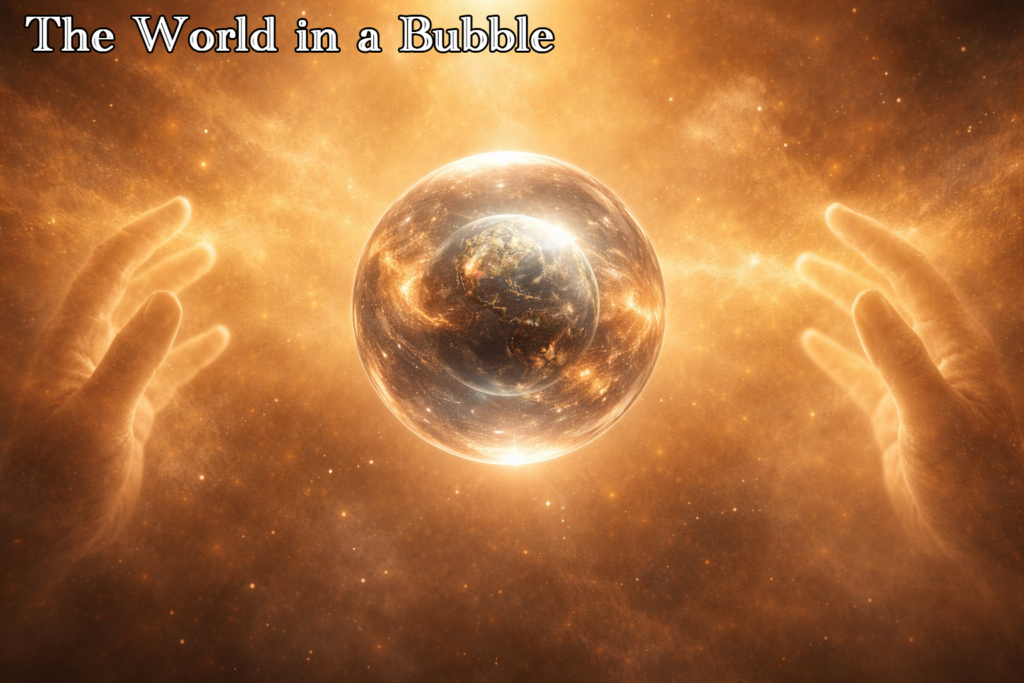
My niece recently asked my thoughts on the concept of the firmament—not the flat-earth notion that has found a second life on social media, but something more considered. She sent along an image: one of those collectible display bubbles, the kind used to house a signed baseball on a shelf. The ball suspended inside. The bubble enclosing it. And the question underneath the image: is existence something like this?
It is not a naive question. It is, in fact, one of the oldest questions in serious theology—asked across centuries, across traditions, across continents, usually in considerably more complicated language. Every tradition covered here was doing precisely what she did: reaching for the nearest tangible metaphor and asking, is it something like this?
That instinct deserves to be taken seriously. So does the question.
The Vocabulary
Before the traditions can speak, three terms need to be in place.
Pantheism holds that the ball and the bubble are all G-d—creation and divinity identical, indistinguishable, one continuous substance without remainder. There is no meaningful distinction between the divine and the world. Everything is G-d; G-d is everything.
Panentheism holds something more precise: the ball is inside the bubble, bubble and all, and G-d exceeds even that. Creation exists within G-d, but G-d is not exhausted by creation. The divine contains the world without being reducible to it. This is a different claim than pantheism, and the difference matters.
But before either framework can be evaluated, a prior question presses in. Can the infinite be defined at all?
Theologians have a word for the discipline of approaching this honestly: apophatic theology. Where most theology proceeds by affirmation—G-d is this, G-d is that—apophatic theology proceeds by negation. It defines the divine not by what it is, but by what it is not. The logic is austere and difficult to argue with: every attribute we assign to G-d immediately limits G-d. Every category we apply is borrowed from finite experience. The infinite, by definition, exceeds every category we impose on it. We can say what G-d is not far more reliably than we can say what G-d is.
This thread runs through everything that follows. Establish it now and hold it.
Genesis 1:6-7 is where the conversation begins in the Western tradition—foundational not to Judaism alone but to all three Abrahamic traditions and to the broader human instinct to describe the boundary between creation and what lies beyond it. The Hebrew word is raqia—the expanse, the firmament. Its root suggests something beaten or hammered out, a stretched boundary between the waters above and the waters below. The ancient writers were already asking the question, in the only language available to them. They drew a boundary. They wondered what lay on the other side of it.
What the Traditions Say
Jewish and Kabbalistic thought
The Kabbalistic concept of tzimtzum is panentheism pressed to its most precise formulation. Ein Sof—the infinite, literally “without end”—fills all. There is no space where G-d is not. For anything other than G-d to exist, the infinite must paradoxically withdraw, contract, make room. But this withdrawal is concealment, not absence. The infinite remains present in the finite, mediated and filtered through successive channels—creation held within G-d without being equivalent to G-d. The ball is inside the bubble. The bubble has not left the ball.
Moses Maimonides functions here as the apophatic anchor. In the Guide for the Perplexed, he is relentless: every positive attribute assigned to G-d is a concession to human limitation, not a description of divine reality. To say G-d is wise is not to describe G-d—it is to admit that wisdom is the closest human concept available, while acknowledging it falls short. Maimonides did not stop praying. He did not instruct anyone else to stop. But he insisted the map is not the territory—and that confusing the two is a form of idolatry more subtle, and more dangerous, than worshipping stone.
Christian mysticism
The mainstream mystical tradition lands firmly in panentheism, though it rarely uses the word. Paul, in Acts 17:28, quotes the Greek poet Aratus: in him we live and move and have our being. The choice is deliberate—Paul draws on a pagan source to make a point that crosses traditions. Creation is not merely adjacent to G-d; it is sustained within G-d. Remove that sustaining presence and creation does not merely suffer; it ceases.
Meister Eckhart, the fourteenth-century Dominican mystic, presses further than institutional theology is comfortable with: “God’s ground is my ground and my ground is God’s ground. Here I live from my own as God lives from His own” (Sermon 13(b), Complete Mystical Works). Not similar. Not analogous. The same. This is mysticism at its most vertigo-inducing—and it places Eckhart squarely in the apophatic tradition, where the closer one approaches the divine, the more language fails and silence becomes the only honest response.
Islamic mysticism—Al-Ghazali
Al-Ghazali’s Mishkat al-Anwar (The Niche of Lights) works through the Quranic light verse—G-d is the light of the heavens and the earth (Quran 24:35)—to build a framework in which only G-d truly is. Everything else borrows its being. Creation is derivative, dependent, held in existence by something that itself requires no holding. This is the apophatic edge at its sharpest: the divine reality is so absolutely transcendent that even existence, as we predicate it of ordinary things, cannot properly be predicated of G-d. G-d does not exist the way a rock exists, or a human being, or even an angel. G-d is the ground from which existence itself is borrowed.
Al-Ghazali also draws the zahir/batin distinction—exoteric and esoteric understanding. The masses need the framework, the scaffolding, the accessible image. The mystic sees through the scaffolding without abandoning it. This is not contempt for ordinary religious practice. It is recognition that the map serves a genuine purpose for those still learning to navigate—and that the map is not the territory even for those who know it best.
Islam’s structural insistence on absolute tawhid—divine unity—creates genuine tension with panentheism. If creation exists within G-d in any meaningful sense, does that compromise the absolute oneness of the divine? Al-Ghazali navigates this carefully. He does not fully resolve it. That unresolved tension is itself theologically honest.
Hindu/Vedanta
Brahman is the most direct parallel the Eastern traditions offer—the infinite, self-existent ground of all reality from which nothing is ultimately separate. The Upanishads approach it through neti neti: not this, not that. Whatever description arises, Brahman exceeds it. This is the Hindu apophatic tradition in its purest form—a systematic dismantling of every conceptual handle the mind reaches for.
In Advaita Vedanta, atman (the individual self) and Brahman (the universal ground) are ultimately identical—a claim that presses toward pantheism. But the tradition resists simple equation. Maya—the veil of appearance—is what makes the ball look separate from the bubble in the first place. The separateness is not illusion in the sense of being unreal; it is a conditioned experience that obscures what is actually the case. The bubble contains the ball. The ball is made of bubble. The bubble exceeds both. Awakening is not the creation of unity but the recognition of a unity that was never absent.
Buddhism
Buddhism refuses the question on its own terms—and that refusal is the answer.
There is no creator G-d in the Buddhist framework. No infinite ground-being. No Brahman, no Ein Sof, no divine sustainer. What Buddhism offers instead is śūnyatā—emptiness—not as void but as the absence of fixed, independent existence. Nothing is self-contained. Nothing arises alone. Everything that exists does so in dependence on conditions, which themselves exist in dependence on conditions, without origin and without bottom.
The image the tradition reaches for is Indra’s Net: an infinite lattice of jewels, a jewel at every node, each jewel reflecting every other jewel in its surface—which are themselves reflecting every other jewel—infinitely. No center. No edge. Only mutual arising. It is not pantheism. It is not panentheism. It is something more vertiginous than either: a universe without a container, held together by nothing but the fact of its own radical interdependence.
The apophatic conclusion is identical to every other tradition considered here. Whatever the ground of existence is, it defeats every attempt to name it directly. Buddhism simply refuses to name it at all—and treats that refusal as the most honest theological position available.
Whitehead and process theology
Alfred North Whitehead gives panentheism its most rigorous modern philosophical form—and in doing so resonates with the Buddhist insight that reality is not substance but event, not static being but dynamic arising. His God has a primordial nature—abstract, eternal, beyond direct predication, genuinely apophatic—and a consequent nature that is responsive to what happens in creation. The world acts. G-d receives, integrates, and returns that action to the ongoing creative process.
The bubble, in Whitehead’s framework, is alive. What the ball does matters to the bubble. This is panentheism with a dynamic dimension that static frameworks miss—not a container that merely holds, but a relationship that genuinely receives.
Spinoza is the instructive foil. His distinction between natura naturans (G-d as active creative ground) and natura naturata (G-d as expressed in creation) gets close—but ultimately collapses the distance between them in ways that shade toward pantheism. When Einstein said he believed in “Spinoza’s G-d”—the G-d revealed in the harmony of all that exists, not a G-d who intervenes in human affairs—he was locating himself precisely at that hinge point, neither fully inside one category nor the other. The hinge is illuminating precisely because it shows where the distinction actually cuts.
For Spinoza, the bubble and what lies beyond it are the same substance. For Whitehead, the bubble is alive to what moves inside it. Neither could tell you what the bubble is made of.
The Map and the Territory
Every tradition covered here arrives, by its own route, at the same uncomfortable conclusion: the ground of existence cannot be named directly. It can only be approached. And yet every tradition also insists—quietly, persistently—on relationship with what cannot be named.
This is not contradiction. It is the human condition pressed against its own limits.
The mind cannot tolerate unstructured infinity. We are finite beings. We think in categories, boundaries, relationships. When we encounter something that defeats all categories, we do not abandon the project—we build scaffolding. Tzimtzum is scaffolding. The sefirot are scaffolding. The light verse is scaffolding. Neti neti is scaffolding. Indra’s Net is scaffolding. Whitehead’s process metaphysics is scaffolding.
The apophatic tradition does not say: stop building maps. It says: hold your map loosely. Know what it is for and what it cannot do.
Maimonides prayed anyway. The Buddha built an Eightfold Path anyway. Al-Ghazali wrote a revival of religious sciences running to forty volumes anyway. Whitehead built a metaphysical system of extraordinary complexity anyway. The scaffolding is necessary—not because it captures the infinite, but because finite beings need somewhere to stand while reaching toward it.
The instinct my niece expressed, reaching for a plastic bubble and asking, is it something like this?—that instinct is not naive. It is the same instinct that built every framework on this list. The theologians simply used more words and took longer to admit they didn’t know either.
The World in a Bubble
The bubble contains the ball. The ball does not contain the bubble. Whatever generates the bubble exceeds every attempt to describe it.
Every tradition that has sat with this long enough says the same thing, in different registers, with different vocabulary, through different disciplines: yes, something like that—and also more than that, and also not quite that, and also beyond that entirely.
She was asking the right question.She just didn’t know how old it was.

Discover more from Many Lamps, One Flame
Subscribe to get the latest posts sent to your email.