
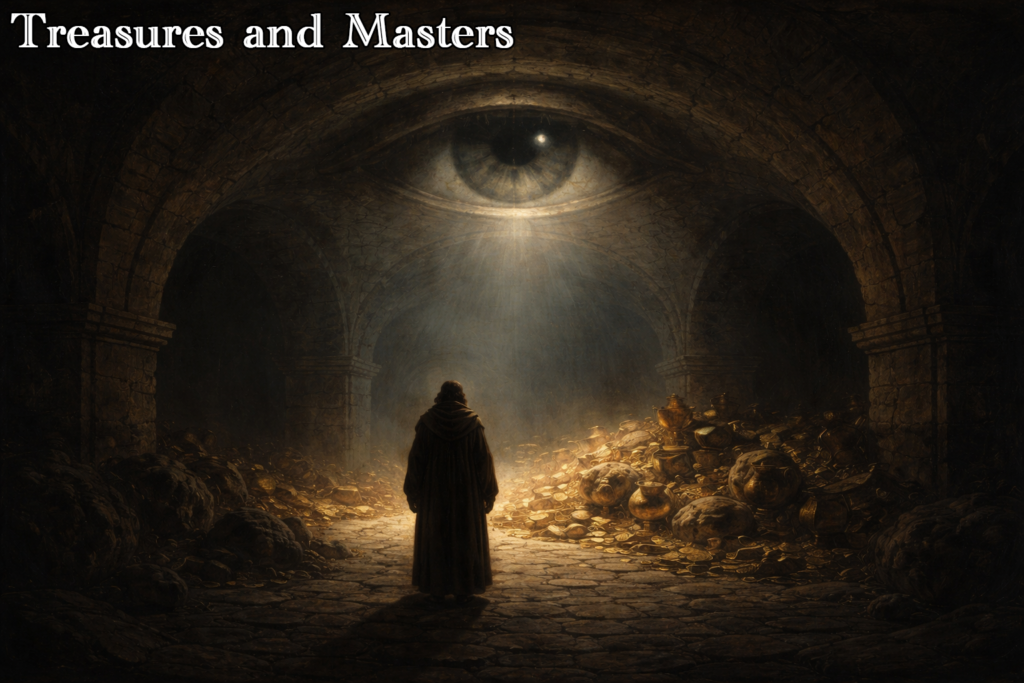
“Do not lay up for yourselves treasures on earth, where moth and rust destroy and where thieves break in and steal; but lay up for yourselves treasures in heaven, where neither moth nor rust destroys and where thieves do not break in and steal. For where your treasure is, there your heart will be also.”
“The lamp of the body is the eye. If therefore your eye is good, your whole body will be full of light. But if your eye is bad, your whole body will be full of darkness. If therefore the light that is in you is darkness, how great is that darkness!”
“No one can serve two masters; for either he will hate the one and love the other, or else he will be loyal to the one and despise the other. You cannot serve G‑d and mammon.”
(Matthew 6:19–24)
The Sermon on the Mount does not meander. Every movement builds on what preceded it, and what precedes Matthew 6:19–24 is a triptych—three teachings, each examining one of the central disciplines of Second Temple Jewish piety, each finding in it the same fracture. In Righteousness in Secret, tzedakah performed for human approval earns human approval—and nothing further. In The Lord’s Prayer, tefillah offered as performance receives performance’s reward. In Fasting and Authentic Devotion, ta’anit worn on the face for public consumption completes the pattern. In each case, the Greek verdict is identical: apechousin ton misthon autōn—receipt given, account settled, transaction closed.
Now, without transition or pause, Jesus turns to ask why. Not why the hypocrite performs—that much is obvious enough. But why a sincere person, one genuinely devoted to the practice, ends up serving the wrong master without ever choosing to. The triptych named the symptoms. These three sayings are the diagnosis.
They are not three independent teachings loosely grouped by theme. They are a single argument, and the argument has a hinge. Miss the hinge and the whole thing collapses into a morality lecture about money. Find it, and you find the mechanism Jesus is actually exposing.
What the Treasure Is
The reduction to money is the first mistake.
The Greek thēsauros—treasure, storehouse—points toward whatever is most valued, most protected, most worth accumulating. The Hebrew resonance beneath it is otzar (אוצר), with the same sense: the storehouse holds what the heart has designated as essential. And in the Jewish anthropological tradition, the lev—the heart—is not primarily the seat of emotion. It is the seat of will. The deciding center of the person. Where your treasure is, there your lev will be: whatever you have made most worth protecting now holds your will.
That can be money. But watch how quickly the category expands.
Comfort is a treasure—the slow, reasonable arrangement of life to minimize friction, difficulty, and demand. Control is a treasure—the illusion of having secured the future against uncertainty, of having made oneself immune to what cannot be governed. Recognition is a treasure—the hunger to be seen, acknowledged, thought well of, credited for what one has done. Fame is a treasure. Security is a treasure. Ease is a treasure.
And then there is the most dangerous treasure of all, because it wears the face of light most convincingly: righteousness as a possession. Religious standing. Accumulated merit. The carefully maintained image of the devout self—the one who gives, who prays, who fasts, who knows the texts, who is recognized by others as serious about G‑d.
This is the treasure the Pharisees are laying up. Not gold. They are not greedy men. Many of them are genuinely devoted. Their treasure is the constructed self—the interior narrative of their own virtue, the standing they have earned in the eyes of their community and, they believe, in the eyes of G‑d. And that narrative, that standing, is what is now directing the tzedakah, shaping the tefillah, arranging the face for the ta’anit. Every practice has been quietly, thoroughly redirected toward its maintenance.
Every treasure named above serves the same thing. Watch what this looks like in practice: the small interior check when someone of standing is watching; the mental narration of one’s own virtue as it is performed; the subtle adjustment of behavior when recognition is within reach. You recognize it. These are not dramatic failures. They are the ordinary texture of a life organized around the wrong center. Different currencies, spent in the same economy—the economy of the constructed self that requires perpetual feeding, perpetual confirmation, perpetual protection.
The ego does not reject religious practice. It repurposes it—for its own maintenance. It does not announce itself as an idol. It presents itself as prudence, as responsibility, as faithfulness. It is the master that cannot be named because it wears your own face.
The Lamp That Lies
Between the treasure saying and the mammon saying sits the passage most readers move through quickly to reach the more quotable material on either side. This is a mistake. The eye saying is not a transition. It is the hinge on which the entire argument turns.
“The lamp of the body is the eye. If therefore your eye is good, your whole body will be full of light. But if your eye is bad, your whole body will be full of darkness. If therefore the light that is in you is darkness, how great is that darkness.”
The Jewish idiom underneath this is real and worth noting. Ayin tovah (עין טובה)—good eye—and ayin ra’ah (עין רעה)—evil eye—appear throughout the Mishnah and Talmud, including Pirkei Avot 2:9 and 2:11, as idioms for generosity and stinginess of spirit. The good eye looks at the world with an open, giving orientation. The evil eye grasps and hoards. But this reading, while accurate, is too thin for what Jesus is actually saying.
The weight of the saying falls not on bad eye but on the final clause: if the light that is in you is darkness, how great is that darkness. This is a different and more disturbing claim. The person being described is not someone who knows they are in the dark. They are someone who believes they are seeing clearly. Their eye is—from their own vantage point—functioning perfectly. They are making rational, even virtuous-seeming choices. The light in them tells them they are doing it right.
The instrument of moral perception has been compromised—and it cannot detect its own compromise. And from that point forward, everything it reports will confirm the error. The person who has organized their inner life around the wrong treasure does not experience this as corruption. They experience it as clarity.
Augustine understood this with precision. In De Trinitate, he returns repeatedly to the soul’s capacity to love—it cannot help but love—but to direct that love toward things that cannot bear the weight of what is being asked of them. Each lesser good presents itself as sufficient. Wealth, security, recognition, righteousness-as-possession—none of these are evil in themselves. They become corrupting when the soul treats them as ultimate. And the soul doing this does not experience it as idolatry. It experiences it as wisdom. Each step feels like solid ground.
John of the Cross names this same territory from within the Christian mystical tradition. The noche oscura—the dark night of the soul—is not simply suffering. It is the stripping away of precisely these false lights: the consolations, the certainties, the self-constructed illuminations that the soul had mistaken for G‑d. The dark night is partly the terrible discovery that what felt like light was not light at all. What felt like proximity to the Divine was proximity to the self’s own reflection.
Catherine of Siena, in The Dialogue, adds a precise turn: where Augustine tracks misdirected love, Catherine identifies what makes the misdirection invisible. Self-knowledge—genuine reckoning with what the self actually is—is the necessary precondition of knowledge of G‑d. Without it, the eye examining its own virtue sees only the reflection it was already prepared to find.
Francis of Assisi requires no text to make the point. The deliberate dismantling of his father’s wealth, his reputation, his standing—the stripping away of every treasure, including the most respectable ones—was not theater. It was the recognition that all of them had been functioning as false lights. The rebuilding began only after the lamps that were lying had been extinguished.
The True Mammon
The sequence is now complete in miniature. A treasure is designated. The eye recalibrates around it. And what the eye now calls light—what it experiences as wisdom, as faithful living, as righteous standing—is the master being served. The master is installed without announcement. Jesus names it.
The Aramaic mamona is not simply money. It carries the weight of that in which you place your final confidence—the load-bearing wall of your life, the thing whose removal would bring everything down. The word carries a theological charge: trust, security, the place where the soul comes to rest.
Aquinas, in Summa Theologica II-II, Q.118, analyzes avarice as a disorder not of possession but of the will. The problem is not having; it is what the having has become. The miser does not love money because money is lovable. The miser loves money because money has been made into the object of trust, security, and rest that only G‑d can provide. It is a substitution—a functional replacement of the infinite with the finite, dressed as prudence.
But money is only the most obvious form. Walk back through the treasures: comfort, control, recognition, fame, and the constructed self-image of the devout. Each one, when it becomes the load-bearing wall, becomes mammon. Each one has been made to carry what it cannot hold. Each one promises the rest the soul is seeking and delivers something that requires constant maintenance instead.
And here the Kabbalistic structure becomes unavoidable. Shefa—the outward divine flow, the emanation that moves through the sefirot and into the world—requires vessels oriented outward and downward, toward giving, toward receiving in right relationship. The ego, by its nature, contracts. It redirects flow back toward itself. It does not transmit—it absorbs. It is, in the language of the tradition, the ultimate klipah—the husk, the shell, the thing that blocks the light rather than transmitting it.
As established in Righteousness in Secret: when the emissary becomes the destination, the circuit breaks. The shefa moving outward—from Ein Sof, through the sefirot, through the human agent—terminates in the self. The applause absorbs what was meant to flow through. The trumpet doesn’t merely corrupt the act. It breaks the channel.
Two masters are not simply incompatible in the way that two employers make competing demands on your schedule. They require opposite orientations of the self. G‑d asks for the dissolution of the constructed self into something larger—the self emptied, aligned, turned outward. Mammon—in whatever form it takes, but most insidiously in the form of the ego itself—demands the subordination of everything to its own maintenance. Including religious practice. Including prayer. Including fasting. Including giving.
You cannot face both directions at once—and you are already facing one.
The Stakes
The person Jesus is addressing throughout this passage is not a villain. He is sincere. His observance is real and serious. He has not consciously chosen to serve himself rather than G‑d. What has happened to him is subtler and more dangerous than conscious betrayal: the treasure has slowly colonized the eye, and the eye now serves the master—without his knowing it.
Bernard of Clairvaux described this descent through degrees—not by choosing evil, but by choosing lesser goods as though they were the highest good. Each step seems reasonable. Each step can be defended—morally, socially, religiously. The person at the bottom of the descent, looking back, can construct a coherent narrative for every choice. And yet something essential has been traded away, incrementally, in transactions that each felt like wisdom.
What is at stake is not wealth. The wealthy can enter. The poor can be as thoroughly enslaved to the constructed self as anyone. What is at stake is whether the soul retains its capacity for orientation toward something beyond itself. Whether the eye can still look outward. Whether the vessel can receive what is already flowing toward it, or whether every channel has been turned inward and sealed.
The darkness is great precisely because it feels like light. This is what makes the teaching so uncomfortable. The obvious sinner is not its target. Its target is the person who, by every external measure, is doing everything right—and who has, in doing everything right, constructed an elaborate system of self-service that has borrowed the vocabulary of faithfulness.
The Question Left Standing
The teaching is not a condemnation. It is a diagnostic.
It does not ask: are you rich? It does not ask: do you give enough, pray enough, fast enough? It asks something more searching, and more uncomfortable, than any of those: what is your eye actually looking at?And beneath that: who is actually being served?
The tameion—the inner room that Jesus pointed toward in The Lord’s Prayer—is also a treasury, a storehouse. What you keep there matters. The practices of tzedakah, tefillah, and ta’anit are not the problem; they are the instruments. The question is what they are pointed at. The question is whether the vessel has been hollowed for the sake of the flow, or hollowed and then immediately filled with the self.
As the Empty Reed established: the reed hollowed and held at the wrong angle produces no music. The fast that empties the body while filling itself with performance has been hollowed and aimed at the wrong source entirely.
Reorientation is not a single act. It is the ongoing work of the spiritual life—the repeated, deliberate turning of the eye away from the self’s own image and toward the One who sees in secret. Not because wealth is evil. Not because the religious disciplines have failed. But because the instrument of perception requires constant recalibration, and the pull of the constructed self is constant, patient, and extraordinarily skilled at dressing itself in the language of virtue.
The treasures moth and rust destroy are not only stored in vaults. They are stored in the inner room—in the carefully maintained image of who we are, what we deserve, and what we have earned.
This is not a future warning. The orientation is already set. The eye is already looking at something. The master is already being served.
Where your treasure is, there your lev will be also.

Discover more from Many Lamps, One Flame
Subscribe to get the latest posts sent to your email.