
You don’t notice a fire going out. Not at first. The room cools so gradually that by the time you feel it, the coals have been dark for hours. The wood is ash. The morning is already gone.
This is not how fires die in stories. In stories, fires are extinguished—by wind, by water, by some decisive act. But in life, most fires go out for a simpler reason: no one brought wood.
Parashat Tzav opens with the priestly regulations for the olah—the burnt offering consumed entirely on the altar. The instructions are precise: the priest shall arrange the fire, carry the ashes outside the camp, return. Then this:
“The fire on the altar shall be kept burning; it shall not go out. The priest shall burn wood on it every morning” (Lev. 6:5–6).
Two commands, inseparable. The fire shall not go out. The priest shall burn wood on it every morning. The first requires the second. The eternal quality of this fire is not miraculous. It is the product of daily, unglamorous return.
Two Fires
Before we go further, a distinction matters. In Parashat Tetzaveh, we examined the ner tamid—the eternal lamp of the Menorah, burning inside the Holy Place. That is the fire of illumination: the light of wisdom and divine knowledge, by which the priest sees to perform his service.
The fire here is something else entirely. The altar stands in the outer court, before the Mishkan rather than within it. And the offering it receives is the olah—from alah, to rise. What is placed on this altar is consumed completely. Nothing is returned to the priest. Nothing comes back to the offerer. The whole of it ascends.
The Menorah illuminates. The altar transforms. They are not the same fire, and they are not doing the same work. To understand what Tzav is commanding, we need to understand what transformation the altar fire actually performs—and on what.
The Self on the Altar
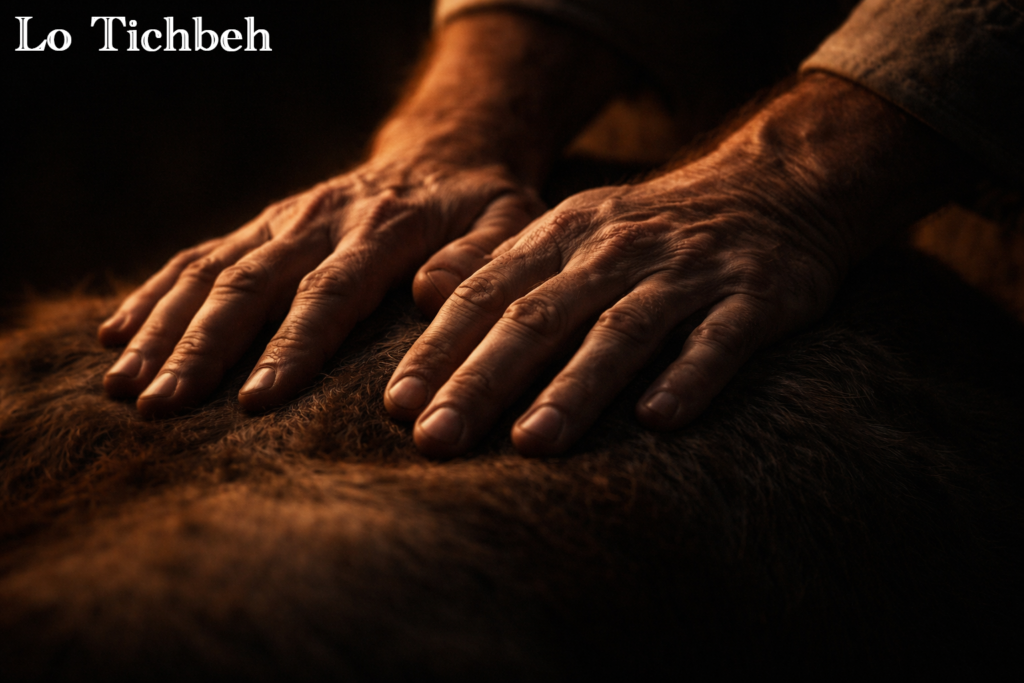
The central gesture of the korban is the semichah—the laying of hands on the animal’s head before it is brought to the flame. The offerer presses down with both hands. Full weight. Full contact. This is not a symbolic touch. It is an act of identification: I and this offering are, in this moment, one thing.
The animal does not substitute for the person. It represents the person—stands in the place of the self being presented to G-d. What the fire receives is not an animal. It is the one who brought it, offered through the semichah.
And the transformation is specific. The olah ascends entirely. The self, in its ordinary state, is too weighted to rise—laden with accumulated habit, with the narratives it has built around itself, with the thousand small investments in its own continuity that it mistakes for identity. The fire is what makes ascent possible. It burns off what holds the self to the mundane. What rises is not the animal. It is the person, refined, freed, ascending.
This is the altar of the interior Mishkan. In Parashat Terumah, we established that the Mishkan was never only a portable sanctuary in the wilderness—it was always a diagram of the human interior. G-d did not say: build Me a sanctuary and I will dwell in it. He said: I will dwell among them. Within them. The dwelling was always the person. And the altar at the center of that interior Mishkan is the place where the self meets its own capacity for transformation.
The Interior Cooling
The sixteenth-century Italian commentator Obadiah Sforno reads the phrase lo tichbeh—“it shall not go out”—with particular care. The phrasing, he notes, implies not catastrophic extinguishing but something quieter: the fire that is allowed to cool. Someone lets it go out. There is negligence in the extinguishing—an interior withdrawal that precedes the visible failure by a long time.
What withdraws first is not the practice but the semichah. The identification. The priest still arrives at the altar. The forms still run. But the moment of genuine self-presentation—the full weight of both hands, the transfer of self into the offering—is quietly absent. The animal is placed on the fire. But the person did not come with it.
This is the failure mode Sforno is diagnosing. Not apostasy. Not dramatic rejection. The slow, barely perceptible withdrawal from genuine self-offering. The forms continue because forms are easy to continue. What atrophies is the interior act that gave the forms their meaning: the willingness to place oneself on the altar and let the fire do its work. The self does not simply drift from the altar. It is often pulled away—by the quiet resistance of an ego that has learned to prefer its own version of reality to the refinement the fire offers. We become indifferent to the altar because some part of us knows what the fire does. And we would rather stay as we are.
Abraham Joshua Heschel names what this withdrawal feels like from the inside. The opposite of faith, he writes in G‑d in Search of Man, is not doubt. It is indifference. Doubt is still engaged—it argues, resists, wrestles. Indifference simply stops bringing wood. It performs the priestly service while retreating, degree by degree, from the heat. What Heschel calls depth theology—the lived awareness of standing before G‑d rather than thinking about G‑d—is precisely the semichah of the interior life. And indifference is its slow dissolution.
The self that never goes to the altar eventually becomes a self that cannot. The capacity for genuine self-offering atrophies when it is not exercised. The ego—which the fire was meant to regularly refine—accumulates instead, hardens, becomes increasingly resistant to the flame. By the time the altar is cold, it has been cooling for a long time.
The Fire Above
The Zohar presses beneath all of this to the foundation—and what it finds there is not abstract metaphysics. It is a description of what is actually happening at the altar.
We are made b’tzelem Elohim—in the divine image. This is not a metaphor for moral dignity. It is a structural claim. The sefirot are not only a map of divine emanation; they are a map of what we are. The Tree of Life is the architecture of the human self as much as it is the architecture of the divine. We are built the way G-d is built. The correspondence runs all the way down.
Which means the Mishkan was always a diagram of both. The altar fire below corresponds to a fire above—not because Torah is fond of symmetry, but because the structure is shared. Two configurations of the same reality: one above, one below, both oriented toward the place where they meet.
And the flow is not in one direction. This is the piece that changes everything. Shefa—the divine overflow—moves downward through the sefirot continuously, from Keter toward Malkhut, from the infinite toward the particular, seeking the point of contact where the ascending human self meets the descending divine light. The altar is that point of contact. The rising smoke and the descending fire are already moving toward each other before the wood is laid.
This is what reyach nichoach actually describes—the phrase translated, awkwardly, as “a pleasing aroma.” It is not G-d smelling dinner. It is the moment of completed correspondence: the refined self, ascending, meeting the divine flow, descending, completing a circuit that both have been moving toward. The offering pleases not because G-d is hungry but because the circuit closes. What was separated is joined. What was below rises to meet what was always coming down.
The fire above never goes out. The shefa never stops descending. G-d does not withdraw the divine fire because we have been inattentive. The channel remains open from above, permanently, unconditionally. What closes is the human side of the correspondence—our capacity to receive what is descending, to answer it with something rising, to keep the circuit alive.
Wood Before Anything Else
Return to the text. The priest burns wood on the altar every morning. Not after other obligations are met. Not when there is time. The fire is tended first. Before the day’s business. Before anything else claims attention. The altar gets the morning.
What we tend first is not incidental. It reveals what we actually serve.
The morning wood is not a metaphor for discipline. It is the concrete, daily act of keeping the human side of the correspondence alive. Of arriving at the interior altar before the ego has time to reassemble itself around the day’s concerns. Of performing the semichah—placing whatever has accumulated since yesterday on the flame and letting it rise. The self, refined by daily offering, remains capable of ascent. The self that never goes to the altar gradually loses that capacity entirely.
In Parashat Vayikra, we examined the korban as an act of drawing near—karav, approach, the movement of the finite self toward infinite holiness. The altar fire is where that approach is completed. You do not draw near and then remain as you were. You draw near and the fire does what fire does. What rises is not what arrived.
Heschel’s depth theology is not a state achieved once. It is a posture renewed every morning at the altar, in the act of genuine self-offering, in the willingness to let the fire refine what has hardened overnight. The priest did not arrive on the first morning and find all subsequent mornings covered. He arrived every morning. The fire required it. The correspondence demanded it.
It Shall Not Go Out
The command lo tichbeh is now something more than a priestly regulation. It is the command to remain a self still capable of transformation. Still capable of bringing itself to the altar. Still capable of rising.
The fire above is always burning. The shefa is always descending. G-d’s side of the correspondence has never faltered and never will. What Tzav commands is that we hold up our side—that we keep the interior altar ready to receive what is always already being offered from above.
The Menorah illuminates. The altar transforms. And transformation is not a crisis event, not a dramatic moment of spiritual breakthrough. It is the daily work of a self that keeps showing up at the altar before anything else, bringing whatever needs to burn, offering it to the fire, and waiting for what rises.
The fire does not go out dramatically. It cools by degrees, in the slow accumulation of mornings when the semichah was not performed. When the forms ran but the self did not come with them. When the wood was not brought.
Bring wood. Every morning. Keep the correspondence alive.
This is what the eternal fire requires. This is what we were made for.

Discover more from Many Lamps, One Flame
Subscribe to get the latest posts sent to your email.