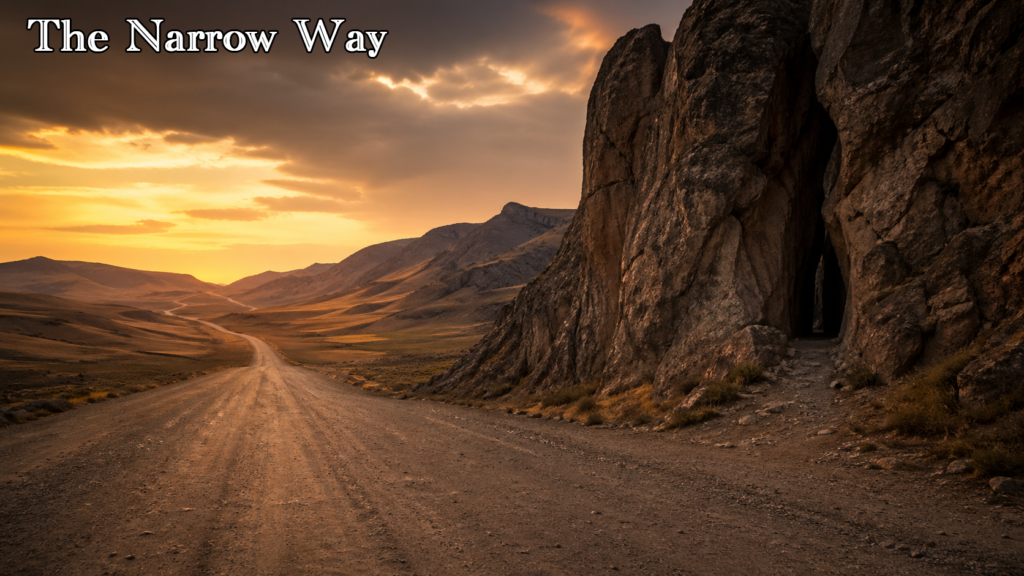
Enter by the narrow gate; for wide is the gate and broad is the way that leads to destruction, and there are many who go in by it. Because narrow is the gate and difficult is the way which leads to life, and there are few who find it.
—Matthew 7:13–14, NKJV
The Sermon on the Mount has been building toward this. For six chapters, Jesus has been progressively relocating the fence inward—not abolishing Torah but demanding that its orientation begin in the heart rather than the hand. He has addressed anger, lust, oath-taking, retaliation, anxiety, judgment, prayer. He has spoken of salt and light, of giving in secret, of the lilies of the field. Now He arrives at the summary image: two gates, two roads, two crowds of vastly different sizes, two destinations.
The image is ancient. The audience knows it. What they are about to hear is not an innovation—it is the oldest Jewish teaching about the shape of the moral life, pressed to its sharpest point. And beneath the historical and ethical surface, it is something more precise still: a kabbalistic map of the human soul, drawn by a rabbi who knew exactly what he was drawing.
Two Ways: The Ancient Inheritance
The “two ways” teaching does not originate with Jesus. It is among the oldest and most widely attested motifs in Jewish literature. Moses sets it before Israel in Deuteronomy 30:15–19: life and good, death and evil, two ways, a choice demanded of the people standing at the edge of the land. Choose life. Psalm 1 opens the entire Psalter with the same structure: the way of the tzaddikim and the way of the resha’im—the righteous and the wicked—two paths, two destinations. The righteous are like a tree planted by streams of water. The wicked are like chaff. The Didache—the Teaching of the Twelve, a Jewish-Christian document of the late first century drawing on older Jewish sources—opens: “There are two ways, one of life and one of death, and there is a great difference between the two.” Rabbi Yohanan ben Zakkai, in Pirke Avot 2:9, poses the same structural question to his disciples: which is the good way a person should cling to, and which the evil way to avoid?
Jesus is not introducing a new framework. He is standing within a tradition His audience inhabits and sharpening it to its edge. He is not claiming novelty. He is claiming that what Torah has always known about the shape of the moral life has arrived at a moment of particular urgency—that the two roads are not abstractions but live options standing directly before the people to whom He is speaking.
He is handing His audience a vessel they already know and asking them to look carefully at what is inside it.
The Gate and the Road
The Greek is precise where most translations flatten it. The word rendered “difficult” is tethlimmenē—pressed, constricted, squeezed from both sides. The narrow road does not merely demand moral rigor. It presses in on the traveler continuously. The image is of a corridor so tight that moving through it requires full compression—nothing extra, nothing surplus, nothing that cannot fit through the gap.
The wide road demands nothing that resists the traveler. And it does not lead nowhere—it leads somewhere quite specific: wealth, comfort, social ease, the satisfaction of fitting in, the warmth of being accepted by one’s community. These are real goods. The road delivers what it promises. This is precisely what makes it so appealing and so populated.
Most of us live in the world of man. The things the wide road offers are the things human existence reaches for naturally. And the wide road provides something else as well: a kind of safety that comes not from protection but from invisibility. Those who conform are seldom targeted. They do not stand out. The cost of that invisibility is the surrender of the very distinctness that kedushah requires—but the cost is paid gradually, almost imperceptibly, and the goods arrive immediately.
This is the anatomy of the yetzer ha-ra—the impulse that orients the human soul toward the immediate, the comfortable, the earthly. The rabbis are explicit that the yetzer ha-ra is not evil in the simple sense. Without it, no one would build a house, marry, have children, or engage in commerce. It is the engine of life in the world. The wide road is wide because the yetzer ha-ra is powerful and its fruits are real. It is not a road of wickedness. It is a road of unbalanced earthly orientation—the left pillar of the Tree operating without the counterbalance of the right, bending slowly toward the sitra achra not through malice but through the accumulated weight of accommodation.
The destination is apoleia—destruction. Not an abstraction about afterlife, but the fate that befalls a people who abandon covenantal faithfulness. And it arrives sooner than the traveler expects. The destruction of Jerusalem forty years hence is what Jesus is warning against—but that destruction is not an isolated event. It is the pattern. Every time the Jewish people lose their distinctiveness beneath the pressure of an assimilating power—Egypt, Babylon, Greece, Rome, and beyond—some form of destruction follows. The covenant consequence is not arbitrary. It is structural. A people who have dissolved their kedushah have dissolved the very thing that sustains them.
The Wide Road Has a Name
Jesus is speaking to Jews in Roman-occupied Judaea. The wide road is not a metaphor for generic moral laxity. It has a precise target His audience would have recognized immediately: assimilation. The systematic surrender of visible covenantal distinctness in exchange for safety, social standing, and Roman tolerance.
Dress like us. Eat like us. Act like us. Think like us. And you will be one of us.
The Sadducees are on that road. The priestly aristocracy that has made its peace with Roman power is on that road. Hellenized Jews (and later, under Rome) who underwent procedures to reverse the mark of the covenant so they could compete in the gymnasium without visible distinction are on that road. Those in the communities around Caesarea who have abandoned the tzitzit—the fringes Torah commands—and taken up the mixed textiles of Roman fashion, violating the kilayim that Kedoshim prohibits, trading the visible mark of covenantal identity for the seamless appearance of belonging. The road is wide and many are on it—not because they are wicked in any simple sense, but because the road delivers comfort, belonging, and earthly flourishing. It is the road of assimilation, and it is not a Roman invention.
This pressure predates Rome. It was present under Pharaoh, who demanded that Israel’s labor serve Egyptian purposes until there was nothing left of the Israelite but the Egyptian’s tool. It was present in Babylon, where Daniel was given a Babylonian name and a Babylonian education. It was present in the Hellenistic world that seduced with philosophy and athletics rather than threatening with whips. And it is present today, in every culture that extends the same offer: become like us, and we will receive you.
This is Parashat Kedoshim distilled into two verses. Kedoshim tihyu ki kadosh ani Adonai Eloheichem—you shall be holy, for I the L’rd your G‑d am holy. The entire Holiness Code is a sustained argument for maintained distinction against exactly this pressure. Be kadosh because G‑d is kadosh. Be distinct because distinctness is what divinity is. The wide road is the road of assimilation, the quiet surrender of visible covenantal distinctness for safety and belonging. Torah knew it was coming long before Rome paved it.
Few Find It
Few find it. Not few are permitted. Not few are chosen. Few find it. The gate is not locked. It is narrow, and finding a narrow gate requires a kind of attention that the wide road actively prevents.
Assimilation is not merely comfort. It is distraction. The work of conforming to the surrounding culture—learning its fashions, adopting its habits, performing its expectations—occupies the full field of attention. There is no remainder left for seeking. You cannot see the narrow gate from the wide road not because it is hidden but because the wide road’s demands have filled the eyes with other things. The yetzer ha-ra, fully occupied with the genuine goods the wide road offers, has quieted the yetzer ha-tov—the impulse that orients the soul toward the divine, toward kedushah, toward the narrow road of maintained distinction. The crowd walks past the narrow gate because they are not looking for it. They are looking at what the wide road is showing them.
The kingdom—Malkut, the Shekhinah, the divine presence accessible in the world—is reached through Da’at: the intimate knowing that is not intellectual assent but direct contact, the knowing of full encounter between a genuinely present self and the divine. Da’at is the hidden sefirah, sitting at the top of the middle pillar where Chokhmah and Binah—wisdom and understanding, the right and left pillars—are brought into integration. It is the knowledge of the tzaddik who has learned to walk the middle pillar, neither surrendering to the yetzer ha-ra’s pull toward the left nor pretending the left pillar does not exist. It is the knowing that Genesis names when it says Adam knew Eve—full contact, nothing held back, nothing dissolved.
The narrow road is the middle pillar. The narrow gate is the gate of Da’at. And the person who has given themselves entirely to the wide road—who has quieted the yetzer ha-tov in favor of the yetzer ha-ra’s earthly goods, who has dissolved their distinctness into the surrounding culture—has dismantled the very instrument through which Da’at is achieved. You cannot know the One with a self that has been dispersed among many masters.
John of the Cross called this the stripping of nada—the progressive emptying of what the wide road accumulates, until the soul is compressed into a shape that can move through what it previously could not. Augustine called it the discipline of disordered love—the soul that follows its inclinations arrives on the wide road by default; the narrow gate requires that the loves themselves be ordered toward their proper end. Aquinas called it phronesis—practical wisdom, the capacity to see what is actually true about a path when the wide road’s goods are right there, visible and immediate and real. All three called the same thing by different names: the cultivation of the yetzer ha-tov against the grain of a world that rewards the yetzer ha-ra. The narrow gate is narrow not because access is restricted but because arriving at it in a condition to enter requires exactly this cultivation—and most people have not done it, because the wide road never demanded it.
The Gate as Filter
The gate does not merely divide two roads. It reveals who the traveler actually is.
Everything accumulated on the wide road can be carried to the gate. Wealth, social standing, the approval of the crowd, the comfort of assimilation—these accompany the traveler all the way to the threshold. At the threshold, the gate does not negotiate. The traveler who has shaped himself to the wide road—left-pillar heavy, yetzer ha-ra dominant, the integrated self dispersed among many accommodations—finds the narrow gate will not receive that shape. Not because G‑d bars the way, but because the middle pillar, the path of Da’at, has no room for what has not been brought into balance.
The compression is not punishment. It is the final stage of the formation the Sermon has been building toward. What cannot come through is stripped here—the accumulated earthly weight, the left-pillar excess, the shape the wide road made. What does come through is what was genuinely formed: the disciplined heart, the ordered loves, the prayer without performance, the giving without audience, the anxiety surrendered to the kingdom. The gate does not create these things. It discloses whether they are actually there, and in the disclosing, makes the vessel ready to be filled.
This is why the warnings that follow—the false prophets, the tree and its fruit, the devastating I never knew you—emerge as necessary consequences. The intimate knowing (Ginosko / Da’at) requires the integrated self that the narrow gate both demands and reveals. It never occurred—not because the gate was locked but because who arrived at it had already been dispersed. They performed. They prophesied. They cast out demons in the name. But they never entered. They found something that looked like the narrow gate from the outside and called it enough. What grows on the other side of where they entered tells the whole story.
Enter
The imperative is enter. Not “wander toward.” Not “find yourself at.” Enter—and traverse the narrow way through. The command is deliberate, active, willed. The gate must be sought, arrived at, and moved through by choice.
This is the summary movement of the entire Sermon on the Mount. Every teaching that preceded this verse has been forming the person who can find and enter this gate—the person whose anger is disciplined, whose desire is ordered, whose speech is precise, whose giving is without performance, whose prayer is without display, whose anxiety has been surrendered to the kingdom, whose judgment is turned first inward. The Sermon has not been a list of rules. It has been the formation of the yetzer ha-tov—the right-pillar orientation, the impulse toward the divine, the capacity to walk the middle pillar toward Da’at—in the person who arrives at the fork.
The crowd on the wide road is large. The road delivers what it promises. The gate is broad, the way is easy, and the earthly goods are real. And we arrive at our destinations sooner than we expect.
The narrow gate leads to life. Few find it.
Enter.

Discover more from Many Lamps, One Flame
Subscribe to get the latest posts sent to your email.