
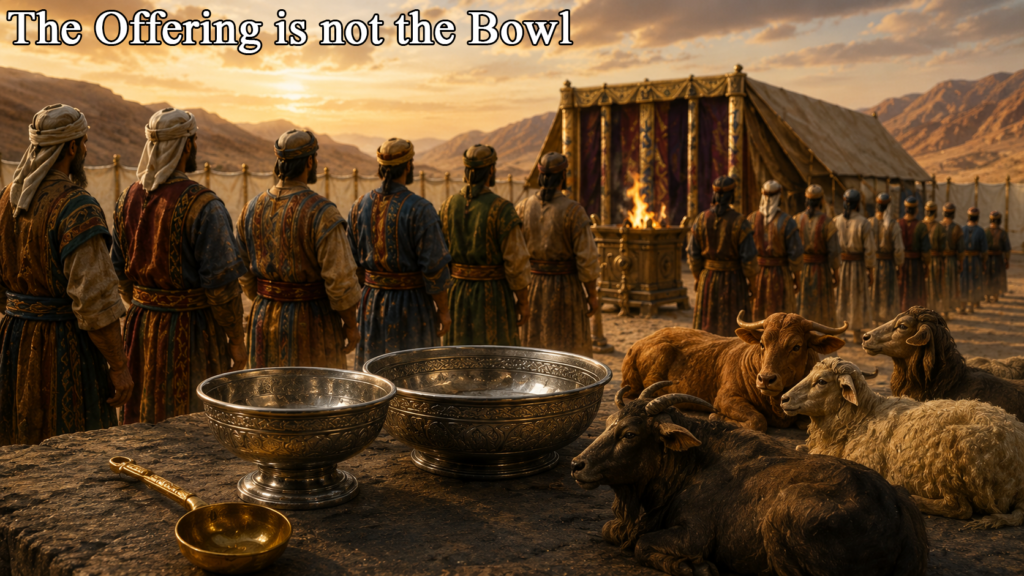
Even though each of them presented an identical offering, they offered it regarding significant matters, and each and every one presented according to his perspective.
—Bamidbar Rabbah 13:14
Numbers 7 is the longest chapter in the Torah. It is also, by almost any measure, the most repetitive. Twelve tribal princes bring offerings to dedicate the newly completed Mishkan. The first prince’s offering is recorded in careful detail—the silver bowl, the silver basin, the golden ladle, the bulls and rams and goats. Then the second prince brings his offering. It is identical. The Torah records it anyway, in the same words, with the same specificity. Then the third. Then the fourth. This continues for twelve days and eighty-nine verses, at which point a reasonable reader might wonder whether the scribes had simply lost track of where they were.
The question is not new. The Abravanel raised it explicitly: why did the text record each offering in full when a single entry followed by and so did the rest of them would have conveyed the same information? It is, he said, “an extreme redundancy and quite a strange thing.” The Ramban, characteristically, went to the root: G‑d honors those who approach with reverence and awe, and each prince deserved his moment. This is not wrong. But the tradition pressed further, and what it found beneath the repetition is not redundancy at all. It is twelve distinct theological statements made through identical vessels.
Bamidbar Rabbah 13:14 records the central insight: even though each prince presented an identical offering, each offered it regarding significant matters, and each presented according to his own perspective. The offerings were the same. The kavanah—the interior orientation, the specific intention—was not. What looks like repetition is, on close reading, twelve unrepeatable acts of approach, each encoding a completely different theological world in the same silver and gold. Torah refuses to abbreviate because there is nothing to abbreviate. The offering is not the bowl. The offering is what the prince brings to the bowl.
For readers who want the numerological layer encoded in the vessels’ weights and counts, the companion piece to this essay—The Library in the Ledger—excavates that dimension in full. This essay goes inside: twelve days, twelve princes, twelve irreducible approaches to the identical form.
What Kavanah Does to Form
Before moving through the tribes, a word about what kavanah means in practice—not as a mystical abstraction but as a precise theological claim. The tradition insists that identical external form can carry radically differentiated interior meaning, and that both levels are real simultaneously. The offering is not diminished by being identical to the others. It is completed by what the prince brings to it. The form is the vessel. The kavanah is the offering.
This is not unique to the Mishkan dedication. It is the same claim the tradition makes about prayer: two people who recite identical words may be doing entirely different things depending on what each brings to the recitation. It is the same claim the Hasidic masters make about mitzvot: the commandment is the structure; the soul that inhabits the structure is what makes it an act of approach rather than a ritual performance. What Bamidbar Rabbah demonstrates across twelve chapters is that this principle was already operating at the Mishkan’s dedication—and that Torah’s refusal to abbreviate is its way of insisting on it.
Day One: Judah — The Sovereignty Reading
Nachshon ben Aminadav presents first. His name derives from nachshol—the wave—and the tradition knows him as the man who walked into the sea before it split. His kavanah is already legible in who he is: the approach that precedes the confirmation that the approach was right.
The silver bowl, in Judah’s reading, encodes the seas that Solomon would rule. The gematria of ke’arat kesef achat—one silver dish—totals 930, the years of Adam’s life. Its weight of 130 shekels: the gematria of yamim(seas) is 100, and Solomon’s Temple sea had a circumference of 30 cubits, yielding 130. The basin corresponds to the world as orb, and its 70 shekels to the seventy nations that Davidic sovereignty would encompass. The golden ladle’s ten shekels encodes the ten generations from Peretz to David. The animals carry the patriarchs—Abraham in the bull, Isaac in the ram, Jacob in the lamb—and Judah’s own guilt with the goat, the blood used to deceive his father encoded in the sin offering he brings now. The two bulls of the peace offering are David and Solomon. The fifteen remaining animals are the fifteen kings from Rehoboam to Zedekiah.
When the Holy One blessed be He saw that Nachshon presented his offering corresponding to the order of the patriarchs and the royal dynasty, the Midrash says, He began lauding it: This was the offering of Nachshon ben Aminadav. The praise is not for the silver. It is for what Nachshon carried to the silver.
Day Two: Issachar — The Torah Reading
Netanel ben Tzuar presents second. His tribe’s identity is scholarship—Issachar’s princes led the Sanhedrin, and the 200 heads of the Sanhedrin Issachar produced are encoded, as we will see, in Zebulun’s offering the following day. Issachar presents second because Issachar was, according to tradition, the one who proposed that all twelve princes bring identical offerings in the first place. The tribe of Torah wisdom initiates the act of communal approach.
The same silver bowl, in Issachar’s reading, encodes Torah. The dish corresponds to bread—Torah is called bread in Proverbs 9:5—and the weight of 130 shekels is calculated differently than Judah calculated it: 24 books of the written Torah, plus 80 for the orders of Mishna (the first and last words of the Mishna both begin with mem, each mem worth 40), plus 26 generations from Adam to Moses through whom Torah was given. Twenty-four plus eighty plus twenty-six equals one hundred and thirty. The same weight. A completely different library.
The basin corresponds to wine—Torah is called wine in Proverbs 9:5—and its 70 shekels to the gematria of yayin (wine), which is seventy, which is also the seventy faces of Torah. The ladle encodes the tablets written by the hand of G‑d, its ten shekels the Ten Commandments, and the incense—ketoret—which the Midrash decodes through traditional letter-substitution to reveal an exact encoding of the 613 mitzvot. The animals carry the recipients of Torah at Sinai: the bull for the priests, the ram for the Levites, the lamb for the Israelites, the goat for the proselytes who were present. The two bulls of the peace offering are the Written and Oral Torahs together.
Not one element of Judah’s reading survives into Issachar’s. The vessels are identical. What they carry could not be more different.
Day Three: Zebulun — The Partnership Reading
Eliav ben Helon presents third, and the Midrash explains why Zebulun follows Issachar immediately: Zebulun loved the Torah and was generous in dispensing his money to Issachar, so that Issachar would not need to earn a livelihood and would not be idle from Torah study. The famous symbiotic partnership—Zebulun the seafarer funds Issachar the scholar—is encoded in the structure of the offering itself.
The dish corresponds to the sea, which was Zebulun’s portion—”Zebulun will dwell at the shore of seas” (Genesis 49:13). The basin corresponds to the land, which was Issachar’s portion. And then the Midrash performs a reading it has not used before: it adds the two weights together. One hundred and thirty plus seventy equals two hundred—the two hundred heads of the Sanhedrin that the tribe of Issachar produced. Zebulun receives the larger number because, the Midrash explains, the one who enables the learning is elevated beyond the one who performs it. The ladle: kaf (the ladle) is nothing other than ḥaf (shore), corresponding to Zebulun’s patriarchal blessing, and its ten shekels the ten words of that blessing in Genesis 49:13. The Midrash’s closer: “It is a tree of life for those who grasp it”—this is Issachar; “and its supporters are happy”—this is Zebulun.
Day Four: Reuben — The Rescue Reading
Elizur ben Shedeur presents fourth—after the banner of Judah’s three tribes is complete—and his reading is the most intimate yet. Where Judah’s bowl encoded the sweep of royal history and Issachar’s encoded the architecture of Torah, Reuben’s encodes a single sentence spoken in a moment of moral courage.
The Midrash instructs: do not read the dish as ke’arat but as akeret—Reuben, who played the primary role in the rescue of Joseph. And its weight of 130 shekels? The first letters of the three words Reuben spoke: lo nakenu nafesh—”let us not smite him mortally” (Genesis 37:21). Lamed, nun, nun: 30 + 50 + 50 = 130. The bowl’s weight encodes Reuben’s plea, letter by letter. The basin corresponds to the counsel he gave—”cast him into the pit”—and its 70 shekels to the sod, the secret in his heart: to return and rescue Joseph himself. The gematria of sod is seventy. The ladle: the hand he raised against his brothers’ violence, “do not lay a hand on him.” The animals carry his penitence—the sin offering for the act with Bilhah, the peace offerings for the two good deeds that restored him to the tally of the twelve.
Reuben’s offering encodes not cosmic history but a single afternoon in a field near Dothan, a decision made in a moment, and the secret intention that no one knew but G‑d. The bowl that weighed the same as Adam’s 130 years now weighs the same as three letters of a sentence that saved a life.
Day Five: Simeon — The Architectural Reading
Shelumiel ben Zurishaddai presents fifth, and his kavanah turns to the structure being dedicated. The prince of Simeon presents his offering corresponding to the order of the crafting of the Mishkan itself.
The dish encodes the Mishkan courtyard surrounding the Tabernacle like the sea surrounds the world—and its 130 shekels: the courtyard was 100 cubits long, the interior of the Tabernacle 30 cubits. One hundred and thirty. The basin encodes the courtyard without the Tabernacle—seventy cubits. The Midrash offers two calculations: the courtyard space excluding the Tabernacle footprint, or the count of seventy pillars in the courtyard complex. The ladle encodes the Torah scroll placed beside the Ark—kaf as the hand with five fingers, five books—and its ten shekels the ten portions of Tabernacle construction commanded in Exodus. The animals: the linen sheets in the bull, the rams’ hides in the ram, the taḥash hides in the lamb, the goat-hair tent in the goat. The two bulls of the peace offering are Betzalel and Oholiav, who completed the labor.
On the day the Mishkan is dedicated, Simeon’s offering encodes the Mishkan’s own measurements. The vessel contains its container. The dedication offering and the structure being dedicated are, in Simeon’s kavanah, the same act.
Day Six: Gad — The Exodus Reading
Eliasaph ben Deuel presents sixth, and his offering, in Rabbi Berekhya’s reading, encodes the entirety of the Egyptian sojourn—from its beginning to its end, compressed into the arithmetic of three vessels.
The dish: do not read ke’arat but keraat—severed—corresponding to Jochebed, Moses’s mother, who was severed from Amram when he divorced her and then taken back. She was 130 years old when Moses was born—born between the walls when Jacob’s family entered Egypt, present among those who descended though not named among them. The basin: Moses himself, cast away—nizrak, the verb from which mizrak derives—into the Nile, and the 70 elders he would appoint, all of them prophets. The ladle: the ten plagues by which the Egyptians were struck at Moses’s hand.
And then the Midrash performs its most expansive calculation: 130 + 70 + 10 = 210—the years Israel spent in Egypt from Jacob’s descent to the Exodus.
Every vessel in Gad’s offering adds to the complete span of the sojourn. The arithmetic of exile encoded in a single afternoon’s dedication offering.
Day Seven: Ephraim — The Shabbat Reading
Elishama ben Ammihud presents seventh. And the Midrash pauses before the vessels to establish something unique among all twelve days: the seventh day was Shabbat. Individual offerings do not override Shabbat. How, then, does the prince of Ephraim present his offering?
The answer crosses generations. Joseph, in Egypt, said to his steward: “Slaughter an animal and prepare it” (Genesis 43:16). Rabbi Yochanan reads this as erev Shabbat preparation—Joseph observed Shabbat before it was given. The Holy One blessed be He said: As you live, your descendant will present his offering on My holy day, and I will accept it. The seventh day is a reward carried forward from a single act of faithful preparation in a palace in Egypt.
The dish: Jacob’s crossing of his hands—laying his right on Ephraim’s head, the younger, and his left on Manasseh’s, the elder—and its 130 shekels the count of words from “he laid it on Ephraim’s head” to “he placed Ephraim before Manasseh” in Genesis 48. The basin: Joseph cast away from his father and sold to Egypt—nizrak again—and its 70 shekels the seventy languages Gabriel taught Joseph so that Egypt would accept him as ruler. The ladle: ten words from “Israel extended his right hand” to “he was the younger.”
The Midrash reads “both of them full” as a claim that Jacob and Joseph are a single righteousness expressed across two lives—the tradition enumerates more than two dozen parallels between them, from barren mothers to bones carried home—and that Ephraim’s offering carries both. The seventh day is not incidental. It is the argument that faithfulness across generations is itself an offering.
Day Eight: Manasseh — The Mirror Reading
Gamliel ben Pedatzur presents eighth, and his offering mirrors Ephraim’s—as the brothers mirror each other, the younger elevated, the elder honored in his place. But the vessels carry different cargo. Where Ephraim’s 130 shekels encoded the words of Jacob’s blessing as he crossed his hands, Manasseh’s 130 encodes Jacob’s actual age at the descent into Egypt. The same weight. One reads a gesture; the other reads a life.
The dish: Jacob’s age when he descended to Egypt—”the days of the years of my residence are one hundred and thirty years” (Genesis 47:9). The basin: Joseph cast away—nizrak appears again, the third time—and its 70 shekels the seventy souls who descended to Egypt through him. The ladle: the ten districts of Manasseh’s inheritance in the land. The two bulls of the peace offering: the tribe of Manasseh divided, half on the east bank of the Jordan and half in Canaan—two portions, two bulls.
Jacob decreed that Ephraim would precede Manasseh, the Midrash records, and the Holy One blessed be He fulfilled that decree like an implanted nail—in judges, in banners, in kings, and now in offerings: Ephraim on the seventh day, Manasseh on the eighth. The same vessels as Ephraim. A different weight of memory in each.
Day Nine: Benjamin — The Temple Reading
Avidan ben Gideoni presents ninth—after Joseph’s sons, because just as the Divine Presence rested in Joseph’s portion at Shilo, it would rest in Benjamin’s portion in Jerusalem.
The dish: Rachel as akeret—pillar of the household, principal among the matriarchs—and its 130 shekels the sum of Jacob’s age when Benjamin was born (100) and Benjamin’s age when he descended to Egypt (30). The basin: Joseph’s goblet, through which he tested his brothers’ righteousness regarding Benjamin, and its 70 shekels the gematria of yayin—wine—because Joseph drank wine from the goblet. The ladle: ten sons Benjamin brought to Egypt, all of them righteous.
The burnt offerings carry the Temples. Three animals: the Temple of Solomon, the Temple of those who returned from exile, the Temple of the Messianic Era—three constructions in Benjamin’s portion across the full span of Israel’s history. The goat sin offering: the structure Herod built, a sinful king’s atonement for having killed the Sages of Israel. The two bulls of the peace offering: Saul and Ish-Boshet, or Mordechai and Esther—two kings and two redeemers, all from Benjamin. Benjamin’s offering contains Israel’s complete royal and redemptive history within a single tribe’s memory, structured around the land where G‑d chose to dwell.
Day Ten: Dan — The Nazirite Reading
Ahiezer ben Ammishaddai presents tenth. And his reading is perhaps the most unexpected of all twelve: not tribal history, not cosmic structure, not patriarchal memory, but the laws of the Nazirite, encoded in the offering because Jacob’s blessing of Dan was, the Midrash says, entirely about Samson.
The dish encodes the Nazirite passage itself—from “this is the law of the Nazirite” to “then the Nazirite may drink wine” in Numbers 6 is 130 words. The basin: yayin at 70—the wine the Nazirite is released to drink at the vow’s completion—or nizrak again, Samson cast away from his brethren by his choice of a Philistine wife, or the 70 letters of Dan’s patriarchal blessing regarding Samson’s judgeship. The ladle: ten prohibitions regarding wine for the Nazirite—wine, vinegar of wine, vinegar of strong drink, grape-soaked liquid, fresh grapes, dried grapes, anything derived from the grapevine, from pit to skin—ten restrictions encoded in ten shekels of gold, because wine is red and gold is red.
Dan’s kavanah is the theology of consecration: what a person voluntarily withholds from himself in order to draw near. The Nazirite does not abstain from wine because wine is wrong. He abstains because the abstention itself is the approach. The offering is what you hold back in order to hold something greater.
Day Eleven: Asher — The Election Reading
Pagiel ben Ochran presents eleventh—after Dan, because Dan is named for judgment and Asher for its confirmation, and the judge must confirm his judgment. Asher’s offering encodes Israel’s election from among the nations.
The dish corresponds to the nations of the world, initially attributed to Abraham. Its 130 shekels: the seventy descendants of Noah plus the sixty queens of Song of Songs 6:8—the full scope of humanity from which G‑d chose. Asher’s Midrash enumerates them: the sons of Esau, the sons of Ketura, Ishmael and his twelve sons, the kings of Edom, completing the count of 130 through careful genealogical arithmetic. The basin: Israel itself, separated out—”For the Lord has chosen Jacob for Himself”—and its 70 shekels the seventy souls who descended to Egypt with Jacob. “Both of them full” because G‑d dispatched prophets both to the nations and to Israel: the flour and oil of prophecy poured into both vessels.
The ladle: from all of them, G‑d chose only Israel—five books, five fingers of the hand, the Ten Commandments received, na’aseh v’nishma as the incense. The two bulls of the peace offering: Written and Oral Torah. Three species of burnt offering: the three crowns G‑d gave Israel—Torah, priesthood, kingship. Asher’s kavanahmoves from the widest possible scope—all of humanity—to the single point of Israel’s election. His offering holds the entire world and then narrows to the covenant.
Day Twelve: Naphtali — The Patriarchal Reading
Ahira ben Enan presents last. Why after Asher? Because Asher is named for Israel’s happiness, and Naphtali is named for Torah—nofet li, sweeter than honey—and the happiness of Israel is contingent upon the Torah. The last offering closes the sequence where the tradition always returns: the patriarchs and matriarchs.
The dish: Sarah as akeret—pillar of the household, primary among the matriarchs—and its 130 shekels approaching her years: “the lifetime of Sarah was one hundred and twenty-seven years” (Genesis 23:1). The Midrash does not force the arithmetic; it says her years approached 130. The basin: Abraham cast out of his land and his birthplace—nizrak from Ur—”Go from your land and your birthplace and your father’s house” (Genesis 12:1)—and its 70 shekels the seventy years of Abraham’s age when G‑d entered into the covenant between the parts. The ladle: Abraham’s ten trials, his actions pleasant before G‑d like the fragrance of incense.
The burnt offerings correspond to the animals G‑d commanded Abraham to prepare at the covenant between the parts—the triple calf, the triple ram, the dove and the pigeon—each species now elevated to the offering of a wealthy man rather than a poor one, because there is no poverty in a place of wealth. The peace offerings: Isaac and Rebecca as the two bulls, Jacob and Leah and Rachel as the three species of five each, fifteen total—Jacob, Leah, Rachel, and the twelve tribes. The concubines are not counted because they were called maidservants. The last offering returns to the first family, the first covenant, the first approach. The final day of the dedication is also its beginning.
The Summation: Rabbi Pinchas Ben Yair
Once all twelve princes have presented, the Midrash steps back to read the totals. Rabbi Pinchas ben Yair’s reading reframes everything that has come before: twelve of everything—twelve silver dishes, twelve basins, twelve ladles, twelve bulls, twelve rams, twelve lambs, twelve goats—corresponds to twelve constellations, twelve months of the solar year, twelve months of the lunar year, the twelve tribes, the twelve loaves of showbread on the Table. The structure of the dedication mirrors the structure of creation itself.
The total weight of all silver vessels: 2,400 shekels—the number of years from creation to Moses at thirty-two, when he began to instruct Israel in Egypt. The total weight of the golden ladles: 120—the years of Moses’s own life. The dedication offering encodes both the span of history that preceded it and the life of the man through whom it was commanded.
And then the connection that closes the entire parashah into a single theological statement: the peace offerings of each prince—fifteen animals in three species of five—correspond to the fifteen letters of Yevarechecha Adonai v’yishmerecha, the opening words of the Priestly Blessing. Each species was of five each, corresponding to the fact that each verse of the blessing is five letters longer than the previous. Because the blessing concludes with peace—v’yasem lecha shalom—peace offerings were brought corresponding to it.
The dedication offering the princes brought and the blessing Aaron speaks over Israel are the same structure. The approach and the benediction are one movement. The library that opens in Numbers 7 closes in Numbers 6—the Priestly Blessing that precedes the dedication in the text is, arithmetically, the offering’s own echo.
What the Twelve Days Were
The Midrash’s final word on the dedication is its most startling. Because each tribe accorded honor to the others—no one presumed, no one abbreviated, each prince waited his day and brought his full offering—G‑d accorded honor to them all. And therefore, the Torah ascribes to them as though they all presented on the first day and as though they all presented on the last day. Twelve days collapse into one. The repetition that opened the problem dissolves not by being explained away but by being fulfilled: the differentiation that makes each offering irreplaceable is precisely what makes the unity real.
They are one because each is irreducibly itself.
This is what Torah refuses to abbreviate. Not twelve instances of the same event, but twelve unrepeatable approaches to the identical form—each encoding a different world in the same silver and gold, each carrying what no other tribe could carry to that bowl, each arriving at the threshold of the Presence with something the tradition has spent three thousand years learning to read. The offering is not the bowl. The offering is what Nachshon brought to it, and what Netanel brought to it, and what Ahira brought to it on the twelfth day when the circuit closed and the patriarchs and matriarchs were returned, once more, to the threshold where the encounter begins.

Discover more from Many Lamps, One Flame
Subscribe to get the latest posts sent to your email.