
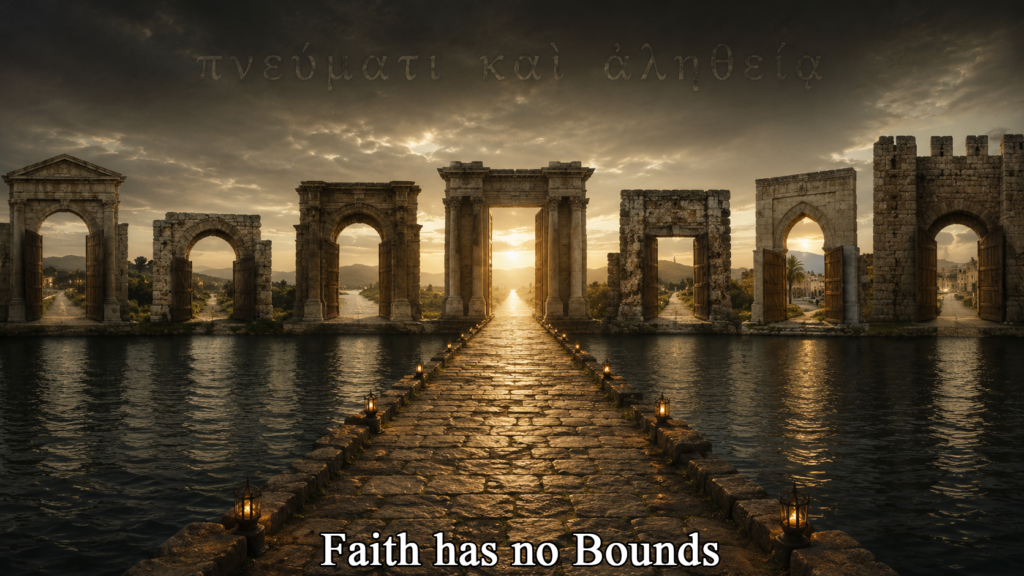
“Then Jesus answered and said to her, ‘O woman, great is your faith! Let it be to you as you desire.’ And her daughter was healed from that very hour.” — Matthew 15:28, NKJV
She had no claim. By every measure the first century world recognized, she stood outside the circle of covenant, outside the tradition, outside the community whose God she was approaching. She was not Jewish. Her people and the Jewish people had no dealings with each other. And she came anyway, pressing through every obstacle the encounter placed in her path—the disciples’ resistance, an initial refusal, a comparison that should have ended the conversation entirely—and she did not stop.
Jesus marveled. He does not marvel often. When He does, the object of His wonder is always the same: a faith that came from somewhere the tradition did not expect it.
The Centurion’s Theology
In Matthew 8:5–13, a Roman centurion comes to Jesus on behalf of his servant boy, paralyzed and suffering at home. The centurion commands roughly a hundred soldiers. He represents the occupying military force that holds Judaea under Roman control. He is not Jewish, has no covenant relationship with the G‑d of Israel, and no formal standing whatsoever to make this request of a Jewish teacher.
He comes anyway. And what he brings is not petition—it is theology.
He does not ask Jesus to come to the house. He asks Jesus to speak. “Only say the word, and my servant will be healed.” He explains his reasoning with the precision of someone who has thought carefully about what he is witnessing: he himself operates within a chain of command, speaks a word to soldiers who act on it from a distance, and he recognizes in Jesus an authority that works by the same principle at an entirely different order of magnitude. The Word is sufficient. Distance is not an obstacle. Physical presence is not required. What the centurion has grasped—without Torah, without tradition, without synagogue formation—is the nature of the Logos: that the creative and restorative Word operates across every boundary the world has drawn to contain it.
Jesus turns to the crowd. “I have not found such great faith, not even in Israel.” The servant is healed in that same hour.
The political weight of this moment is not incidental. A Roman officer—a representative of the empire that occupied the land, whose soldiers enforced the taxation that impoverished the people, whose presence was a daily reminder of subjugation—comes to a Jewish teacher in humility, states his theology with precision, and is held up before the crowd as the exemplar of faith. Not a priest. Not a scribe. Not a Pharisee. A centurion. The outsider reads the authority correctly. The insiders are still working it out.
The Woman Who Would Not Be Deflected
In Matthew 15:21–28, a Syrophoenician woman approaches Jesus on behalf of her demon-oppressed daughter. She is a Canaanite—the word Matthew uses is deliberately archaic, invoking the oldest category of Israelite otherness. She cries out for mercy. The disciples urge Jesus to send her away. Jesus’s initial response is a statement of limitation: “I was not sent except to the lost sheep of the house of Israel.”
She kneels before Him. “Lord, help me.”
What follows is one of the most theologically charged exchanges in the Gospels. Jesus says: “It is not good to take the children’s bread and throw it to the little dogs.” The metaphor is stark. The children of the covenant first; the bread is for them. And she does not flinch. She takes the metaphor and turns it with a precision that is itself an act of faith: “Yes, Lord, yet even the little dogs eat the crumbs which fall from their masters’ table.”
She is not arguing against the priority of Israel. She is arguing that the table is large enough, the bread abundant enough, that even the crumbs that fall from it carry the power of the whole. She accepts the terms of the exchange and wins on those terms. Jesus marvels. “O woman, great is your faith! Let it be to you as you desire.” Her daughter is healed from that very hour.
The persistence itself is the faith. She did not arrive with correct doctrine. She did not arrive with covenant credentials. She arrived with the absolute conviction that what she sought was available to her—and she would not stop pressing until she found it. The kingdom does not turn away that kind of asking.
The One Who Returned
In Luke 17:11–19, ten men with leprosy call out to Jesus from a distance—they stand apart, as the Levitical code requires, unclean, excluded from community until a priest pronounces them clean. Jesus tells them to go and present themselves to the priests. The healing happens as they go, in motion, before they arrive. The Word already spoken; the restoration occurring on the road.
Nine continue to the Temple, as instructed. One turns back.
He is a Samaritan.
The Jewish-Samaritan schism runs deep and bitter. After the Assyrian conquest of the northern kingdom in 722 BCE, the region of Samaria was resettled with peoples from other nations who intermarried with the remaining Israelites. The resulting population—the Samaritans—maintained their own version of the Torah and their own temple on Mount Gerizim, rejecting the Jerusalem Temple entirely. Centuries of mutual contempt followed. Jews and Samaritans, in the conventional understanding of the first century, shared nothing but a disputed and distant ancestor. They did not speak. They did not travel through each other’s territory if it could be avoided.
This Samaritan—healed alongside nine Jewish men, all of them given the same instruction, all of them sharing the same restoration—turns back. He falls at Jesus’s feet and gives thanks. Jesus looks around. “Were there not ten cleansed? But where are the nine? Were there not any found who returned to give glory to G‑d except this foreigner?”
The nine do what religion instructs. The Samaritan does what encounter demands. He recognizes not merely that something has happened to him but who has made it happen—and he returns to the source. The nine are restored to community. The Samaritan receives something more: “Arise, go your way. Your faith has made you well.” The word translated well is sōzō—saved, made whole, restored entirely. The healing that the nine received was physical. What the Samaritan received went further.
It also echoes the Levitical framework Jesus worked within throughout the healing narratives. He sent all ten to the priests—not to abolish the Torah’s prescribed path for restoration to community, but to fulfill it. The Samaritan’s return does not circumvent that; it adds to it. There is an irony worth naming: had the Samaritan continued to Jerusalem as instructed, he would almost certainly have been turned away at the Temple gates—the schism ran that deep. He returned to Jesus not merely out of gratitude but because the source he had found was the only one fully open to him. The nine did what religion instructed. The Samaritan did what encounter demanded. The law provides the structure. The encounter provides the depth.
Living Water
In John 4:1–42, Jesus sits down at a well in Samaria—Jacob’s well, ancient ground, the kind of place where the tradition is thick underfoot. A woman comes to draw water. Alone, at midday, which is to say: at the hour when no one else comes, for reasons the text leaves the reader to understand. She has had five husbands. The man she is with now is not her husband.
Jesus asks her for a drink.
She is astonished. Jews do not speak to Samaritans. Men do not address women alone at wells. Every convention of the encounter forbids this conversation. And He opens it anyway—with a request, not a teaching; with need, not authority; with the posture of someone who wants something from her rather than someone who has come to instruct her.
What follows is the longest recorded conversation Jesus has with any individual in the Gospels. And at its center is a distinction that carries the essay’s entire argument:
“Whoever drinks of this water will thirst again, but whoever drinks of the water that I shall give him will never thirst. But the water that I shall give him will become in him a fountain of water springing up into everlasting life.” — John 4:13–14, NKJV
The well she comes to every day satisfies temporarily and requires return. The living water Jesus offers becomes a source within—not a supply drawn from outside but a spring that wells up from within the person who receives it. The displacement she has sought to fill at every surface well is not a displacement surface wells can heal. What she lacks is not water. It is the living water that restores what has been displaced from its created wholeness, the same restorative Word that has moved through every healing account in a different register.
She asks about worship. Where is the proper place—this mountain, as her tradition holds, or Jerusalem, as the Jewish tradition holds? The schism between Samaritan and Jew has a geography; the question is a genuine one, the wound of centuries in it.
Jesus does not adjudicate the dispute. He dissolves it:
“Woman, believe Me, the hour is coming when you will neither on this mountain, nor in Jerusalem, worship the Father… But the hour is coming, and now is, when the true worshipers will worship the Father in spirit and truth; for the Father is seeking such to worship Him.” — John 4:21–23, NKJV
Neither mountain. Neither location. The hour is coming—and already is—when the question of where to worship will be superseded entirely by the question of how. Spirit and truth. Not geography. Not institutional affiliation. Not which mountain your ancestors stood on. The kingdom is not locationally bounded. It never was. And the one who receives this teaching first—before the disciples, before any crowd, in the middle of the day at a Samaritan well—is a woman her own community would have preferred to avoid.
She leaves her water jar and goes into the city. “Come, see a man who told me all things that I ever did. Could this be the Christ?” Many of the Samaritans believe because of her testimony. Many more believe when they hear Him directly and say: “This is indeed the Christ, the Savior of the world.”
Not the Savior of Israel. The Savior of the world.
What the Insiders Missed
The centurion arrived with a theology of the Word that the disciples had not yet articulated. The Syrophoenician woman pressed through every obstacle with a faith the crowd around Jesus had not demonstrated. The Samaritan returned when the nine did not. The woman at the well received the teaching on living water and worship in spirit and truth—the essay’s deepest teaching on the nature of the kingdom—before anyone else.
In every case, the one who receives is the one the tradition had placed outside. In every case, what they bring is not correct doctrine or covenant credentials but recognition—of authority, of presence, of what is actually available and what it would cost them not to reach for it. This is what Jesus calls great faith. Not propositional belief. Not institutional membership. The Greek is pistis—loyalty, trust, covenant fidelity. The centurion trusted the authority he recognized. The Syrophoenician woman trusted that the table was large enough. The Samaritan trusted that what had happened to him pointed back to a source worth finding. The woman at the well trusted what she heard enough to go into the city and tell everyone.
The covenant has never recognized the gates the gatekeepers erect. The G‑d named in the Shema is the G‑d of all creation—the one who spoke light into being before there was a covenant, before there was an Israel, before there was a mountain. The healing narratives have been demonstrating this from the beginning: the Word restores whoever comes into contact with it, across whatever boundary the world has drawn to limit access. The gentile healings make the implication explicit.
The insiders—the scribes, the Pharisees, the crowd that had grown up within the tradition—had the map and could not always read it. The outsiders arrived without the map and sometimes read the territory more clearly. Jesus marveled both times. The marvel is not condescension. It is the genuine astonishment of someone who knows exactly how hard this kind of recognition is, and who sees it appearing where no one expected to find it.
Neither on this mountain, nor in Jerusalem. The hour is coming, and now is. The covenant has never recognized the gates the gatekeepers erect, and the Word that speaks creation into being speaks restoration into whoever receives it—across every boundary the world has drawn to keep it contained. The kingdom does not require the right mountain. It requires the right kind of asking.

Discover more from Many Lamps, One Flame
Subscribe to get the latest posts sent to your email.