
Og, King of Bashan, and the Tragedy of Seeing Without Perceiving
The battle at Edrei takes three verses. Numbers 21:33–35 dispatches it with the economy of a ledger entry: Og came out, Israel fought, Og fell, his sons fell, his land was taken. No eulogy. No elaboration. The narrative moves on without looking back.
But the Talmud and Midrash know exactly who Og is. They have been tracking him since before the flood. To the tradition, three verses are not a biography—they are a closing parenthesis on a life that stretches back further than almost any figure in all of sacred history. He was there when the world drowned. He was there when Avram became Abraham. He was there through Egypt, through Sinai, through forty years of wilderness. He watched more of the unfolding of covenant than any human being who ever lived.
And he was unchanged by every moment of it.
That is what makes Og worth excavating. Not the mountain. Not the giant. The witness who never became a student.
Before the World We Know
To understand Og at Edrei you have to begin where the tradition begins—with Genesis 6:1–4, the rupture that preceded the flood. The Watchers—the bnei Elohim, sons of G-d—descended and took human wives. From that transgression came the Nephilim, the giants of the ancient world, beings whose very nature straddled the boundary between the human and the divine in a way that was never sanctioned and never stable.
Og was their heir. Niddah 61a identifies Sihon and Og as brothers, sons of Ahijah, son of Shemhazai—one of the two fallen Watchers of Genesis 6. This is not incidental genealogy. It places Og within a specific lineage of beings who belong to the world before the flood’s moral reckoning, creatures who carry within them a pre-covenantal mode of being. He is not a man who grew very large. He belongs to a category that Sinai’s moral architecture was never designed to contain.
This is why the rabbis keep reaching backward to locate him. He is not merely old. He is old in a particular way—continuous with a world that was supposed to have ended.
The Flood That Didn’t Reach Him
The flood was not a rain event. The tradition is unambiguous on this point. Rosh Hashanah 12a and Sanhedrin 108b explain it in terms of measure-for-measure justice: the generation of the flood sinned with burning passion—the rabbis use the word chamin, heat—and so they were punished with scalding water. Pirkei DeRabbi Eliezer 22 is explicit: G-d heated the waters as they broke forth. This was total annihilation, designed to be inescapable.
Almost inescapable.
Zevachim 113b records the rabbinic debate about how Og survived at all. One opinion: the floodwaters never reached the land of Canaan. Another: Og was simply tall enough that even the surging waters only reached his knees. The Talmud holds both without resolving them—which is itself a kind of answer. Og’s survival resists clean explanation because it was, at its root, an anomaly.
Pirkei DeRabbi Eliezer 23 fills in what actually happened. Og clung to the rungs of the Ark as the waters rose. Noah, the tzaddik, took pity on him and fed him through a hole bored in the hull. In exchange, Og swore eternal servitude to Noah and his line. The oath was witnessed. The arrangement held.
But G-d was displeased—and the text does not pause to elaborate on why. The displeasure is noted and the narrative moves on. The rabbis, however, understood the problem intuitively: the Ark was meant to be a crucible. The flood was designed to wipe the pre-covenantal world clean, to annihilate the Nephilim and their inheritance and start the human project again. Noah’s chesed—genuine, generous, the act of a righteous man—accidentally smuggled a fragment of the old world through the judgment. Og survived the flood without passing through it. He emerged from the other side of the catastrophe unchanged because he had ridden above it, sheltered by the mercy of a man who did not fully reckon the cost.
Survival is not the same as transformation. That distinction will define everything that follows.
The Witness Who Watched
The next time Og appears in sacred history he is performing an act of apparent loyalty. Genesis 14:13 mentions a fugitive who runs to tell Avram that his nephew Lot has been taken captive in battle. The text gives no name. But Bereishit Rabbah 42:8 identifies him: the fugitive is Og.
Reish Lakish, in the name of Bar Kappara, is precise about both the act and the motive. Og ran to Avram—the Midrash is candid that his hope was to see Avram die in battle so he might take Sarai—and yet the act itself earned him divine reward for the strides he walked. G-d sees into both simultaneously and renders a double verdict: Og will be granted long life for his legs, and his end will come at the hands of Avram’s descendants.
This is the kavanah problem in its sharpest form. The outward act is loyal. The inward reality is corrupt. Og is adjacent to covenant—living in its orbit, performing its gestures—but never of it. His action and his intention point in opposite directions, and G-d tracks both.
The tradition also places Og in Avram’s household after the rescue of Lot. He is not a stranger who wanders in. He is present, proximate, embedded in the emerging story of the covenant people. He witnesses what Abraham witnesses. The promises. The covenant of circumcision. The arrival of Isaac. The binding on Moriah.
He watches. And nothing enters him.
The Long Wait
Consider what Og lived through.
He smelled the pitch of the Ark. He sat in Avram’s tent. He outlived the entire generation of the patriarchs—Abraham, Isaac, Jacob. He outlived Joseph. He outlived the four hundred years of Egypt. He was alive, somewhere in the Transjordan, when Moses stood before Pharaoh. He was alive when the sea split. He was alive through forty years of wilderness wandering, watching from the edges of the narrative as a people was forged, a Torah given, a tabernacle built, a covenant ratified across generations.
He is a living archive of sacred history. He possesses more data, more direct witness, more sheer accumulated observation than any human being who ever walked the earth.
And he cannot read a word of it.
The distinction the tradition draws here is between re’iyah—sight, the physical act of witnessing—and binah, the inward understanding that builds, that integrates, that transforms the one who receives it. Binah does not merely process information. It allows what is seen to change the structure of the seer. Og had perfect re’iyah.He saw everything. He had no binah. The flood was a thing that happened to him. The covenant was a structure he lived near. Sacred history moved through his field of vision for centuries and left no mark on the interior.
This is not evil, exactly. It is something quieter and more final: impermeability.
Edrei
By the time Israel arrives at the border of Bashan, Og has watched Sihon fall. Sihon was his brother—Niddah 61a again—and Sihon’s kingdom had just been dismantled by the same people now camped at his door. The political calculus is simple: the buffer is gone. Israel has just dismantled his neighbor’s kingdom and stands, organized and advancing, at the edge of his own. But what Og faces is not merely a military threat. He is looking at the final realization of the curse pronounced over him when he ran to Avram with treachery in his heart. He is looking at Abraham’s descendants, organized as a covenantal nation, marching under Torah toward the land he occupies.
Before the battle, Moses is afraid—but not of Og’s size. Deuteronomy 3:2 records G-d having to tell Moses explicitly: do not fear him. What Moses fears is Og’s accumulated merit from the Abraham episode. The act of those strides, however corrupt the motive, had been credited. Moses worries that the ancient ledger still carries weight. G-d’s reassurance is itself a theological statement: the merit is spent. Og has drawn on it long enough. The account is closed.
What Og does next is recorded in Berakhot 54b, and the Talmud tells it straight, without apology for its proportions.
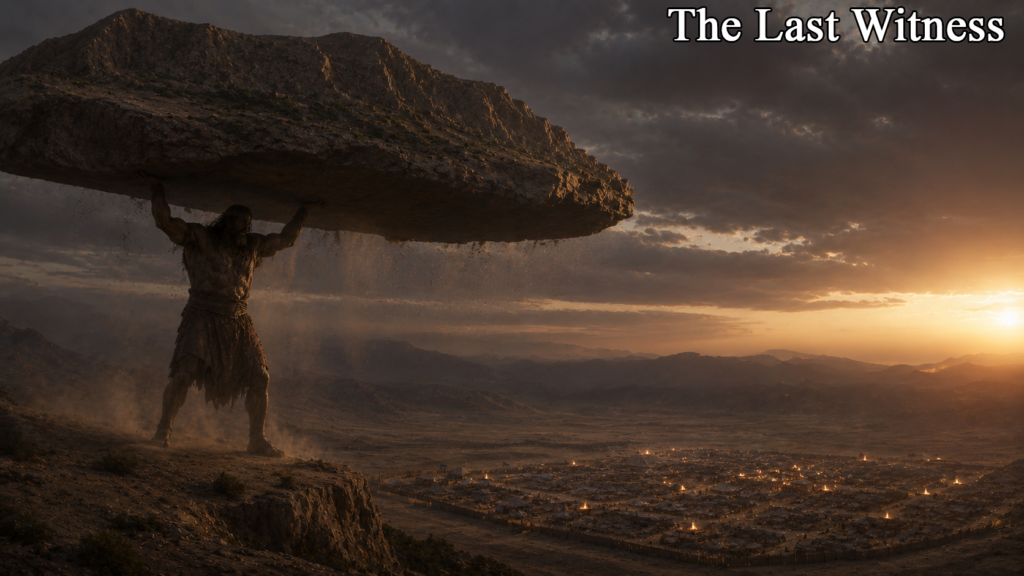
Og measures the Israelite camp: three parasangs across. He goes and uproots a mountain three parasangs long, lifts it onto his head, and carries it toward the encampment, intending to drop it and end the matter in a single stroke. G-d sends grasshoppers. They bore through the peak of the mountain. It slides down around Og’s neck. He tries to remove it, but his teeth—extended, enormous—lock into the rock on either side of his head and he cannot free himself. The Talmud reads this through Psalms 3:8: You break the teeth of the wicked. The mountain has become a collar. The weapon has become a trap.
Moses, ten cubits tall, takes an axe ten cubits long, leaps ten cubits into the air, and strikes Og in the ankle. Og falls. The battle is over.
The Talmud knows how this sounds. It does not soften it. The absurdity is not incidental—it is the point.
What the Ankle Means
Og went to the mountain. That choice is the whole story.
He did not appeal to the oath sworn to Noah’s line. He did not invoke the mercy that had preserved him through the flood. He did not speak, negotiate, or reckon. He reached for the oldest thing he knew—primordial mass, geological force, the physics of a world before covenant existed. He fought in the only language he had ever learned.
G-d responded with grasshoppers and an ankle.
The disproportion is not comedy, though it reads as comedy. It is a precise theological statement about what kind of power actually moves history. The mountain is the wrong weapon in the wrong register entirely. Og’s mode of being—overwhelming, geological, pre-moral. It is simply no longer operative. Sinai changed the structure of reality. Covenant displaced gigantism as the relevant force in human affairs. Og is still fighting as though the flood were yesterday, as though scale and mass were the currencies that mattered. But the currency changed, and he never noticed, because noticing would have required binah—the inward turning that Og never made.
This is the tragedy the tradition is circling when it keeps dragging Og backward through sacred history. He was present for the flood and did not receive it. He was present for the covenant of Abraham and did not enter it. He watched Israel carry Sinai through forty years of wilderness and remained untouched. He is the longest-lived witness in all of sacred history and the least transformed by what he saw. The mountain was all he had left—the last gesture of a world that was supposed to have drowned with the generation that made it.
Moses leaps. The ankle gives. And Og, King of Bashan, last of the Rephaim, the one survivor who was never quite a survivor, falls back into the world he had always refused to leave.

Discover more from Many Lamps, One Flame
Subscribe to get the latest posts sent to your email.