
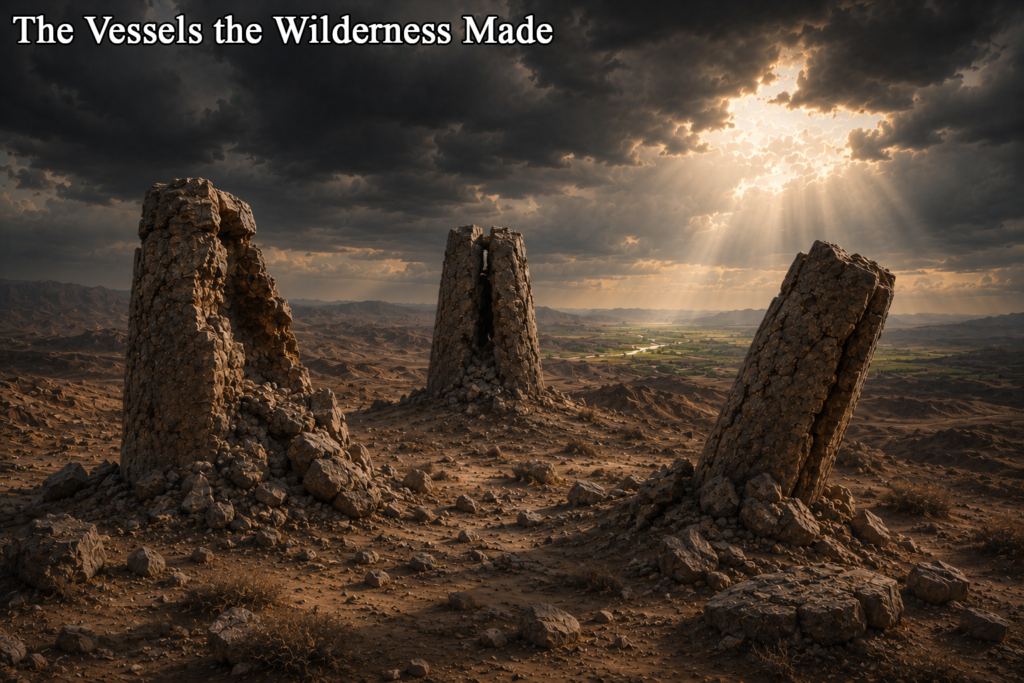
Picture Moses before the rock. Not the strike—the moment before it. The rod is raised. The people are behind him, assembled as they have been assembled a hundred times before, with the same complaint they have lodged a hundred times before. Miriam is three days in the ground. Aaron stands beside his brother, the last of what has always been three. Forty years of carrying a people who could not stop being afraid, who could not stop being hungry, who could not stop being impossible—forty years compressed into a single suspended instant. And somewhere in the space between the rod and the rock, something that had held for four decades finally gave. The crack became a crevasse.
The Chapter That Dismantles Everything
Numbers 20 does not ease the reader into what it is doing. It moves with the brutal economy of a document that has no time for grief because the people it describes had no time for grief either. Verse 1: Miriam dies at Kadesh and is buried there. Verse 2: the community has no water, and they assemble against Moses and Aaron. No mourning interval. No grace extended. The same reflex that has defined forty years activates the moment the well runs dry—which is, in the rabbinic tradition, the moment it does run dry, because Miriam’s well was Miriam’s well. The people feel the absence without understanding its source. They know thirst. They do not yet know what they have lost.
By the chapter’s end, Aaron’s priestly garments have been transferred to his son Eleazar on the summit of Mount Hor, and Aaron has died on the mountain. The people weep for thirty days—the mourning period Miriam did not receive, noted here without comment, quietly devastating. Three losses in a single chapter: the well, the priesthood, and Moses’s future, though he does not die here. What Israel has known for forty years—the three figures who carried them through the wilderness, who held the structure together when it should have collapsed, who embodied between them every function the desert required—is being systematically dissolved. The generation that the wilderness made is passing. The chapter is not a series of unfortunate events. It is a completion.
The Lower Triad—What They Were Built to Carry
To understand what is dissolving, we must first understand what it was. The Kabbalistic tradition maps divine emanation across the sefirot of the Tree of Life, and within that structure Moses, Aaron, and Miriam occupy the lower operational triad—the tier closest to human experience, through which shefa, divine flow, descends from the harmonizing center above into the world below. They did not generate the light. They carried it.
Miriam stands in the register of Malchut and Chesed: the earthly reception point and the outward abundance of blessing made physical. Malchut has nothing of its own—it is entirely what it receives from above. Miriam’s well does not generate water; it channels what descends. And water, in the wilderness, is not a convenience. It is the condition of every other condition. Without it, there is no food, no movement, no life, no forty years. Every soul Israel sustains in the desert passes through Miriam’s reception before it reaches anything else. The rabbinic tradition marks this precisely: the well follows Israel for as long as Miriam lives, and the three days between her death and the complaint about water is exactly how long a people can survive without her. She is the ground of reception for a people who needed, above all, to be sustained. When she dies, the reception point of that generation closes. The well dries because the vessel that carried it is gone.
Aaron occupies Chesed and Hod: the priestly outpouring of divine blessing—the Birkat Kohanim flowing through his hands—and the structured form that gives the sacred service its architecture. Hod is the left column’s capacity to receive, shape, and give definition to what the right column extends. Aaron does not pour out blessing spontaneously; he channels it through the precise ritual form that the priesthood embodies. When Moses transfers Aaron’s vestments to Eleazar on Mount Hor, he is not performing an administrative succession. He is passing Hod’s function to the vessel prepared to carry it into the next stage.
Moses is Netsach: endurance, transmission, the sustained movement of covenant into history across forty years of resistance. Not the priestly outpouring, not the earthly reception—but the persistence of the transmission itself, the prophetic thread that does not break even when everything around it is breaking. Netsach is what makes the carrying possible across time, what holds the channel open when the people make it as difficult as possible to hold.
Together these three form the lower operational triad around Yesod—the position of the perfectly transparent conduit. Proverbs 10:25 names it precisely: v’tzaddik yesod olam—the righteous one is the foundation of the world. The tradition embodies this in Joseph: tempted, stripped of everything, sold into slavery, and yet the channel never closes. He transmits shefa into Egypt and sustains the world through famine without claiming ownership of what flows through him. That is Yesod embodied. The Tzaddik through whom shefa passes without obstruction, the unifying channel between Tiferet above and Malchut below. The wilderness generation never had a Yesod. They had the three vessels surrounding that position, holding the form and sustaining the flow and enduring the transmission—but no perfectly transparent center. Yesod is what Canaan requires. Tiferet—the harmonizing center, the Holy Name, Shalom itself—is what the entire triad was oriented toward. They carried the flow downward from that center into the people, into the desert, into forty years of formation. They did not fail to carry it. They carried it completely, until they could carry it no further.
The Signs Were Already There
The wilderness did not only form these three. It marked them. And the marks were visible before Numbers 20—not as moral failures in the ordinary sense, but as the inevitable tectonic wear on vessels carrying more than vessels were made to bear indefinitely.
Miriam’s challenge in Numbers 12 is the first signal: “Has G‑d spoken only through Moses? Has He not spoken through us also?” The channel asserting its own centrality. Malchut reaching toward the authority that belongs above it. The misorientation is corrected—she is struck with tzara’at and healed, the correction landing clearly—and she continues. But the strain is visible. The vessel has shown where it can crack.
Aaron at the golden calf does not initiate the catastrophe. He does something in some ways more telling: he gives it form. When the people demand a god they can see, Aaron collects their gold and shapes it. Hod lends its architectural function to the people’s misalignment, structuring what should not have been structured, giving definition and presence to an idolatry it did not choose but did not refuse. The vessel that gives form to holy things gives form instead to the wrong desire of an untransformed people. Aaron survives this too. But the mark remains.
Moses carries his own accumulating signs: the fury that surfaces repeatedly, the grief held for decades without adequate expression, the weight of a people who have never stopped testing the limits of what one man can transmit without breaking. He has struck in anger before. He has spoken from exhaustion before. He has, across forty years, shown every sign of a vessel operating at the outer edge of its capacity. The wilderness needed everything he had. It took everything he had. And then it asked for more.
These are not petty moral failures. They are the inevitable tectonic wear of the specific architecture required to carry an entire people through an entire wilderness. The cracks did not disqualify the vessels. The vessels fulfilled their function completely, cracks and all. But the cracks were there. And at Meribah, under the weight of everything Numbers 20 had already taken, one of them opened.
Meribah—The Moment the Vessel Strikes
G‑d’s instruction to Moses in Numbers 20:8 is precise: “Take the rod and assemble the community, you and Aaron your brother, and speak to the rock before their eyes, and it will give its water.” Not strike. Speak. The method of transmission has changed. At Horeb in Exodus 17, striking was the command; Moses obeyed and water came. The same physical gesture, previously sanctioned, has been superseded by something that requires a different orientation entirely—not force but address, not the rod’s impact but the prophet’s voice. To speak to the rock is to transmit. To strike it is to command. The distinction is the whole of the kavanah question.
Moses speaks first. Numbers 20:10:
“Listen now, you rebels—shall we bring water out of this rock for you?”
Two failures in one sentence, and both of them are visible in the grief and fury that produced them. Rebels: the rage undisguised, forty years of accumulated impossible people pouring through the channel in a single word, Miriam three days dead and the complaint already assembled, the same complaint, again. And we: the conduit claiming ownership of the current. Not “G‑d will bring water” but “shall we bring water”—as if the water belongs to Moses and Aaron, as if the forty years of carrying have made them the source rather than the channel. In that single syllable, the vessel forgets what it is. And then the rod comes down.
This is not Korach’s misorientation. Korach turned his kavanah inward deliberately, out of ambition, out of a calculated reading of his own theological position. This is not the spies’ failure in Shelach, the gaze turning horizontal out of fear, the ten men who could not lift their eyes above the giants in the land. This is something more human and more devastating than either: a man of complete faithfulness, in a moment of absolute depletion, wielding what has always flowed through him as though it were his own. The frustration is comprehensible. The grief is real. The exhaustion is forty years earned. None of it changes what happened. For one struck blow, Moses is Korach.
The Consequence That Was Already Written
G‑d’s response in Numbers 20:12 is not delivered in anger. It is delivered with the precision of a structural diagnosis: “Because you did not trust Me enough to affirm My sanctity in the sight of the Israelite people, therefore you shall not lead this congregation into the land that I have given them.” The consequence fits not as retribution but as revelation. Moses will see the land and not enter it. Aaron will die on Mount Hor. Miriam has already died at Kadesh. All three remain in the wilderness.
This is not primarily a judicial sentence. It is the structural completion of what they were. Moses, Aaron, and Miriam were formed by the wilderness, for the wilderness, and for the specific people the wilderness was trying to transform. They bore the mark of that formation in everything they did—in Miriam’s well, in Aaron’s ritual architecture, in Moses’s endurance across forty years of an impossible people. The vessels that carried Israel through the desert were shaped by the desert. They cannot be what Canaan requires, because Canaan is a different kind of formation entirely: not survival and transmission but inhabitation, the complex, rooted, politically embodied life of a people in their own land.
Joshua and Caleb oriented their gaze correctly in Shelach, when ten others could not. They are the vessels the promised land can receive—formed in the wilderness but not broken by it, marked by the desert without being made only for the desert. Their generation did not carry the people through the worst of it. They walked through the worst of it as the people being carried. And that difference—the difference between the ones who bore the weight and the ones who were borne—is the structural distinction between those who enter and those who remain.
The exclusion of Moses, Aaron, and Miriam from the promised land is not punishment. It is completion. Their function has been fulfilled. The vessels have carried what they were made to carry, across every mile of wilderness that required carrying. What is left of them now belongs to the wilderness that formed them. And the people move on.
Tiferet Does Not Fail
The water comes out of the rock anyway.
G‑d does not withhold the flow because the prophet failed the protocol. Moses strikes when he was told to speak, wields what he was told to transmit, claims in a moment of fury what was never his to claim—and the rock opens, and the water pours out, and the people drink. The consequence for Moses is real and it is structural and it will stand. And the water comes out of the rock anyway.
This is what Tiferet means in practice. The harmonizing center, the Holy Name, Shalom itself—the sefirahfrom which the lower triad received everything it carried—does not fail when the vessels fracture. The source is not diminished by the cracking of the channels. The divine flow is larger than the integrity of its human carriers, larger than the accumulated grief of forty years, larger than a rod striking stone when a voice was required. Tiferet holds. The lower triad passes. Israel drinks and moves toward the land.
This is the arc the three portions form together. In Shelach, the eye misorients and a generation loses its way. In Korach, a man of genuine theological insight turns his kavanah inward and attempts to make the vessel into the fountain. In Chukat, the most faithful of all the wilderness’s carriers—the three who held the lower triad together for forty impossible years—show, each in their way, that even the most faithful vessel is shaped by what it carries through. The wilderness made them. The wilderness marked them. And when the wilderness was done with what it needed them to do, the wilderness kept them.
None of this diminishes the sin at Meribah. The misorientation was real. The kavanah collapsed in the moment it was most needed. Taking as one’s own what flows only through—this is the error that runs through all three portions of this arc, in three different registers, for three different reasons, by three different kinds of people. The spies could not lift their gaze. Korach would not surrender his claim. Moses, in one exhausted and grief-broken instant, forgot the difference between the rod in his hand and the source of what the rod was meant to convey.
The image of G‑d in which we are made is a beginning, not a destination. It is the capacity for alignment, not alignment itself. The vessels the wilderness made carried that capacity faithfully across forty years of everything the wilderness could produce. And when they cracked—as vessels shaped by that much weight, over that much time, for that many people, inevitably must—the source from which they drew did not crack with them. It held the people. It holds still.

Discover more from Many Lamps, One Flame
Subscribe to get the latest posts sent to your email.