
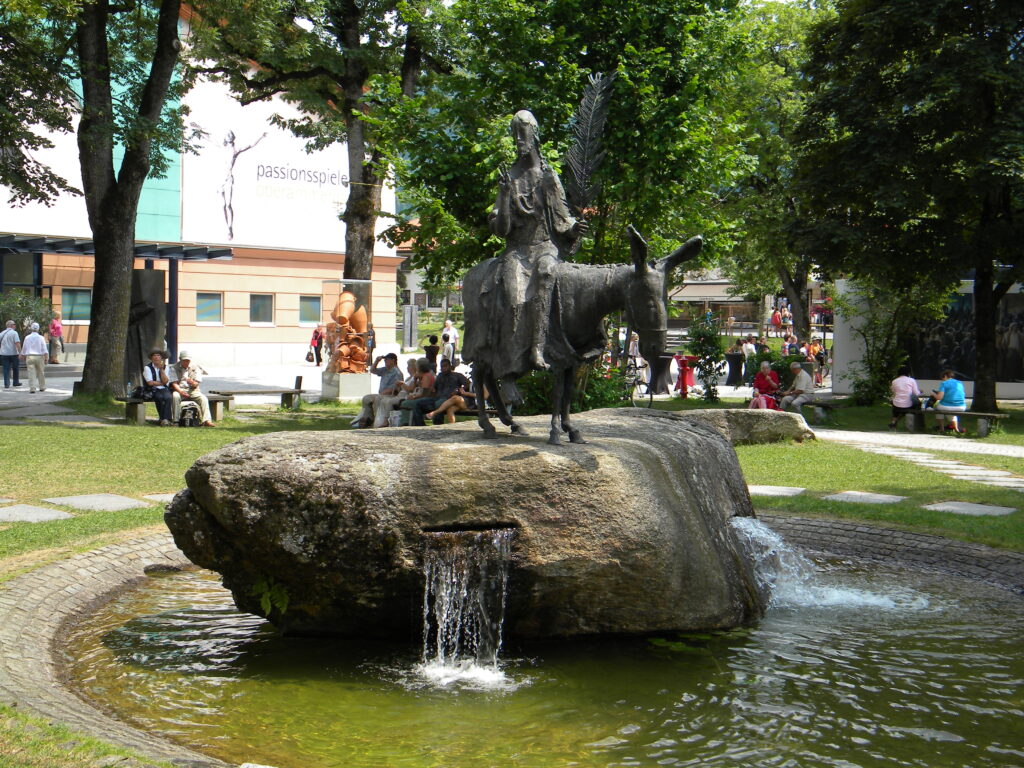
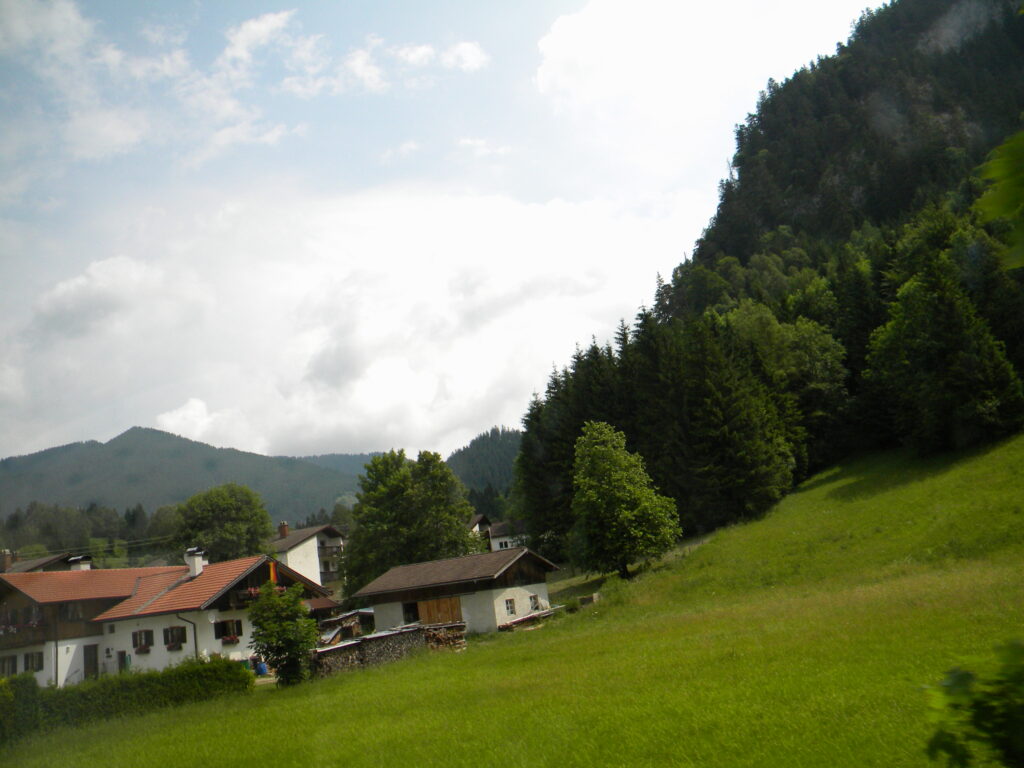
This is what it looks like before you arrive.
There is a particular quality to the German countryside that is difficult to explain to someone who has never stood inside it.
I love the American countryside. The long fields of Ohio and Indiana, the quiet dignity of a country road disappearing into the distance, the sense that the land goes on forever and the pace of life slows to match it. There is beauty there—real, uncomplicated, open beauty. But Germany feels different. Not more beautiful. Older. The same farms exist, the same green rolling hills and quiet lanes. But everything carries the weight of accumulated time. The buildings standing in these villages were old before the United States existed. The churches have been watching generations pass for centuries. The homes, the streets, the murals painted across building faces and maintained with quiet domestic care—all of it radiates a sense not of construction but of continuation. Life here is not being built. It is being carried forward.
When I came to Oberammergau, that feeling struck me the moment the village came into view. It sits in a valley in the Bavarian Alps, the mountains pressing in close on every side, and it is almost aggressively beautiful—the kind of beauty that seems arranged, almost theatrical, as though the place has been composing itself for centuries and has finally gotten it right.
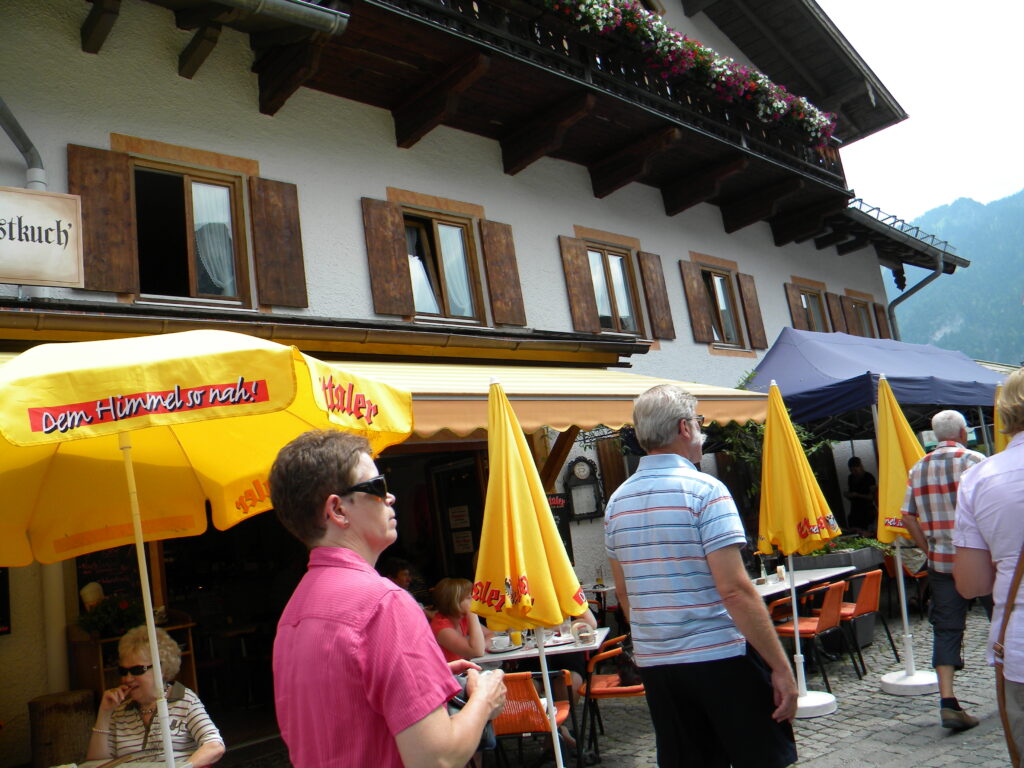
Dem Himmel so nah! — So close to heaven.
Restaurants spill their tables out into the squares and the lanes. Window boxes overflow with geraniums in summer. The cobbled streets wind past homes that look less constructed than inherited, each one carrying the quiet confidence of a structure that expects to be here for another few centuries. People linger over meals in the way that people linger when they are not in any particular hurry to be somewhere else. It felt, I remember thinking, like the sort of place where a person could disappear from modern life and live quietly for the rest of his days. Norman Rockwell would have set up his easel in one of those squares and painted exactly what he saw, and the result would have looked like something he invented.
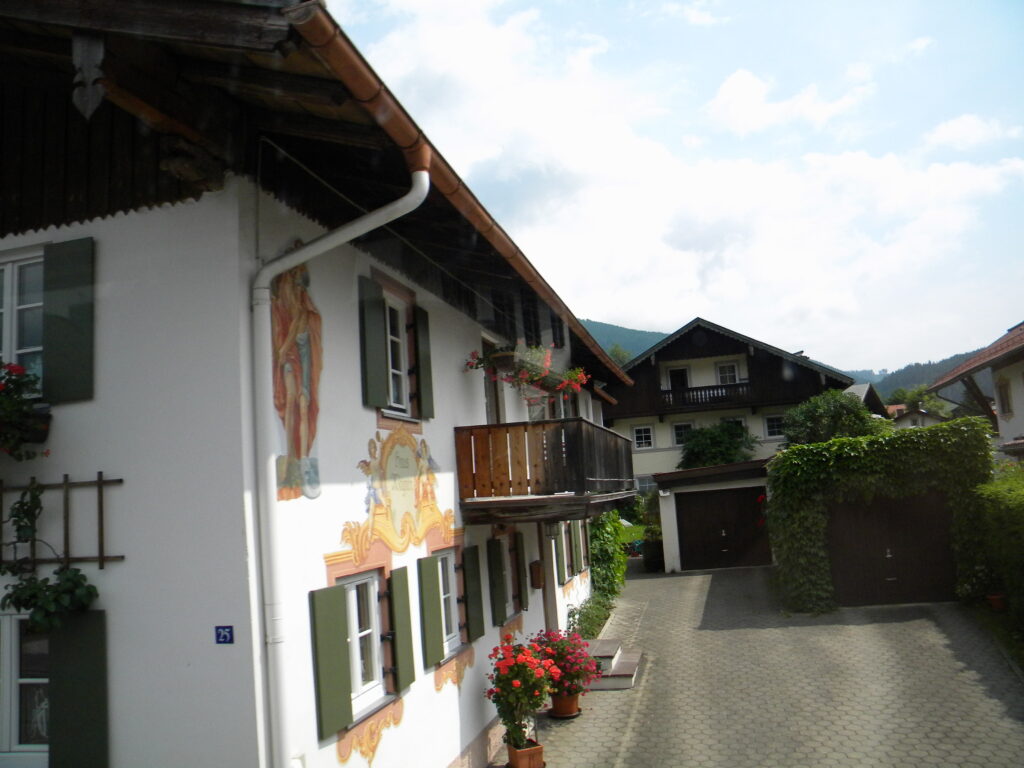
Geraniums on the balcony. Someone lives here.
What struck me most was not the tourist center, which was easy enough to account for—any beautiful village in Bavaria draws its pilgrims in summer. It was the residential streets. The neighborhoods where people actually lived. The same Lüftlmalerei that covered the facades of shops and inns covered the sides of ordinary homes: saints, angels, Baroque cartouches framing windows, fairy-tale scenes running the full height of a building face as casually as wallpaper. The murals were maintained. Not preserved as artifacts—maintained, as a matter of course, because they had always been maintained. The sacred and the domestic occupied the same walls without any apparent awareness that the distinction required acknowledgment. The Passion on one, Hansel and Gretel on another.
The entire village felt deeply at ease with itself. Bucolic, in the precise sense—not a performance of pastoral life but the thing itself, continued without interruption across generations too numerous to count individually.
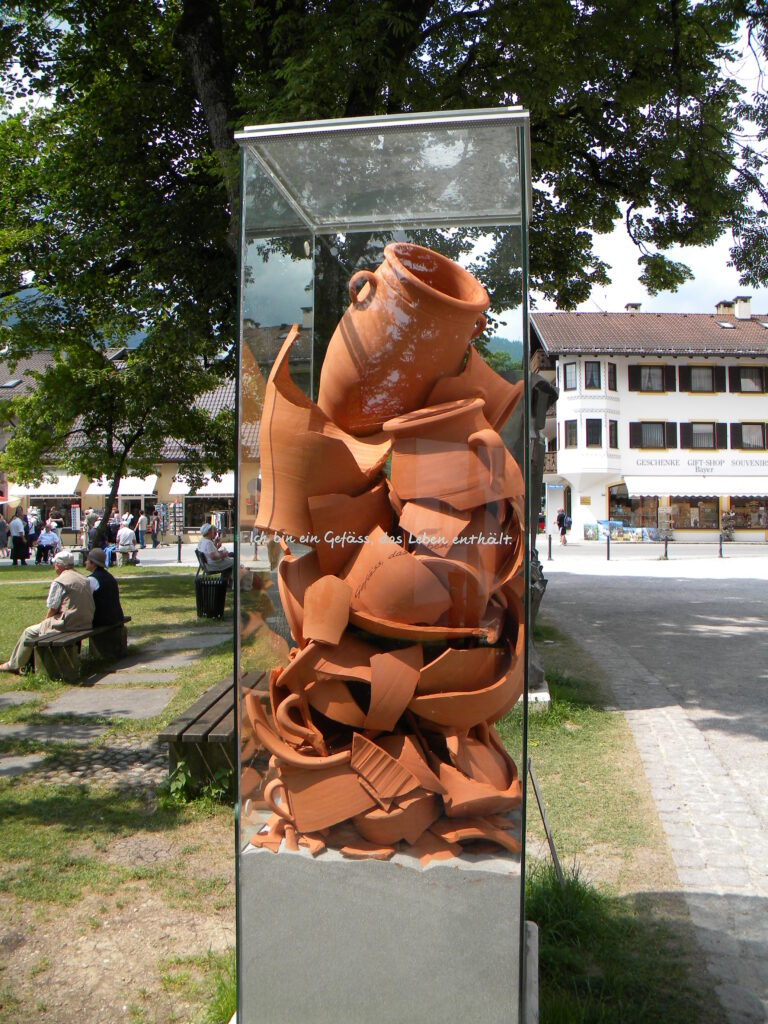
Inside: broken terracotta vessels. Inscribed on the glass:
Ich bin ein Gefäß, das Leben enthält.
I am a vessel that contains life.
In the public square, that summer, there stood a glass vitrine—a tall transparent case containing a pile of broken terracotta. Shards and handles and fragments of jars, heaped from floor to lid. On the glass, in white script: Ich bin ein Gefäß, das Leben enthält.
I am a vessel that contains life.
I stood in front of it for a while. I did not fully understand, at the time, what I was looking at.
I do now.
The Vow
In 1633, the plague was moving through Bavaria. The Thirty Years’ War had fractured central Europe, and the pestilence that followed in its wake did not distinguish between the faithful and the indifferent. The village of Oberammergau, nestled in the Ammergau Alps, made a bargain with G-d: perform the Passion of Christ every ten years, and be spared. The plague passed. They have kept the vow across nearly four hundred years—through the Enlightenment, through Napoleon, through two world wars, through the century that produced the gas chambers, into the present.
The cast is drawn exclusively from village residents. To perform in the Oberammergau Passion Play you must have been born there, or have lived there for at least twenty years. The roles pass through families. A man who plays a Roman soldier teaches the part to his son, who will teach it to his. The next production is scheduled for 2032. The vow is still being kept.
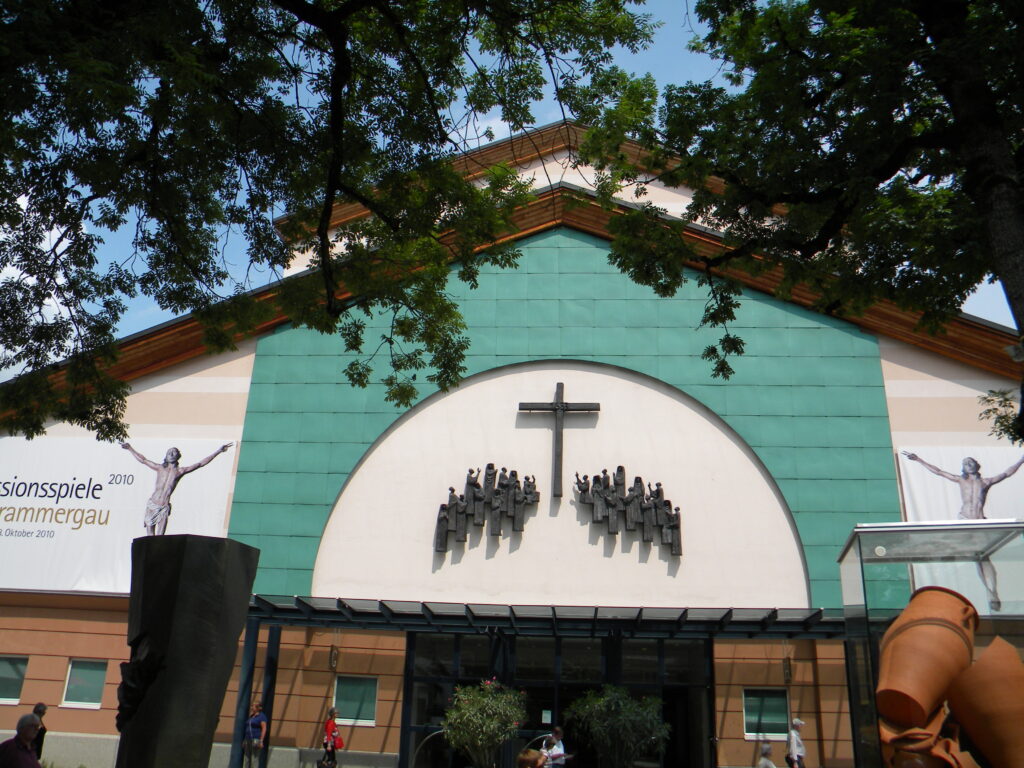
The cross and gathered figures above the entrance are built into the building itself.
To enter, you pass beneath them.
This is not a museum piece or a historical recreation. It is a living tradition—a community organized around a story it has been telling itself for nearly four centuries, with the discipline and intergenerational commitment that only a vow can sustain. The Passion is not something Oberammergau does. It is something Oberammergau is.
That is precisely what makes it useful as the entry point for discussion. Not because Oberammergau is exceptional. It is not exceptional. But it is unusually visible—and what it makes visible is the mechanism by which culture carries what it carries. Not through argument, not through formal instruction, not through institutional mandate. Through ritual repetition. Through inherited performance. Through the embodied transmission of gesture and role from one generation to the next, in the way the murals on the building faces are transmitted: not as artifacts requiring preservation, but as part of life requiring continuation.
Doctrine moves through books and councils and official declarations. Culture moves through bodies. That distinction—between what institutions announce and what communities actually carry—is the central argument. Oberammergau did not invent it. But for nearly four hundred years, it has been performing it.
The Führer Attends
In August 1934, Adolf Hitler attended the Oberammergau Passion Play. He attended twice, first the traditional 1930 performance then a special anniversary performance in 1934. He came with senior Nazi leadership, and the record of his visit is unambiguous: the play was, in his words, of significance for the Reich.
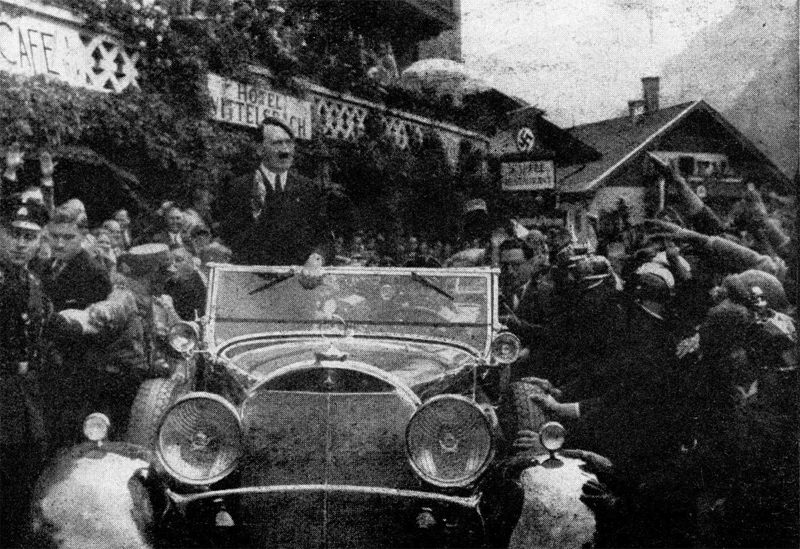
Swastika banners hang from the same buildings whose painted facades have carried saints and angels for generations.
He was not wrong about what he had seen. The 1934 script portrayed the Jewish leadership of first-century Jerusalem in terms that centuries of Christian theological tradition had established and refined: conspiratorial, bloodthirsty, the architects of an innocent man’s death. The crowd that calls for crucifixion, the priests who demand it, the people who accept collective guilt for the verdict—these were not neutral theatrical choices. They were a narrative inheritance, passed down through every prior production since 1634, rooted in a reading of the Gospel texts that the institutional Church had underwritten for more than a millennium.
The architect of the Final Solution encountered something in Oberammergau he recognized immediately—something that had been there, unremarked and unexamined, for three hundred years before he arrived. He did not bring the animus with him. He found it already present, wearing the clothing of devotion, tended as carefully as the painted facades and the geraniums in the window boxes.
That is a harder fact to sit with than the photograph itself. It is harder because it cannot be resolved by identifying a villain. The villagers of Oberammergau in 1934 were not, in the main, ideological Nazis. They were a community keeping a vow, performing a story they had performed for three centuries, in the form in which they had received it. The transmission mechanism does not require malice. It does not require intent. That is precisely what makes it a mechanism.
The Declaration
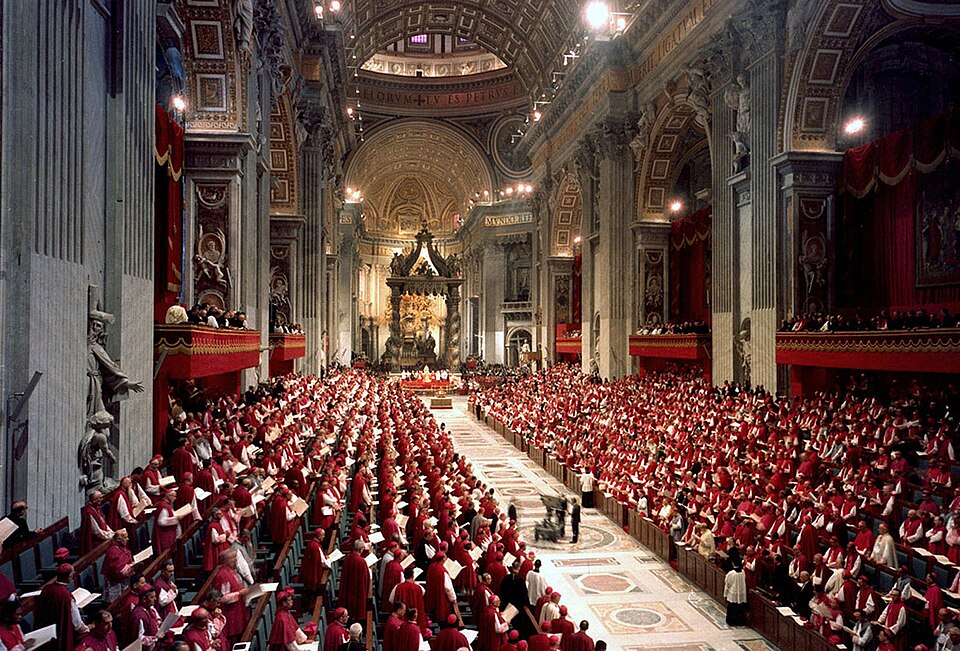
On October 28, 1965, the Second Vatican Council issued Nostra Aetate—the Declaration on the Relation of the Church with Non-Christian Religions. In its fourth section, the Council formally repudiated the charge of collective Jewish guilt for the crucifixion: what happened in the Passion, the declaration states, cannot be charged against all Jews then living, nor against the Jews of today. The deicide charge—the blood curse, the inherited guilt of an entire people across all generations for a verdict rendered by some of their ancestors against one of their own—was formally, institutionally, officially withdrawn.
This was not a small gesture. The deicide charge had underwritten the legal degradation, social exclusion, and periodic massacre of Jewish communities across Europe for more than a thousand years. Its formal repudiation by the largest Christian institution on earth was a genuine act of reckoning—however late, however incomplete in its reach.
Nostra Aetate, it should be said, traveled no further than Rome’s authority reached. It bound Catholic teaching and no other. The Protestant traditions—the Lutheran, Reformed, Baptist, Evangelical, and Pentecostal communions that together account for hundreds of millions of Christians worldwide—received no equivalent declaration, because no equivalent authority exists to issue one. Each tradition would have to reckon with the deicide charge on its own terms, through its own institutional processes, on its own timeline. Many have not done so to this day. The Southern Baptist Convention, the largest Protestant denomination in the United States, did not formally address Jewish collective guilt until 1995. Vast portions of global Evangelical Christianity have never addressed it at all—not because they considered and rejected the declaration’s logic, but because the declaration simply had no reach there. This remains visible today in productions like The Chosen—the most widely distributed Jesus narrative in history, made with genuine Evangelical devotion—whose treatment of the Passion carries all the structural weight of the classical telling, not because its creators chose contempt, but because the narrative itself does.
Oberammergau’s thirty-five year gap, in this light, is not a failure. It is a success story.
The Oberammergau script was not substantially reformed until the 1990 production. Further reforms came in 2000.
That is the gap. Twenty-five years at minimum. Thirty-five at the far edge. Between the institutional declaration and the living practice. Between what the Church announced through its proper channels and what the culture was still performing in the village square.
Doctrine travels fast. It moves through councils and encyclicals and formal revisions of catechism, through the proper channels by which institutions communicate their positions. Culture travels differently. It travels through the body of an actor playing Caiaphas who learned the role from his father, who learned it from his, and for whom the declaration of a distant council is real in the abstract and essentially inert in practice. It travels through an audience for whom this story is not a theological position to be revised but a vow to be kept.
The villagers of Oberammergau were not defying Rome. They were protecting something that felt older and more immediate than a Vatican council—a covenant with G-d, a community identity, a living tradition that had organized their village since before anyone’s great-great-grandparents were born. Nostra Aetate changed what the Catholic Church officially taught. It did not, for another quarter-century, change what Oberammergau performed. The transmission mechanism is patient. It waits.
And this is not a story about Oberammergau’s particular stubbornness. It is not an anomaly. It is the rate at which cultures actually move—the normal speed of embodied inheritance, moving on its own clock, indifferent to the declarations of institutions. This is the rule.
Where the Poison Entered the Water
How did the narrative that Hitler found immediately recognizable in a Bavarian village square in 1934 come to be there? How did it travel across eighteen centuries, through the collapse of empires and the fracturing of Christendom and the upheavals of modernity, and arrive intact—tended, maintained, passed from parent to child like the murals on the building faces—in a place that intended nothing but devotion?
The answer is not simple, and it does not begin where most people expect it to begin. It does not begin with Christianity, and it does not end with the Holocaust. It runs from the pre-Christian world to the present moment, and it is still running. It passes through Roman polemicists and early Church fathers, through imperial law and medieval iconography, through Luther’s pen and the printing press, through the Enlightenment’s secular translation of a theological animus into the language of race and nation, through the industrialized murder of the twentieth century, and into the political landscape of 2026. Each of these is a stage in a single continuous transmission history—a history not of unique monsters but of ordinary mechanisms: law, performance, art, story, liturgy, habit.
The same civilizational inheritance that preserved the beauty of Oberammergau preserved what ran underneath it. The same mechanisms that carried the murals forward from generation to generation carried the script. The same communal discipline that kept the vow kept everything the vow contained.

Discover more from Many Lamps, One Flame
Subscribe to get the latest posts sent to your email.