
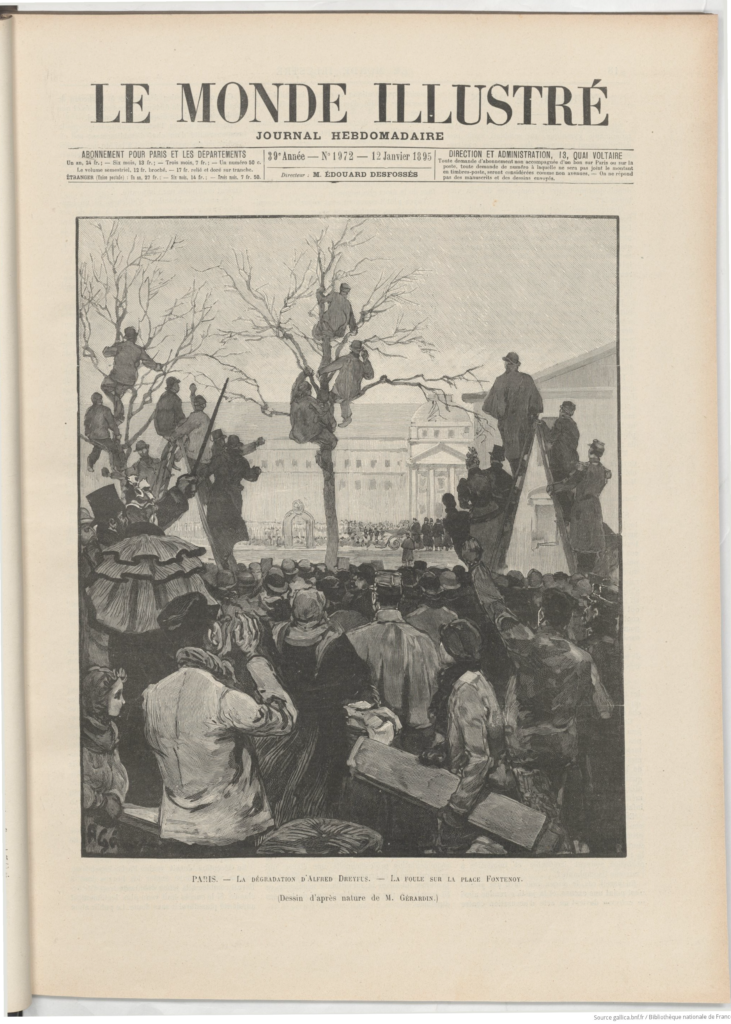
Paris, January 5, 1895. In the courtyard of the École Militaire, soldiers tear the epaulettes from Captain Alfred Dreyfus’s uniform and break his sword across their knee. Beyond the gates, a crowd is screaming. Not “death to the traitor.” Death to the Jews. Dreyfus raises his arms and shouts that he is innocent, that he remains worthy to serve. It does no good. He is a Polytechnique graduate, an artillery officer, a member of the General Staff of the army of the French Republic—fully assimilated into French civic life, patriotic to the point of self-destruction. None of it matters. The cry from the crowd is not about espionage.
What, exactly, was he supposed to have converted out of?
A Rationalist’s Contempt
The instinct is to expect that the answer runs backward through the Church—through medieval blood libel, through Chrysostom, through fifteen centuries of a Christian Europe that made Jewish unbelief the whole of the charge. And the instinct is only half right. Something did change in the eighteenth century, in exactly the circles that get credit for dismantling that inheritance.
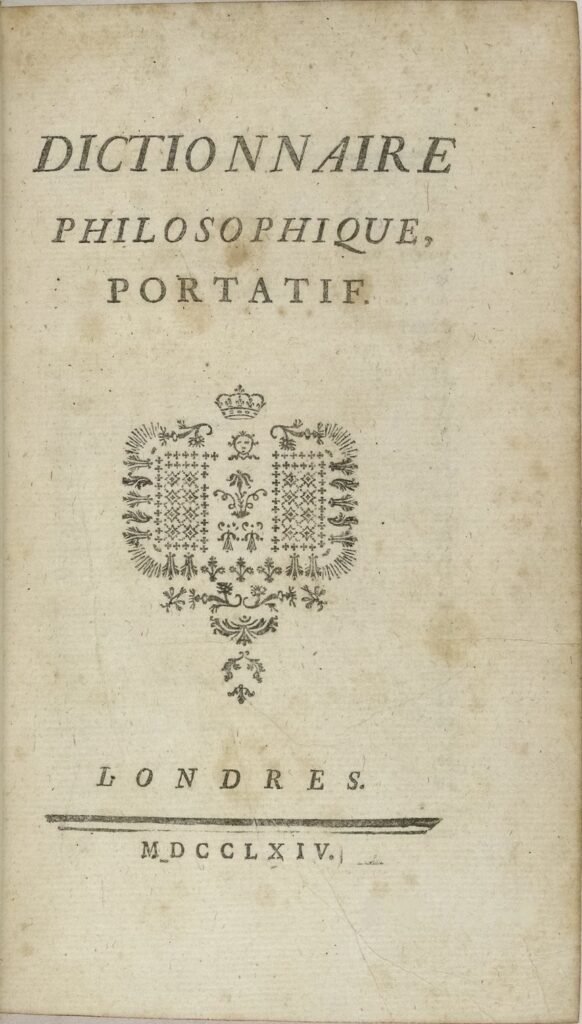
Voltaire spent much of his career attacking clerical authority, biblical literalism, and revealed religion in every form. In the same body of work, he wrote some of the most sustained hostility toward Jews of any Enlightenment figure—the article “Juifs,” the longest entry in his Dictionnaire philosophique, and the flat declaration elsewhere in the same book that the Jewish nation was, in his estimation, the most detestable ever to have defiled the earth. Scholars still argue about how to name this—Voltaire rejected Christianity, Islam, and Judaism alike as revealed religion, and much of his contempt is aimed at the ancient Israelites of scripture rather than his Jewish contemporaries. But he did not simply set Judaism aside while he worked. He blamed it—diagnosing Jewish exclusivist monotheism as the historical origin of the very zealotry he spent his career attacking in its Christian form. The disease he was treating, in his own account, started with the patient he had the least sympathy for. But that argument is itself the point worth noticing.
Voltaire could reject the entire theological apparatus that had organized Christian anti-Judaism for a millennium and a half—clerical power, biblical inerrancy, the doctrine of Jewish guilt for the crucifixion—and the animus survived the demolition intact. He is not the villain of this account. He is the proof that the contempt does not need the theology to carry it. Theology had given the contempt a language, a structure, and a justification. Voltaire discarded the justification without discarding the contempt. When that framework went out of fashion in important parts of Europe’s intellectual culture, the thing underneath proved perfectly capable of finding another one.
From Belief to Blood
That search took the nineteenth century roughly three steps to complete, and the steps are worth naming separately, because each one narrows the exit a little further.
Christian anti-Judaism had located the defect in belief. You believe wrongly. Conversion, in principle, changed the category—however dangerous, coerced, or historically fraught that promise actually was in practice.
Enlightenment rationalism relocated the defect into culture. Your civilization is backward, particularist, incompatible with universal reason. This is Voltaire’s register, and it is also the register of the emancipation debates that followed him—Jews could be admitted to full citizenship, the argument ran, once they were sufficiently civilized, sufficiently French, sufficiently modern. The defect was still, notionally, something that effort could overcome.
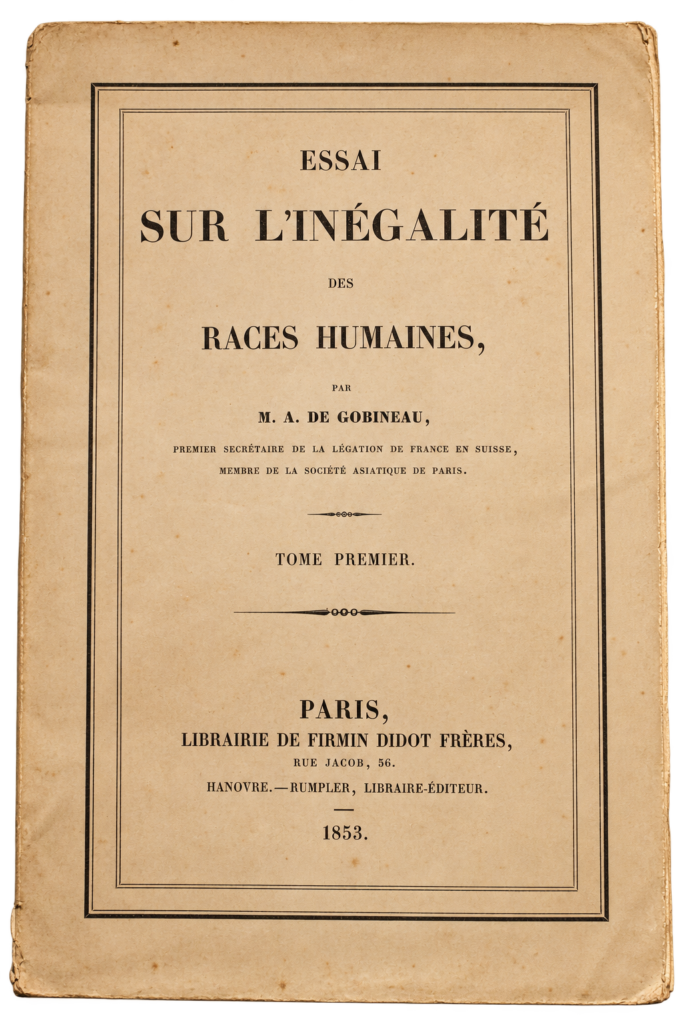
The final step removed the exit altogether, though not by its author’s own design. In the Essai sur l’inégalité des races humaines (1853–1855), Arthur de Gobineau proposed that humanity divided into three original races—white, black, and yellow—ranked by fixed and unequal capacity, with an Aryan strain at the summit of the white; and, crucially, that this ranking owed nothing to climate, custom, or belief. It was a property of descent, not something environment, education, or conversion could simply erase. Gobineau’s own opinion of Jews was, notoriously, not a hostile one—he praised them at length for the same trait he prized in Aryans, an instinctive resistance to mixing their blood with others—and later racial theorists had to edit him selectively to put his system to a purpose he had not intended for it. But the apparatus did not need his permission to travel. Once character was descent and descent was fixed, no rite remained that could reach the defect, because the defect no longer lived anywhere a rite could touch. The Völkisch nationalism that emerged alongside and after this racial thinking supplied the audience and the Jewish target Gobineau’s own text had not supplied. You are, biologically, what you are.
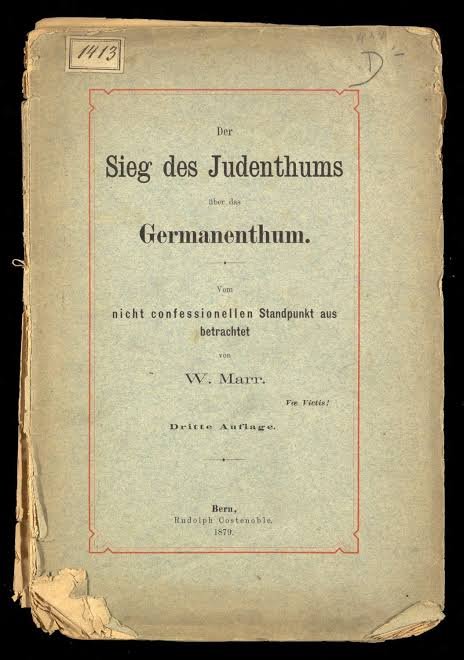
Wilhelm Marr gave the completed mutation its name in 1879, when he founded the League of Antisemites in Berlin on the explicit premise that his hostility toward Jews had nothing to do with their religion. The subtitle of the pamphlet that made him famous that year announced the point outright: considered from a non-religious standpoint. Marr did not invent a new hatred. He gave an old one a new word, and the word did real work—antisemitism sounds like a finding. Jew-hatred sounds like what it is. Once the category was biological, baptism could not fix it. Neither could assimilation, patriotism, secularism, or intermarriage. The old theoretical door—the one Christian anti-Judaism had at least claimed to leave standing—was now gone entirely.
The vocabulary was German; the mutation was not. By the century’s end the same distinction—Jewish belief set apart from Jewish ancestry—was fully legible elsewhere in Europe, including in the nation that had made emancipation its civic boast.
What Was He Supposed to Convert Out Of
Which returns to the courtyard.
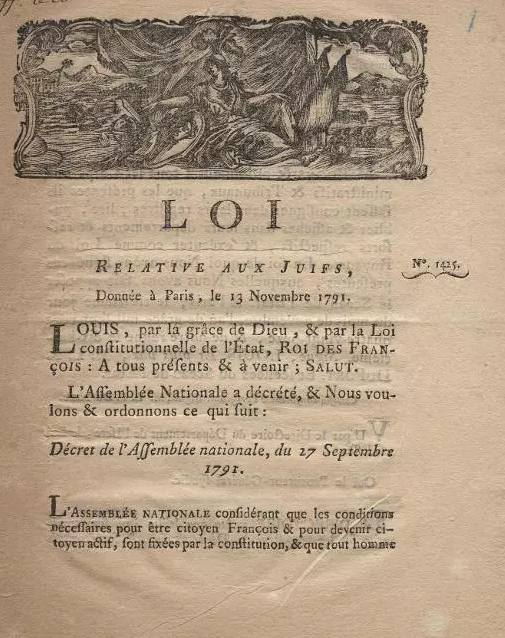
Dreyfus was not merely a French citizen—he was the product of the exact civic promise France had extended with Jewish emancipation. On December 23, 1789, addressing the National Assembly’s debate over Jewish citizenship, Stanislas de Clermont-Tonnerre laid out the bargain’s actual terms: full civic rights for Jews as individuals, while explicitly rejecting any separate Jewish corporate or national legal identity—the nation within the nation. Two years later France acted on it, becoming the first state in Europe to grant its Jews full citizenship. A century later, Dreyfus had done everything that bargain asked of him and more: Polytechnique, the artillery, a seat on the General Staff, the uniform of the institution most closely bound to the nation itself. He had dissolved into individual citizenship as completely as the promise demanded.
The crowd outside the gates did not know, and would not have cared, whether Dreyfus kept the Sabbath or had ever set foot inside a synagogue as an adult. The charge in the courtroom was espionage; the charge outside the gates was ancestry. The Affair’s actual machinery was more tangled than any single cause—fabricated evidence, institutional self-protection, the later forgeries of Colonel Henry, the maneuvering of Esterhazy—but the army and much of the press that helped destroy Dreyfus operated throughout on the same racialized assumption the crowd made plainly: that what he was born mattered more than what he had done or believed.
Among the journalists covering the trial was the Viennese correspondent Theodor Herzl, who had been watching the mutation take shape for years before that morning. He had read Eugen Dühring’s The Jewish Problem as a Problem of Race, Morals, and Culture over a decade earlier and recorded in his diary how badly it had shaken him—not because it was crude, but because its author was serious and learned, and had built a case for racial exclusion out of real intelligence rather than vulgar prejudice. By the turn of 1892 into 1893, following the Austrian Reichstag’s evasive debates on the subject, Herzl had already concluded that the hostility he was tracking had stopped being theological at all—in his own words at the time, a social question, not a religious or nationalistic one. Dreyfus did not hand him a new idea. He handed him proof, delivered by the one country that should have made it impossible. Writing four years later, Herzl described the verdict as reaching past one man to convict an entire people in him, and located the scandal precisely: it had happened in republican, modern France, a century after the Declaration of the Rights of Man, so that the edict of the great Revolution had been revoked.
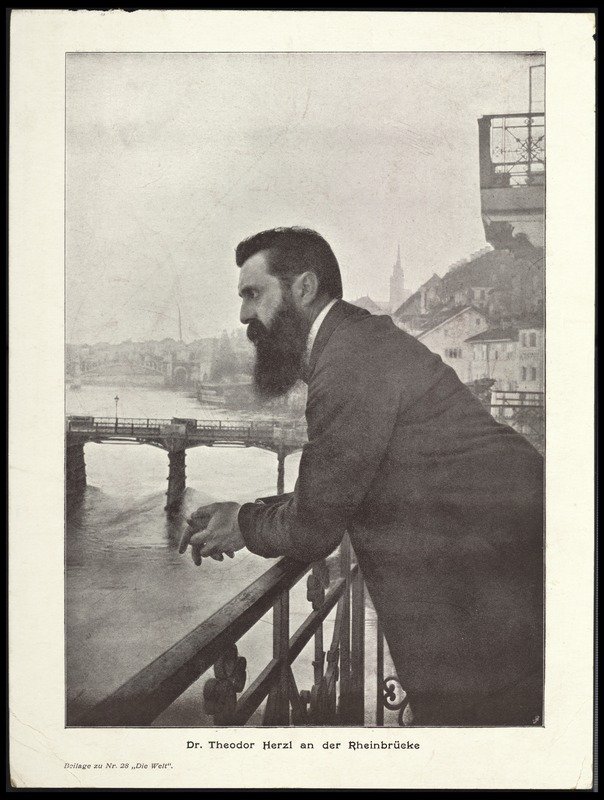
That is the argument Der Judenstaat draws out to its full length the following year—and by then Herzl had revised his own diagnosis again. The pamphlet insists the Jewish question is no more a social question than a religious one; it is, in his phrase, a national question, and only a people without a land of their own could remain permanently exposed to a hostility no individual behavior could satisfy. Herzl’s pamphlet is not a religious tract and not a plan of moral reform. It is, by design, a political and territorial one, because he had concluded the disease was no longer curable by any change of belief, culture, or behavior on the Jewish side of the ledger. Assimilation, he argued, was not merely insufficient. He believed Jewish social and economic advancement actively intensified the hostility it was meant to dissolve, and that quiet periods only stored up pressure for worse outbreaks later. If the accusation had migrated into blood, no degree of belief, culture, or service could dissolve it. The only answer left was to leave the board the accusation was being played on. Read this way, Der Judenstaat is less a rejection of assimilation than an autopsy of it—the record of a man watching belief become culture become blood from the inside, and finding no door left standing anywhere in the building.
A Forgery That Didn’t Need to Be True
Once ancestry has been made the whole of the charge, something still has to explain what that ancestry supposedly does—what all these biologically fixed, incorrigible people are actually plotting. In 1903 a Russian publication supplied an answer, in the form of a document purporting to be the secret minutes of a Jewish plan for world domination.
The Protocols of the Elders of Zion was not a discovered record. It was a forgery, assembled largely by lifting passages nearly verbatim from Maurice Joly’s 1864 political satire Dialogue in Hell Between Machiavelli and Montesquieu—a work about Napoleon III’s France that never mentions Jews at all—along with material borrowed from Hermann Goedsche’s 1868 novel Biarritz. Its precise origin is still debated among historians, though its assembly from stolen fiction and its circulation through reactionary Russian circles are well documented. In 1921 Philip Graves, the Times of London’s correspondent in Constantinople, laid the Joly text and the Protocols side by side in a three-part exposé and demonstrated the plagiarism beyond serious dispute. The forgery was, from that point forward, a matter of settled documentary record.
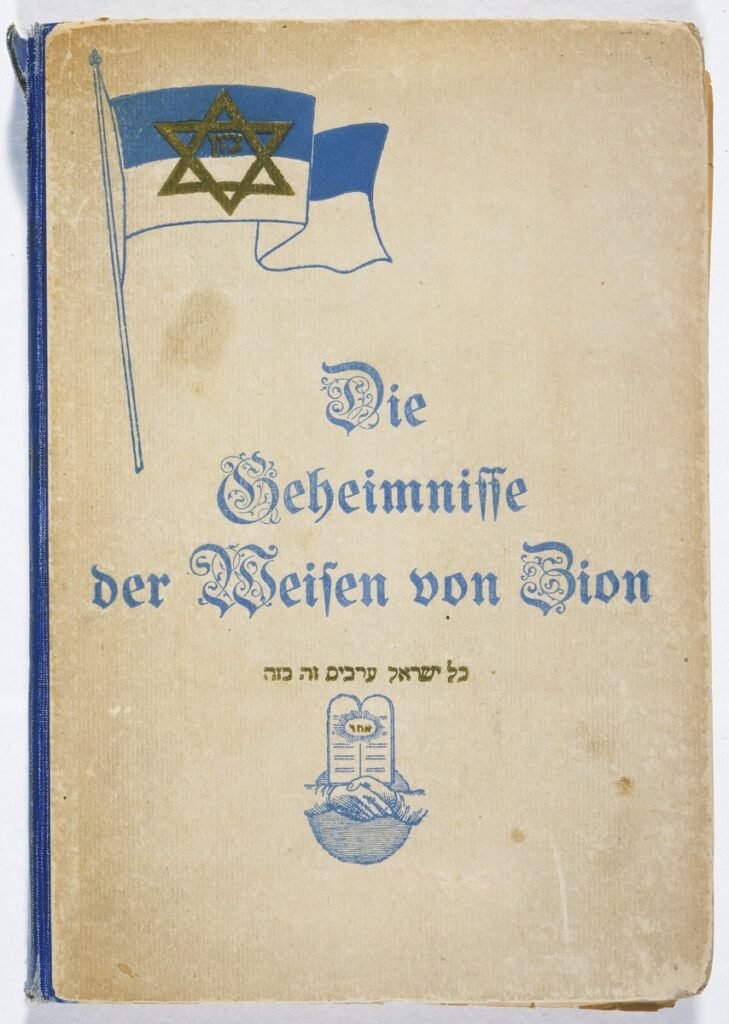
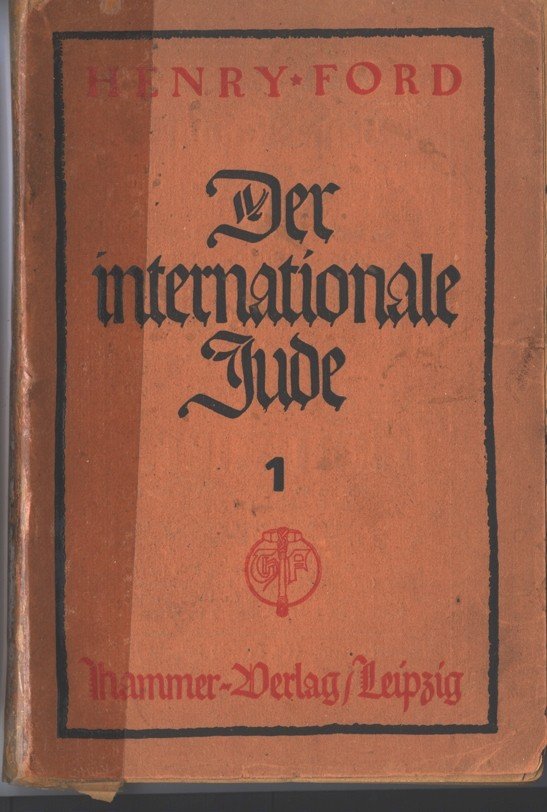
It made no difference. Henry Ford serialized the material in The Dearborn Independent through the early 1920s under the title The International Jew and distributed the resulting volumes through Ford dealerships nationwide. The collection was quickly translated into German, where by 1922 it had already reached its twenty-first printing. The following year, in a Chicago Tribune interview, Hitler named Ford the leader of “the growing Fascisti movement in America,” singled out his “anti-Jewish policy” for praise, and noted that his own circle had just had Ford’s articles translated. In 1938, on Ford’s seventy-fifth birthday, Hitler awarded him the Grand Cross of the German Eagle—the highest honor Nazi Germany could confer on a foreign national.
By the time it entered Nazi ideology, the document had already been publicly and definitively debunked for over a decade. The exposure changing nothing is the actual finding here, more than the forgery itself. The Protocols were never functioning as evidence from which a conclusion was drawn. The conclusion already existed. The document only gave it a shape that looked like proof.
The Door Off Its Hinges
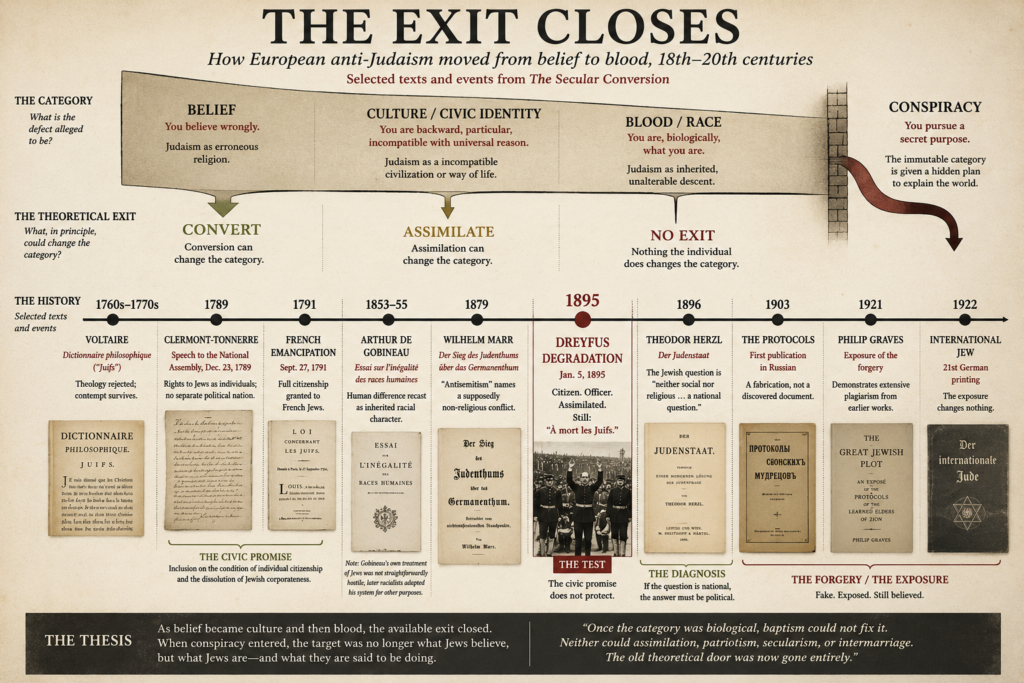
Across most of the history here, the accusation still imagined an exit—a confession of error, a conversion, a repudiation of the wrong book. Cruel and often insincere in practice, it nevertheless implied a version of the accused who would no longer be accused, if only he changed.
The racial mutation removed the hinge along with the door. It did not liberate the old hostility from theology so much as free it from theology’s one remaining constraint—the idea that the target could, in theory, stop being the problem. Once the charge lived in blood rather than belief, nothing Alfred Dreyfus did in that courtyard, and nothing he had already done in the decades before it, could have changed the verdict the crowd outside had already reached. The exit was not narrowed. It was removed from the building entirely, and nobody thought to mention that it was gone until someone tried to use it and found the wall solid where the frame used to be.

Discover more from Many Lamps, One Flame
Subscribe to get the latest posts sent to your email.