
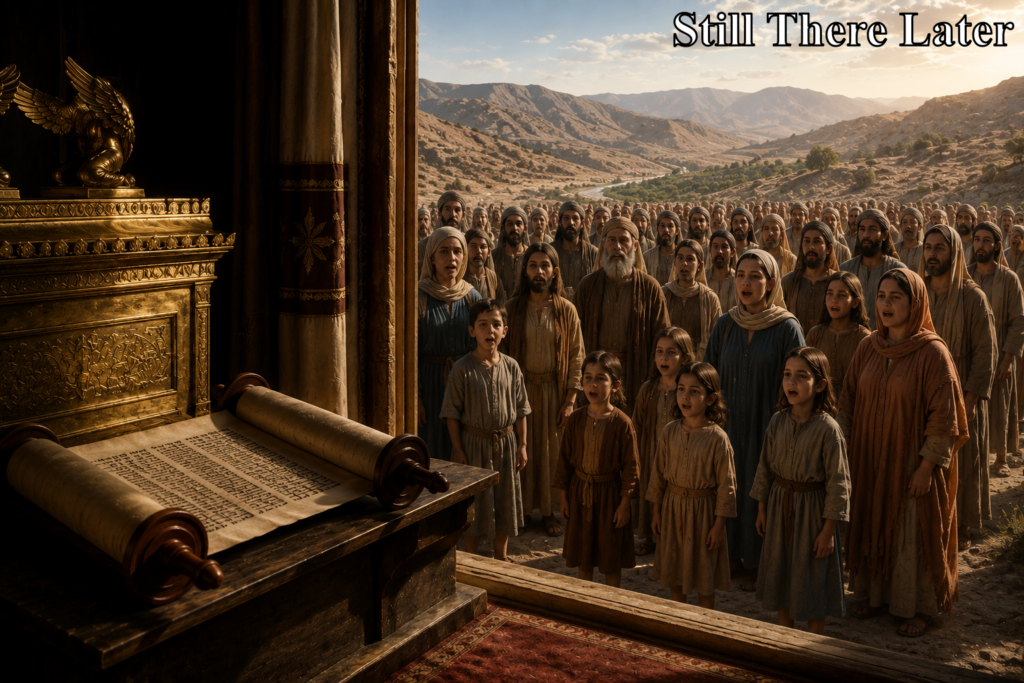
Therefore, write down this song and teach it to the people of Israel; put it in their mouths, in order that this song may be My witness against the people of Israel. … And when many evils and troubles befall them, this song shall confront them as a witness, since it will never be lost from the mouth of their offspring. … Take this book of the Teaching and place it beside the Ark of the Covenant of the L-rd your G-d, and let it remain there as a witness against you.— Deuteronomy 31:19, 21, 26
Twice in one chapter Moses is told to preserve something, and both times the Hebrew uses the same word for what is being made: ed, a witness. The two objects could hardly be less alike. One is a completed scroll, handed to a priesthood, given a physical location in the sanctuary. The other is a song, taught to a population and set into their mouths. Both are placed. Only one of them is promised it will still be there later.
Two Witnesses
Read the two commissions side by side and the parallel is exact enough to be deliberate.
At 31:19: v’atah kitvu lachem et hashirah hazot v’lamdah et b’nei Yisrael, simah b’fihem, l’ma’an tihyeh li hashirah hazot l’ed bivnei Yisrael—now write this song and teach it to the children of Israel, put it in their mouths, so that this song may be a witness for Me against the children of Israel.
At 31:26: lako’ach et sefer haTorah hazeh v’samtem oto mitzad aron brit Hashem Elokeichem, v’haya sham b’cha l’ed—take this book of the Teaching and place it beside the Ark of the Covenant of the L-rd your G-d, and it shall be there as a witness against you.
Two objects. Two acts of placement. The same designation.
And then, attached to one of them only, a guarantee. At 31:21, in the middle of a bleak forecast about what Israel will do after Moses is gone, the text pauses to certify the song’s endurance: v’anta hashirah hazot lefanav l’ed, ki lo tishakach mipi zar’o—this song shall answer before him as a witness, for it will not be forgotten from the mouth of his offspring.
No comparable promise is made about the scroll. The book is told where to sit. The song is told where to live, and then told it will still be alive later.
Both are witnesses. Both, as this chapter will make plain, are witnesses against. What separates them is not their function but the medium each is entrusted to—and what each medium can survive.
Beside the Ark
The scroll’s placement is stated with unusual precision: mitzad aron brit Hashem—at the side of the Ark of the Covenant. What exactly “at the side” means is another question.
That preposition generated one of the more granular arguments in the Talmud. In Bava Batra 14b, the sages divide over what mitzad actually describes. Rabbi Yehuda holds that the scroll rested on a shelf projecting outward from the Ark—outside the box, supported by it. Rabbi Meir holds that it lay inside, positioned at the side of the tablets rather than between them. The dispute concerns whether the written witness was housed within the holiest object in Israel or attached to its exterior, and the tradition argues it out in terms of ledges, dimensions, and the interior space of a chest.
That argument is possible because the scroll has the kind of location one can argue about. It occupies a place. It has custodians—hakohanim bnei Levi, the priests who carry the Ark, and all the elders of Israel, to whom Moses hands it at 31:9. It has an institutional address.
And later halakhah responds to precisely that exposure by refusing to let written Torah remain singular or merely inherited. Rava puts it plainly: even if a man’s ancestors have left him a Torah scroll, it remains a mitzvah to write one of his own. He derives the ruling from this very verse—kitvu lachem, write for yourselves. Later tradition will famously hear that phrase as the command to write an entire Sefer Torah rather than the song alone; the chapter’s own distinction between hashirah hazot and sefer haTorah hazeh stands regardless.
What Rava’s ruling accomplishes is worth naming. Possession of a scroll is not participation in one—an inherited book is furniture until someone takes up a pen. But the ruling does more than diagnose. It multiplies. Written Torah does not stay beside the Ark in a single authoritative copy; it proliferates into households, one hand at a time. The tradition builds redundancy into the written channel too, having understood what a single located object is exposed to.
Read It Again
The chapter does not leave the scroll unattended either. Immediately after handing it to the priests and elders, Moses attaches a protocol to it.
Deuteronomy 31:10–13: mikeitz sheva shanim, at the end of seven years, at the appointed time of the year of release, at the festival of Sukkot, when all Israel comes to appear before the L-rd—read this Teaching aloud in their hearing. The received practice fixes the timing at the Sukkot that follows the sabbatical year’s conclusion, in the eighth: Mishnah Sotah 7:8 sets the reading at the conclusion of the festival’s first day, with the king on a wooden platform in the Temple courtyard and the scroll passed hand to hand up the chain of officials until it reaches him.
Then the enumeration: hakhel et ha’am, ha’anashim v’hanashim v’hataf v’gercha asher bish’arecha. Assemble the people—the men, the women, the little ones, and the stranger within your gates.
The purpose clause is doubled, and both halves are verbs of reception: l’ma’an yishme’u ul’ma’an yilm’du—so that they may hear, and so that they may learn.
Then verse 13 names the audience with a precision that is easy to read past. Uvneihem asher lo yad’u yishme’u v’lam’du—and their children, who have not known, shall hear and shall learn. Not the scholars. Not the ones who will grasp it. The ones who do not yet know, brought into earshot on a schedule and exposed to the words before they can be expected to hold them.
This is what the written medium requires that no other object in the sanctuary requires. The Ark does not need to be periodically opened to remain the Ark. The menorah does not need an audience. A scroll is different: it is a set of words that has been converted into an object, and it stays an object until somebody converts it back. Hakhel is the mechanism for that conversion—scheduled, compulsory, national, and built into the calendar at the festival when the whole people is already assembled.
Every seven years, take the thing out of its place and make the population hear it. That is not devotional enthusiasm. It is maintenance.
What Josiah Heard
The tradition preserves a record of what happens when the maintenance lapses, and it is one of the more devastating scenes in Kings.
Josiah has ordered repairs to the Temple. Money is being counted, carpenters and masons paid. In the middle of an ordinary administrative operation, Hilkiah the high priest says to Shaphan the scribe: sefer haTorah matzati b’veit Hashem—I have found the book of the Teaching in the House of the L-rd.
What follows is the part worth slowing down over. Shaphan takes the scroll and reads it himself. He goes to the king and reports first on the silver, then—almost as an afterthought in the sequence of the narrative—mentions that Hilkiah has given him a book. And then he reads it aloud to the king.
Vay’hi kishmo’a hamelech et divrei sefer haTorah, vayikra et begadav. When the king heard the words of the book of the Teaching, he tore his clothes.
Not when it was found. When it was read to him.
The text does not say how long the scroll had been there, or where inside the House it had been sitting, and it should not be made to say more than it does. What it does establish is the shape of the failure. Something had survived materially inside the Temple complex, and its public function had stopped. The object was intact. The transmission was not. A king of Judah could reign in Jerusalem, order the repair of the House, and pay the workmen—and the words of the covenant could still reach him with the force of news.
That is precisely the kind of failure Hakhel exists to prevent, and it is not a failure of preservation. It is a failure of retrieval. The witness had not been lost. It had gone quiet, which for a witness amounts to the same thing.
In Their Mouths
The second witness is commissioned under different circumstances, and the circumstances matter.
Between the Hakhel instruction and the song, G-d calls Moses and Joshua to the Tent of Meeting and tells them plainly what is coming: this people will rise up and go astray, and will forsake the covenant, and troubles will find them—haster astir panai, I will surely hide My face. The chapter does not linger there, and neither will this reading. What matters for the argument is what happens next. Having foretold apostasy, rupture, and concealment, G-d does not answer the coming hiddenness with another appearance. He orders a song.
V’atah kitvu lachem et hashirah hazot v’lamdah et b’nei Yisrael, simah b’fihem. Write it, teach it, put it in their mouths.
Three verbs, and the third is the one that does the work. The song is not deposited with custodians. It is not assigned a shelf. It is placed into the population itself, distributed across every mouth that can be taught to carry it. That is a location—as real a location as mitzad aron—but it is a location with no address, no guardian, and no door that can be closed on it.
Note also what the middle verb refuses to allow. V’lamdah—teach it. This is not a commission for rote sound; the song is to be learned, not merely emitted. But learning and exhausting are not the same operation, and the medium permits a gap between them. A mouth can carry words for a long time before a mind has finished with them. That is not a defect in the arrangement. It is the same assumption Hakhel already made when it gathered uvneihem asher lo yad’u—the children who have not known—and required them to hear anyway. The tradition deliberately transmits into people whose knowing is incomplete, because knowing arrives later and the words have to be there when it does.
This is the answer to a fear raised earlier in the same book. Va’etchanan is preoccupied with the third handoff—the generation at which nobody living stood at the mountain, when what gets passed down is a transmission of a transmission with nothing outside the retelling to measure the retelling against. Vayeilech supplies what that anxiety was asking for. Not a better scroll. A second carrier, placed differently on purpose. The scroll is given a fixed address. The song is given a distributed one.
A Witness Against
There is a hardness in this that the word witness tends to soften in English, and the chapter does not soften it at all.
Both witnesses are for the prosecution. The song is commissioned l’ed li bivnei Yisrael—as a witness for Me against the children of Israel. The scroll is deposited l’ed bach—as a witness against you. At 31:21 the song does not comfort the afflicted generation; it answers before them, which is courtroom language. And 31:27 gives Moses’s own reason without any diplomacy: I know your rebellion and your stiff neck—if you have been defiant while I am still alive among you, how much more after my death.
So what is being guaranteed is not the permanence of consolation. It is the permanence of the accusation. Of the two instruments Moses leaves behind, the one certified against loss is the one that will testify. A scroll can be misplaced. This song, the text insists, cannot be gotten out of the nation’s mouth.
And yet the arrangement itself carries an implication the harshness can obscure. Testimony is preserved against a party still held to the agreement. The trouble taken here—to write, to teach, to distribute into every mouth, to certify against forgetting—presumes that the covenant’s claim on Israel has not been set down. The song is not a threat held over Israel’s head. It is a claim on Israel that has not been withdrawn, lodged in the one place from which it cannot be removed, precisely so that it will still be there when it is needed.
What Cannot Be Shelved
Moses is one chapter from the end of his life, and everything here is an arrangement for his absence. He is one hundred and twenty years old. He will not cross. Joshua is charged, the scroll is completed, the assembly is scheduled, the song is written down and taught.
What he is actually building is redundancy—and its shape becomes clear only when the two witnesses are held together. One is precise, complete, and authoritative, and it depends on a building, a priesthood, a place beside a chest, and a calendar of public readings to keep it from going silent. Those supports can fail. Kings preserves a record of what happens when retrieval and public transmission fail; later halakhah answers the broader vulnerability of the written medium by multiplying Torah scrolls into private hands.
The other is not free of requirements. The commission begins with write it and teach it, which means a scribe, a teacher, and an initial act of transmission that has to actually happen. What it does not require, once taught, is fixed infrastructure. Not a Temple, not an Ark, not a shelf, not a designated custodian, not a scheduled assembly, and not literacy. Its custody is distributed rather than singular, and the failure of any one carrier does not exhaust the medium.
That is the one the text certifies. Not because song is holier than script, and not because oral memory is invulnerable, which it plainly is not. Only because of the two witnesses, this is the one whose persistence the chapter explicitly promises: ki lo tishakach mipi zar’o.
A scroll can be laid beside the Ark and still arrive as news. A song in the mouth arrives as something the hearer already knew, in words he has been carrying since before he understood them.
Vayeilech leaves both, and the arrangement is not a ranking. The scroll keeps the words recoverable from outside the people, so that memory has something to be corrected against. The song keeps a witness resident inside them, so that when the scroll is opened it does not arrive entirely from outside. Neither is sufficient alone. That is why there are two.
The scroll waits to be opened. The song is already there when the opening comes.

Discover more from Many Lamps, One Flame
Subscribe to get the latest posts sent to your email.