
Who is a G-d like You, bearing iniquity and passing over transgression?
— Micah 7:18
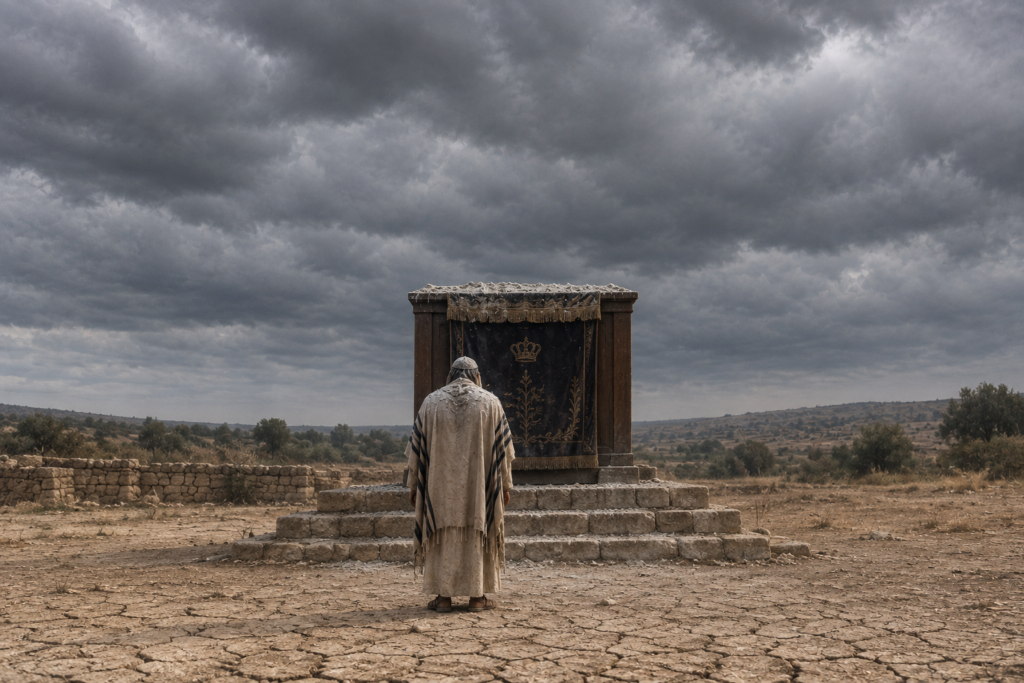
The rains did not come. The community did what a community does when the sky stays shut: it fasted, it assembled, and it sent its best man to the ark.
Rabbi Eliezer descended and recited twenty-four blessings—the full fast-day liturgy, the eighteen with six added, every word the tradition prescribes for precisely this emergency, offered by a sage whose learning no one questioned. Nothing happened. The sky held.
Rabbi Akiva descended after him—he had been Eliezer’s student—and said two sentences. Avinu Malkeinu, ein lanu melekh ela atah—our Father, our King, we have no king but You. Avinu Malkeinu, l’ma’ankha rachem aleinu—our Father, our King, for Your sake have mercy on us.
The rain fell.
The Talmud, in Ta’anit 25b, records what happened next among the men who had just watched it. They began to murmur.
Everything the System Prescribes
A public fast was not a private discipline. It was civic machinery. Mishnah Ta’anit 2:2–3 lays out an escalating protocol for a community under threat: the ark carried into the open street, ashes placed on it and on the heads of the elders, an elder who speaks words of admonition, and six additional blessings appended to the standing eighteen, making twenty-four. This was the tradition’s structured answer to catastrophe, refined over generations, and a drought was exactly the catastrophe it was built for.
Rabbi Eliezer performed it completely. He was the appropriate man, the liturgy was the appropriate liturgy, the occasion was the occasion the liturgy exists for. Nothing was omitted and nothing was done carelessly.
Which closes off the first explanation before it can be offered. There is no error to find. Whatever separates the two men, it is not that one of them got the ritual wrong.
Not Because This One Is Greater
The murmuring was the natural response, and it contained the second explanation. If the same sky answers one man and not another, the difference must lie in the men. Akiva must be the greater sage.
A bat kol, a voice from heaven, went out and refused it: lo mipnei shezeh gadol mizeh—not because this one is greater than that one—ela shezeh ma’avir al midotav, v’zeh eino ma’avir al midotav.
Notice what is being refused. Not merely the conclusion. Both explanations available to the watching sages—Eliezer erred, or Akiva ranks higher—ask the same question underneath: whose account stood higher at the moment of asking. The voice does not adjudicate the accounts. It declines the accounting.
That is harder to absorb than it looks, because the accounting is how the mind reaches for these things by default. We speak of deserving. The word carries a whole apparatus with it: an offense creates a debt, the debt requires satisfaction, merit accrues or fails to accrue, and the balance determines what follows. It is a coherent way to think. It is what produced both readings the sages reached for. It is also not what the voice says.
The One Who Passes Over
Ma’avir al midotav resists translation. Literally: one who passes over his measures. Idiomatically: one who does not collect what is owed him, who lets a slight go by rather than settling it, who declines to exact.
The Hebrew is carrying something the English cannot. The root ע-ב-ר means to cross, to pass over, to traverse. An avera—a transgression—is a crossing, a stepping over a line that was there. And ma’avir is a crossing too. Someone crosses a boundary against me; I cross over the offense. The same motion, in opposite directions. The language notices this well before any theology makes it explicit.
Rosh Hashanah 17a states the principle and reads it out of Micah: whose iniquity does G-d bear? The one who passes over his measures. The verse supplies the verb. Over al pesha—passing over transgression. The one who passes over is passed over.
Now the precision that matters. The trait is horizontal. It says nothing about how Akiva addressed heaven, nothing about the fervor of his two sentences, nothing about his interior condition before the ark. It concerns what he did with wrongs done to him by other people—whether he kept the tally.
And that is the hinge, because the accounting is not two accountings. A man who keeps a careful record of what his neighbor owes him is a man who keeps records. He does not set the ledger down at the threshold of prayer and retrieve it on his way home. He brings it in with him, because it is the instrument he thinks with.
The Measure of the Man
The word inside the idiom is midah—measure. It is the same word Ramchal uses in Mesillat Yesharim 22, which opens b’ve’ur midat ha’anavah, an explanation of the measure of humility. What Akiva passes over and what he possesses turn out to be one noun.
Anavah is routinely mistaken for self-abasement, and it is not that. Moses is anav me’od mikol ha’adam, humbler than any man on the face of the earth (Numbers 12:3), and he is simultaneously the greatest of the prophets, and both are true, and he knew both. Anavah is accurate measure—knowing exactly what one is and exactly what one is not, without inflation and without the counterfeit modesty that is inflation turned inside out.
Which is why Moses belongs here. He is the one figure who could plausibly have arrived carrying an invoice. He did not. Reading his plea at the border—va’etchanan, and I pleaded—Devarim Rabbah 2:1 has Rabbi Levi observe that the word is the language of matnat chinam, a free gift: when a man has nothing in his hand, G-d deals with him gratis. Moses says chinam aseh imi. Do with me as a free gift. And Deuteronomy 3:26 records the answer he received: rav lach—enough; speak to Me no more of this matter. He asked without a claim and was refused.
That refusal is doing necessary work. Without it, Akiva’s rain hardens into a formula—relinquish entitlement, receive the answer—which would make humility the twenty-fifth blessing, a better technique appended to the twenty-four that failed.
What is being asked for cannot work that way, and the Hebrew says so before any argument does. Chinammeans for nothing, gratis, without cause. A gift that could be claimed would not be a gift; it would be payment. This is not a soft observation about generosity but a hard one about categories: whatever is available at the ark is available on those terms or it is not that thing at all. The same root gives chen, favor, and tachanunim, the word for supplication itself—so that in Hebrew one cannot name the act of asking without conceding one has no claim. Akiva’s own words concede it. L’ma’ankha. For Your sake. He offers no ground at all.
This is where kavanah enters, and it is not quite what kavanah is usually taken to be. It is commonly rendered as sincerity, and more carefully as intention, and both are words about the interior condition of the person performing the act—whether he meant it, whether he was present to it. The Hebrew is describing something else. Mishnah Berakhot 5:1 has the pious of old waiting an hour before prayer kedei sheyekhavnu et libam la’Makom—in order that they might direct their hearts toward the Place. The verb is the root itself, and it takes a direction and an object. Kavanah is not a state. It is an aim.
Which matters here, because Rabbi Eliezer had everything the interior reading asks for. Nothing in the account suggests he was insincere, and nothing suggests he was inattentive. Whatever he lacked was not a quality of his attention but the direction of it. And a claim divides direction: if some part of a man believes he is owed a hearing, some part of him is turned toward the account rather than toward G-d. Anavah purchases nothing. It leaves the aim undivided.
The language of birthright is not wrong about what is available. It is answering a question the story never raises. A birthright is possessed; it is inherited; it can be claimed. Both men stood at the same ark on the same afternoon. Nothing was withheld from Eliezer, and nothing was extended to Akiva that Eliezer had been denied. There was no gate and no threshold and no possession. There was nothing to collect.
One Instrument
The season makes this practical. Mishnah Yoma 8:9 draws the line: transgressions between a person and G-d, Yom Kippur atones; transgressions between a person and his fellow, Yom Kippur does not atone until the fellow has been appeased. The vertical cannot substitute for the horizontal. No quantity of prayer discharges what is owed to a person; that account is settled with the person or it is not settled.
The Sages have a name for reciprocal justice—midah k’neged midah, measure for measure—and it is worth noticing what gets measured here. Rosh Hashanah 17a is a measure-for-measure statement: the one who passes over his measures has his own transgressions passed over. The reciprocity is exact, and it is worth pressing on what is being reciprocated. Not a quantity of merit—the Gemara never weighs one. What returns is the posture itself: whether a count is being kept at all. The measure applied is whether you are measuring.
Which turns the question around. It is a short distance from I do not deserve this to a posture that feels like humility and is not. I am owed nothing is still a sentence about what is owed. A balance of zero is still a balance. Declaring bankruptcy is still bookkeeping, and the account stays open, and it requires the same attention the other one did.
Akiva is not described as a man who audited his worth and found it wanting. He is described as a man who did not collect. The mechanics of return—its stages, its structure, the work of turning itself—are their own subject. What the drought adds is prior to all of it: whether a man comes to the ark with a claim in the first place.
Not in Order to Receive
There is a question waiting on the other side of that. If a man is not to come with an account, what does he come with?
Antigonus of Sokho answers it in a line. Avot 1:3: al tihyu ka’avadim hameshamshin et harav al menat lekabel pras—do not be like servants who serve the master in order to receive a reward—but like servants who serve shelo al menat lekabel pras, not in order to receive.
Read the construction rather than the sentiment. Al menat means in order to. It is a phrase about purpose, not about amount. Antigonus does not say the reward is imaginary, and he does not instruct anyone to total up a balance and find it nil. He says the receiving must not be the reason. A ledger can record a large balance or a small one or none at all. It has no column for why.
That is where the distinction finally holds. I am owed nothing is a figure. I am not doing this in order to be paid is a purpose. The first can be entered in the books. The second cannot be entered anywhere, because it is not a quantity.
Maimonides gives the disposition a name and a content. One who serves from love, he writes in Hilchot Teshuvah 10, oseh ha’emet mipnei shehu emet—does the true because it is true—and looks for nothing to follow from it. He identifies it with Abraham. And in the same passage he declines to despise the alternative: people are taught first through reward and through fear, and from acting shelo lishmah, not for its own sake, they are brought to acting lishmah. The transactional stage is not an error to be repudiated. It is where one begins.
Nor does any of this dissolve the account. A wrong done to a person creates an obligation that no quantity of prayer discharges. Wages are owed. Restitution is owed. Promises bind. A theology in which accounting itself were corrupt would be a remarkably convenient one for whoever happens to be holding the money. The claim is narrower and harder: accounting belongs where accounting belongs, and the error is carrying it into an act whose nature changes the moment compensation becomes its purpose.
Akiva offers no ground for his request. He does offer something. L’ma’ankha—for Your sake. It is a purpose clause, and it points away from the man saying it. Whatever else is in those two sentences, nothing in them is being done in order to receive.
The direction is not divided.
What Crossed Over
Abraham is called Ivri. Reading the name in Genesis Rabbah 42:8, Rabbi Yehuda derives it from ever—a side, a far bank: the whole world stood on one side, me’ever echad, and he stood on the other. The transgression, the passing-over, and the name of the people are built from one root.
The answer is a motion too. To answer, in Hebrew, is l’hashiv davar—to return a word. A reply is a returning: the motion of teshuvah, coming back the other way.
This is the deepest quarrel with the ledger, and it is not a moral quarrel. A ledger does not move. It holds debits and credits and balances and claims, and it holds them still, and everything in it is a position. Teshuvah is not a position. It is a motion—and so is the answer to it, and so is the name of a people who are remembered for having crossed over.
Akiva did not ask better. He arrived with nothing to collect, and the asking was all that was left in his hands.

Discover more from Many Lamps, One Flame
Subscribe to get the latest posts sent to your email.