
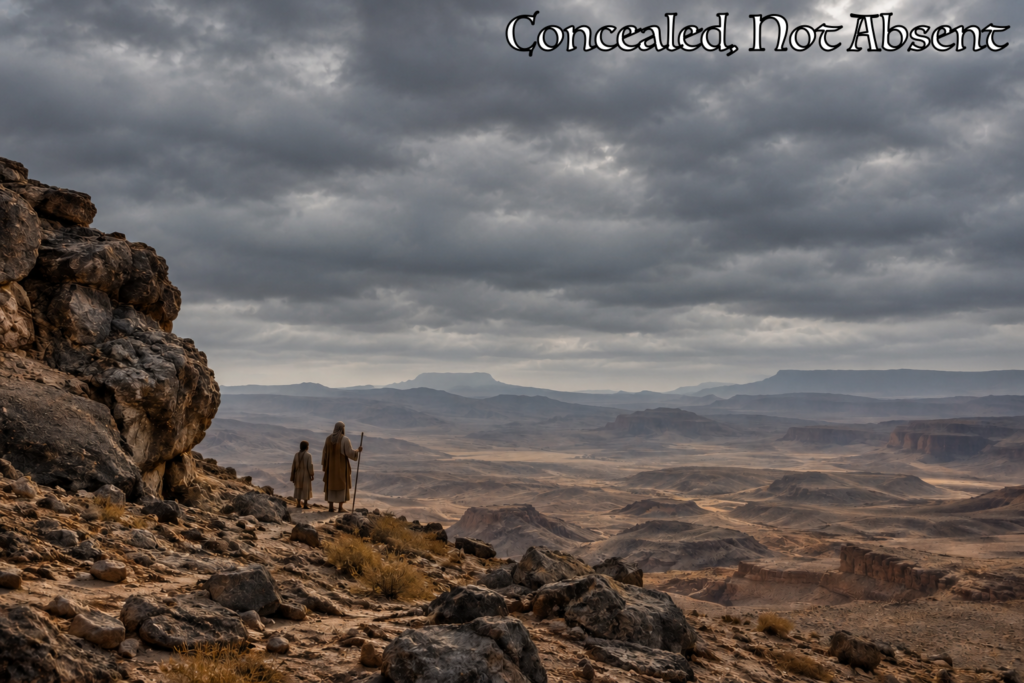
And He will say: Where are their gods, the rock in which they sought refuge, who ate the fat of their offerings and drank the wine of their libations? Let them rise up and help you, let them be a shelter over you. See now that I, I am He, and there is no god beside Me. I deal death and I give life, I wounded and I will heal, and there is none that can deliver from My hand.— Deuteronomy 32:37–39
The verse repeats the pronoun. Ani ani hu—I, I am He. It is not a stammer, and calling it emphasis only names the effect without explaining why the poem doubles the pronoun in this particular place. The doubling arrives at the end of a taunt that already seems finished on its own terms: the gods failed, the shelter collapsed, let them get up and try. Then the pronoun doubles, and the poem stops mocking and starts declaring. Something in the taunt was unfinished, and the doubled ani is what finishes it.
Where Is the Rock
Read plainly, the mockery in 32:37–38 is a familiar kind. You bought protection and the protection did not deliver. The gods ate the fat of the offerings and drank the libation wine, took payment and produced nothing, and now that the payment has stopped mattering, let them stand up and be a shelter.
But the song has spent thirty verses assigning agency, and it has been specific about it. Someone kindled anger. Someone hid a face. Someone sent the sword outside and terror within. By the time the taunt arrives, the poem has established that the catastrophe had an author, and the author is not in doubt.
Which means the question is not really about capability. It is not that the other gods were too weak to intervene in a history they were part of. The declaration that follows says something harder: v’ein Elohim imadi, there is no god beside Me. Ibn Ezra reads the phrase precisely—the point is that G-d has no co-worker, no second party to whom some portion of the acts might be assigned. Not a rival who lost. A collaborator who never existed.
Rashi hears the same insistence in the opening imperative. R’u atah — רְאוּ עַתָּה — see now. What to see, Rashi supplies: the punishment which I brought upon you and from which there was no one to save you, and the help which I will render, which none can prevent. The atah here is the adverb, not the pronoun.
Note what he has done with the final clause of the verse. There is none that can deliver from My hand is usually read forward, as a promise about rescue. Rashi reads it backward as well, onto the striking. Nobody could have taken you out of that hand either.
And on the doubled pronoun itself: I am He who has the power to abase, and it is I who have the power to raise.
So the taunt is not exposing gods who failed to help. It is clearing the room of rival gods. The rocks Israel sheltered in did not wound and did not abandon and did not hand anyone over to anyone. They were not defeated. They were not there.
What They Said
The strangest thing about this argument is that the poem is answering a specific sentence, and the Torah supplies that sentence in advance.
Before the song exists, G-d tells Moses what is coming. The people will go astray, His anger will burn, and then: v’hisarti panai mehem, I will hide My face from them. They will become prey, and many evils and troubles will find them. And then they will say, on that day: halo al ki ein Elohai b’kirbi metza’uni hara’ot ha’eleh—is it not because my G-d is not in my midst that these evils have found me?
That is the sentence the doubled ani is aimed at. And it is worth being exact about what is wrong with it, because most of it is right.
The face is hidden. G-d says so here, says it again in the next verse with the intensifying doubled infinitive—haster astir panai—and the song itself says it a third time at 32:20. Israel is not hallucinating a concealment that isn’t happening. They are reporting accurately.
They are also not wrong that the evils have found them. That is stated as fact in the same breath.
The failure is one step past the observation, in the small word ki. Because. The face is hidden, therefore He is gone. That is not a perceptual mistake and it cannot be corrected by looking harder. It is an inference, and it is the inference a reasonable person makes from that evidence, which is presumably why G-d predicts it word for word before it happens.
Full and Empty
Three verses after that forecast comes another one, and the two together are the actual diagnosis.
When I bring them into the land flowing with milk and honey, G-d says, v’achal v’sava v’dashen—they will eat and be satisfied and grow fat—ufanah el elohim acherim, and turn to other gods. The song puts it more brutally at 32:15: vayishman Yeshurun vayiv’at—Jeshurun, the upright one, grew fat and kicked.
The form that turning takes already has a name earlier in the book. V’amarta bilvavecha, and you will say in your heart: kochi v’otzem yadi asah li et hachayil hazeh—my own strength and the might of my own hand produced this wealth for me. Not a denial that G-d exists. A reattribution of the harvest.
So the apostasy, in the text’s own account, is not caused by deprivation. Nobody here abandons the covenant because the wilderness was hard or because the provision stopped. The song has just finished reciting that provision in loving detail—honey out of the crag, oil out of flinty rock, curds and milk, the finest of the wheat, the blood of the grape. Israel turns after all of it, and because of it.
Now hold the two forecasts side by side. Eleven verses apart in the same chapter, the same people are described making opposite errors under opposite conditions. Abundance arrives and the covenant becomes unnecessary. Catastrophe arrives and the covenant is declared void.
Both readings are performed the same way. Both take the visible arrangement of things—a full table, an emptied field—and treat it as a report on whether G-d is present. Neither has any other method. Moses has already said it outright: Deuteronomy 29:3, v’lo natan Hashem lachem lev lada’at v’einayim lir’ot v’oznayim lishmoa ad hayom hazeh—the L-rd has not given you a heart to know, or eyes to see, or ears to hear, until this day. Forty years of provision, and the capacity to read it arrives last.
When the evidence looks like blessing, the source disappears behind the blessing. When the evidence looks like ruin, the source is declared gone.
That is what the hidden face finally exposes. Not weak faith, exactly. A faith that has learned to read the furniture.
That Same Day
Against that, the response is almost anticlimactic. G-d does not answer the coming concealment by promising to stop concealing. He offers no sign, no guarantee, no method for verifying presence when the evidence runs the other way. He orders a poem written down and taught.
And the timing is the part to slow down over. Vayichtov Moshe et hashirah hazot bayom hahu vaylamdah et bnei Yisrael—Moses wrote this song that same day, and taught it to the children of Israel.
That day. In Moab, on the far side of the river. Before the crossing, before the land, before the milk and honey, before the fat, before the turning, before the hidden face, before the enemies, before a single one of the evils has found anybody.
The timing matters because a corrective like this cannot be issued later. Consider the moment it is built for—and the song is explicitly built for a moment that has not arrived, for people not yet born, in circumstances the text has already described in detail. At that moment the face is hidden, which is true. The catastrophe is real, which is true. The gods of the people whose armies are winning have temples, power, and visible results. Every fact in the room argues for the same conclusion, and the conclusion is the one G-d has already quoted word for word. Anyone arriving then with a different reading of the evidence is offering an argument, and a losing one.
So the reading is installed before the evidence arrives. Not as reassurance, and not as a claim that the wilderness will not be a wilderness. It goes in while there is still nothing to argue against.
What Finds You
And then there is what was placed there.
The verb in Israel’s forecast complaint is matza, to find. The evils found me. G-d uses it again two verses later when He explains why the song will hold: when many evils and troubles find them, the song will answer before them as a witness.
The song uses the same verb once, near its beginning, about a different subject.
Yimtza’ehu b’eretz midbar—He found him in a desert land, uvtohu yelel yeshimon, in a howling waste of tohu. He encircled him, gave him understanding, guarded him as the pupil of His eye.
Same root, reversed agency. Israel will one day stand in a landscape stripped of every reassuring sign and say that the evils have found them because G-d is no longer there. What has been in their mouths since Moab is the memory of another waste, in which G-d found them first.
And the word for that waste is doing work. Tohu is what the world is called in the second verse of Torah, before it has taken any recognizable form, and the verb for what hovers over it there is the verb the song uses two lines later for the eagle over its young. The point is not that G-d was invisible in the wilderness; that generation had cloud and fire and manna and Sinai, and the song is in the middle of listing what it was given.
The point is that Israel had nothing there from which it could plausibly construct a story of self-sufficiency. What kept them alive was visibly given. No land, no harvest, no house, no table. Israel’s founding memory begins in a place with no furniture at all.
And immediately after, the song forecloses the alternative it will foreclose again at the end. Adonai badad yanchenu, v’ein imo el nekhar—the L-rd alone guided him, and no foreign god was alongside. Whether imorefers to Israel or to G-d is disputed, and for this purpose it hardly matters: the exclusion is being made from both directions. Nobody else was on that road.
The song says near its beginning what the doubled ani will say near its end.
What the Song Cannot Do
Which brings the verse back to where it started, and to the half of it that has been waiting.
Machatzti va’ani erpa. I wounded, and I will heal.
The pronoun repeats inside the clause—va’ani, and I—so the two halves cannot be handed to different speakers. And the final clause seals it: v’ein miyadi matzil, there is none that delivers from My hand. There is no second god who might have done it instead.
This is not consolation of the ordinary kind, and the song is not offering the ordinary kind. It does not promise that the wilderness will be brief, or that the concealment will lift on a schedule. It cannot prevent either, and it never claims to.
Nor does it prevent the sentence. Israel will say it; G-d has already quoted them saying it. What the song denies that sentence is the last word—and it denies it from inside the mouth that speaks it.
Because the indictment is not the only thing that was put there. Erpa—אֶרְפָּא, I will heal—went in with it, on the same day, into the same mouths, taught before there was anything to test it against. When the evidence finally runs the other way and every visible fact argues that nothing is coming, the words that say otherwise will not have to be found. They are already in their mouths, and they have been since Moab.

Discover more from Many Lamps, One Flame
Subscribe to get the latest posts sent to your email.