
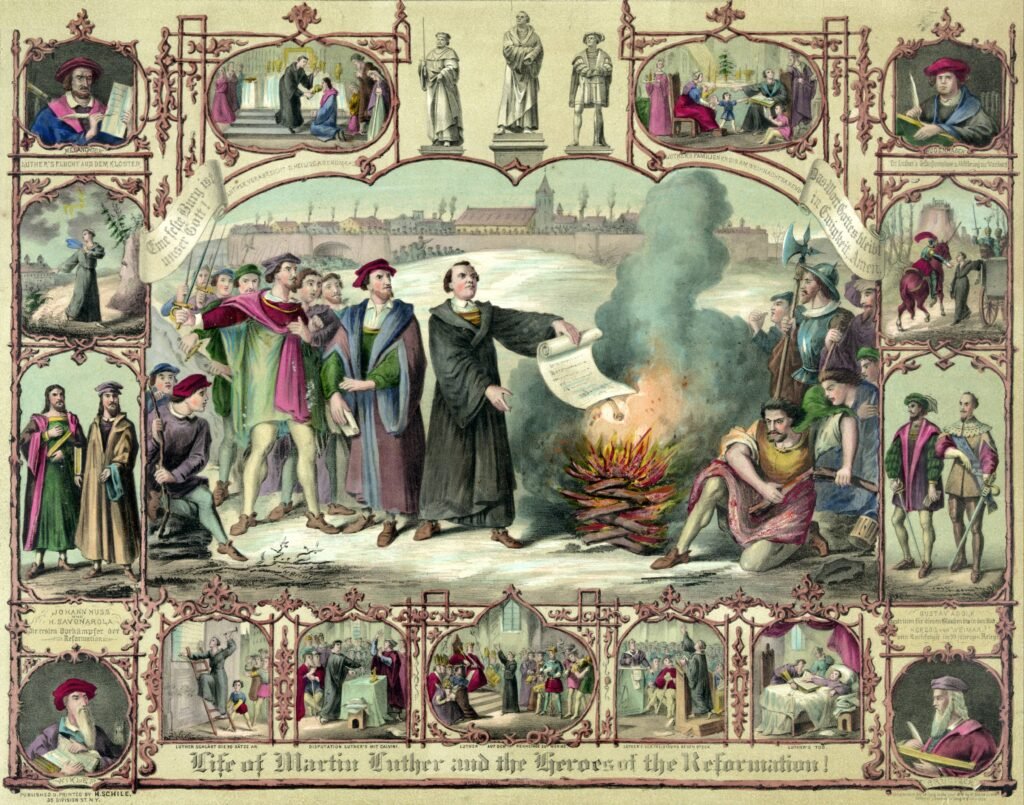
They are twenty years and one author apart.
In 1523, Martin Luther writes: “The way our fools, the Papists, bishops, sophists, and monks… have dealt with the Jews, a good Christian might actually have become a Jew. If I had been a Jew and had seen such mugs and blockheads rule and teach the Christian faith, I should rather have turned into a pig than become a Christian. They treat the Jews as if they were dogs and not human beings.” He goes further: “I would advise and beg everyone to deal kindly with the Jews and to instruct them in the Scriptures. In such cases we could expect them to come over to us.”
In 1543, the same man writes that synagogues should be burned, homes destroyed, prayer books confiscated, rabbis forbidden to teach.
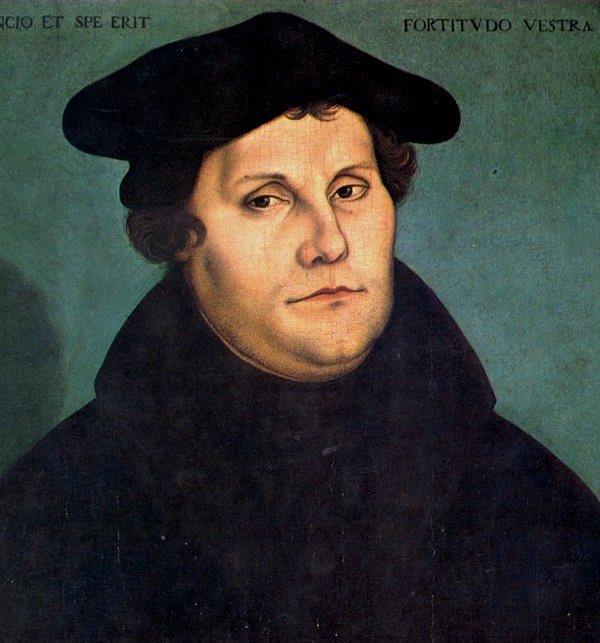
The temptation is to treat this as a man who changed his mind, or a mask that finally slipped. Neither holds up against what he actually wrote, both times. What follows works from the documents themselves—not from a theory of Luther’s inner life, but from the structure of his own arguments, which explain the distance between 1523 and 1543 more precisely than any account of his character could.
What 1523 Actually Argues
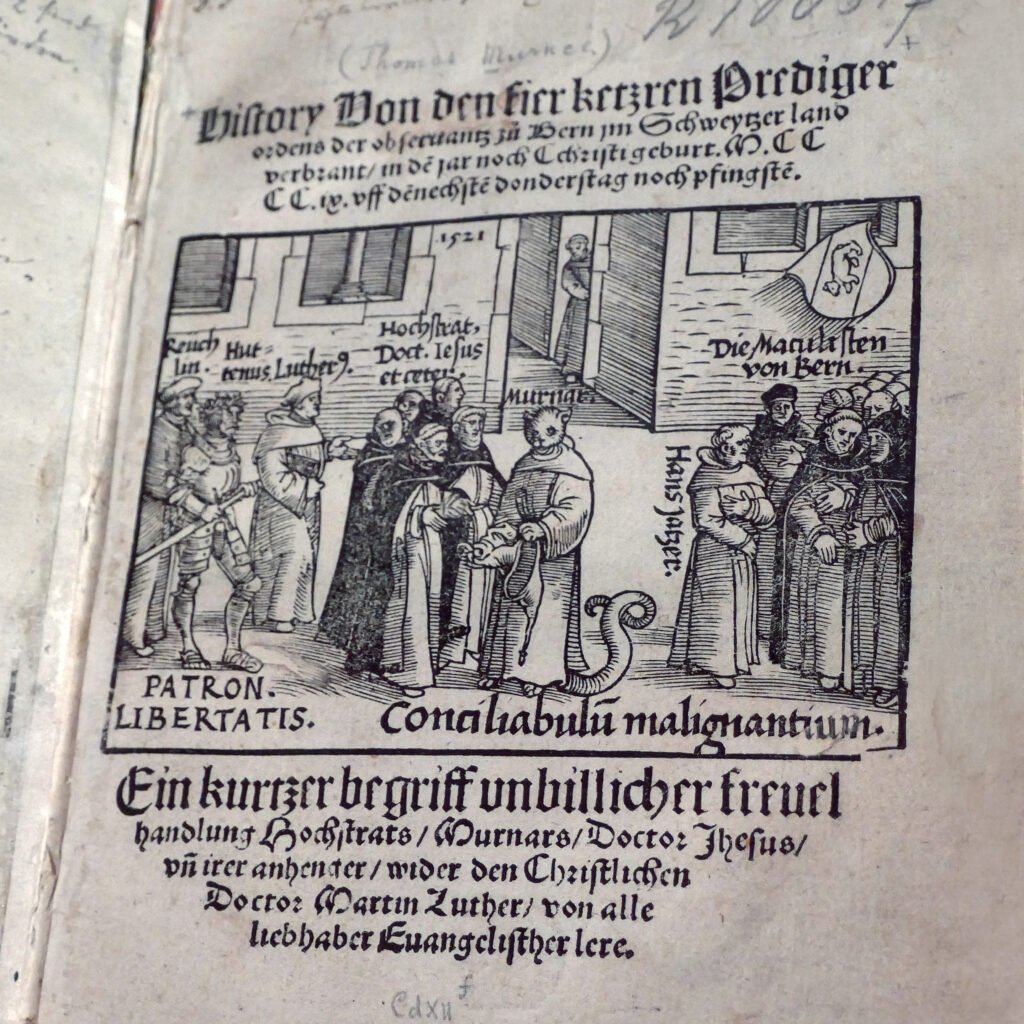
That Jesus Christ Was Born a Jew is genuinely remarkable for a public Christian polemic of the period. Luther condemns Christian cruelty toward Jews in unusually direct language and proposes something concrete: humane treatment, ordinary social contact, an end to coerced baptism and persecution. Set against a Europe that had expelled Jews from England, France, and Spain, blamed them for blood libel and well poisoning, and confined many communities to segregated quarters, this was not a small thing to say.
But it was never a claim that Judaism was a legitimate path in its own right. Luther’s argument is evangelical throughout: Christians have treated Jews so badly that their refusal of Christianity is unsurprising; treat them decently, expose them to a properly reformed Gospel, and conversion should follow. The humane treatment was not the end of the argument. It was the method by which Luther expected the argument to succeed. Not Jews have a right to remain Jews—closer to stop persecuting them, then see what happens. The toleration is real. It is also conditional, and the condition is Luther’s own.
Worth noting without overstating it: this period follows immediately on Luther’s own 1520 heresy trial, in the intellectual air still unsettled by the Reuchlin affair—the controversy over whether Jewish books should be burned, which had split German humanism a decade earlier. Johannes Reuchlin had written, in defense of those books, “do not burn what you do not know” (1510). Luther would later criticize Reuchlin by name for it, accusing him of whitewashing Jewish blasphemy. The two men’s positions on the same question, in the same intellectual generation, run in opposite directions.
The Twenty Years That Weren’t
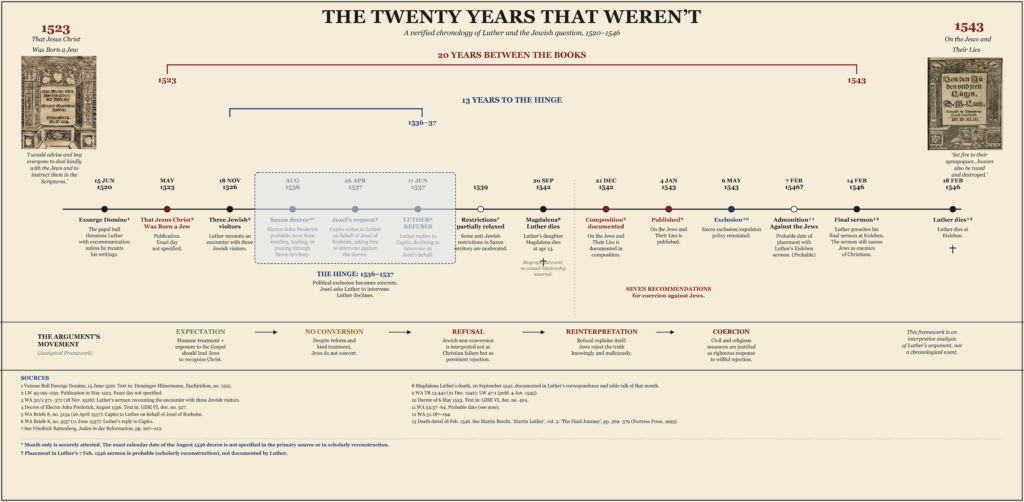
The popular version of this story treats 1523 to 1543 as two decades of good-faith Christian toleration that simply failed to produce results. The record doesn’t support that.
In 1536, Elector John Frederick of Saxony barred Jews from residing, trading, or even passing through his territory. Josel of Rosheim, the Holy Roman Empire’s recognized advocate for Jewish communities, sought Luther’s help overturning the decree. He declined. Thirteen years after telling Christians to deal kindly with the Jews, the most influential Protestant reformer in Germany refused to intervene against an actual anti-Jewish decree. That is thirteen years after the first treatise, seven years before the second—not the end of a patient experiment, but its practical abandonment well before the book that supposedly marks its collapse.
Luther’s own apocalypticism matters here. He did not understand the Reformation as one reform movement among many, working on a normal historical timescale. He believed he was living near the terminus of history, that the true Gospel had been recovered for what might be a final opportunity before the end. A man operating on that timeline is not conducting a generational experiment in toleration. He is watching for a sign. Its absence would not need decades to register as failure.
The Closed Loop
Here is the argument’s actual center, and it does not require guessing at what Luther felt.
Christian reading of the Hebrew Bible, since Paul, has had a specific mechanism available to it for handling Jewish disagreement. Second Corinthians describes a veil over the Jewish reader’s understanding of their own Scripture—a veil removed only in Christ. Under that framework, Jewish disagreement cannot falsify the Christian reading. It confirms the mechanism that explains why Jews cannot see it. Luther did not invent this. He inherited it, along with the rest of the medieval Christian argument against Judaism, and he applied Reformation-grade certainty to it.
The loop runs: Hebrew Scripture testifies to Christ. A properly instructed Jew should therefore recognize Christ. Luther believed the Reformation had restored proper instruction. Jews still do not convert. Therefore the failure cannot be the teaching.
Watch what happens to the word error across twenty years.
In 1523, marshaling Old Testament prophecy to prove Jesus is the Messiah, Luther frames Jewish rejection as exactly that — an error, correctable by better argument: “we conclude — and thus mightily overcome the error of the Jews.” An error is something a person hasn’t yet seen. It doesn’t indict the person holding it; it indicts the evidence that hasn’t reached them, or the teachers who withheld it. That is the premise the whole 1523 treatise rests on — bad Christian argument, corrected, should dissolve Jewish error the way better light dissolves a shadow.
By 1543, error has nowhere left to hide. Luther writes that Christians who once tolerated Jewish worship “unknowingly” will be forgiven for it — ignorance excuses. But Christians “now that we are informed” who continue that toleration become complicit in what he calls Jewish “lying, cursing, and blaspheming” of Christ — “the same as if we were doing all this and even worse ourselves, as we very well know.” Elsewhere in the same treatise, Jewish teaching has become a “den of devils” practicing blasphemy “most maliciously,” and Jews themselves are “possessed by all devils.”
Error, in 1523, is something that happens to a person. By 1543, in Luther’s own telling, it is something a person does — knowingly, after being shown the truth and refusing it anyway. The object under discussion has not changed. What Luther is willing to call it has.
What the loop cannot accommodate is the possibility that Jewish readers possessed a coherent, internally consistent interpretive tradition of their own—one that reads the same text and arrives, deliberately and defensibly, somewhere else.
The asymmetry is worth sitting with directly. Luther’s entire career rests on the claim that he had the right to read Scripture against fifteen centuries of institutional Church authority and be correct. When Jewish readers made the structurally identical claim—we have read this text, within our own tradition, and you are wrong—he did not extend to them the interpretive standing he had claimed for himself. He read the text. He simply operated inside a system that had already explained Jewish disagreement before any Jew spoke.
When the Answer Was No
Luther asked a question of Jewish communities in 1523: would they, treated humanely and exposed to reformed Christianity, convert? He received an answer. It was no.
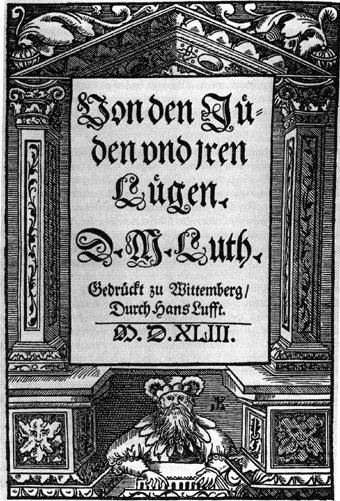
On the Jews and Their Lies (trans. Martin H. Bertram, in Luther’s Works, vol. 47, Fortress Press, 1971, pp. 268–293) answers that refusal with seven specific measures, addressed directly to Christian rulers. “First to set fire to their synagogues or schools and to bury and cover with dirt whatever will not burn.” Second, that Jewish homes “also be razed and destroyed.” Third, that their prayer books and Talmudic writings be confiscated. Fourth, that rabbis be forbidden to teach, on pain of death. Fifth, that “safe-conduct on the highways be abolished completely for the Jews.” Sixth, that usury be prohibited and all silver, gold, and cash confiscated. Seventh, that the able-bodied be put to manual labor—“a flail, an ax, a hoe, a spade, a distaff, or a spindle.” The seven measures are the beginning, not the ceiling: “If this does not help, we must drive them out like mad dogs.”
Luther does not present the seven measures as arbitrary cruelty. He states the reasoning that makes them obligatory in the sentence immediately before he gives them: “whatever we tolerated in the past unknowingly… will be pardoned by God. But if we, now that we are informed, were to protect and shield such a house for the Jews… it would be the same as if we were doing all this and even worse ourselves, as we very well know.”
Ignorance excuses. Knowledge implicates. That is the hinge the seven measures actually swing on — not a new verdict about who Jews are, but a claim about what Christians become guilty of if they fail to act. The measures that follow are framed as self-defense against complicity, not naked aggression.
The premise beneath the loop had not moved. Only the verdict on who was to blame for its failure.
Two Extractions
Luther’s anti-Jewish writings did not vanish from view after 1543. They were printed, read, and available across the centuries that followed—but they were not central to how Protestant tradition chose to remember him. Enlightenment and Pietist readers could foreground 1523 and find a forerunner of toleration; later racial antisemites foregrounded 1543.
That later selection was underway before Nazism existed as a movement to justify it. By November 1938, the extraction was complete enough to be used in real time. Weeks after Kristallnacht, the pro-Nazi Lutheran bishop Martin Sasse published Martin Luther über die Juden: Weg mit ihnen!, reprinting Luther’s anti-Jewish writings, opening with the observation that the pogrom had fallen on Luther’s birthday: “On November 10, 1938, on Luther’s birthday, the synagogues are burning in Germany… the voice must be heard of the man who… became the greatest antisemite of his time.” Sasse was not claiming the date had been chosen for Luther. He was pointing at the coincidence and declaring it usable.
Seven years and five months later, in the dock at Nuremberg, Julius Streicher told the International Military Tribunal: “Dr. Martin Luther would very probably sit in my place in the defendants’ dock today,” if his book had been considered by the prosecution—and named it: On the Jews and Their Lies.
The contradiction the essay opened with was never quite the contradiction it appeared to be. The man who wrote in 1523 that Jews should be dealt with kindly and the man who wrote twenty years later that their synagogues should burn did not leave behind two bodies of work. He left one. His earlier admirers found reasons to remember one part of it. His later ones found reasons to remember the other.
The division came afterward.

Discover more from Many Lamps, One Flame
Subscribe to get the latest posts sent to your email.