
“I will bring you out from under the burdens of the Egyptians.”
“We know that the train carries all loads, so after getting on it why should we carry our small luggage on our head to our discomfort, instead of putting it down in the train and feeling at ease?”
—Sri Ramana Maharshi, Who Am I?, Q. 18
Two people stand in the same place, under the same weight, in the same posture. One of them is keeping faith. The other is being held. From across the room there is no telling them apart, and the harder truth is that from the inside there is often no telling either. Endurance looks like one thing. It is at least two, and the difference between them does not announce itself.
Two Ways of Remaining
In Paramahansa Yogananda’s Autobiography of a Yogi, chapter 34, a government accountant named Lahiri Mahasaya is called into the Himalayas by the deathless master Babaji. He spends seven days in samadhi. On the eighth he falls at his guru’s feet and begs to be kept “always near him in this sacred wilderness.”
Babaji refuses. “Your life lies in the crowded marts, serving as an example of the ideal yogi-householder,” he tells him. “Not of this world, you must yet be in it.” Lahiri Mahasaya goes back down the mountain to his office desk, his wife, and his children, and, in his own words, “assumed the manifold business and family obligations of a householder.” He stays in them for the rest of his life. Yogananda calls that balanced life “the silent inspiration of thousands of questioning hearts.”
Nothing about that staying was captivity. It was chosen and assigned, and it was free.
The Sfas Emes, the second Rebbe of Ger, describes the same thing from inside Torah, in a teaching preserved in Arthur Green’s The Language of Truth (Shemot). He finds three rungs among those in exile. On one rung are the prisoners, who cannot widen the point of divine life within them. Above them are those he calls “the humble”: “they themselves are not really in exile, but they remain there only for the common good.” His example is Moses, already a free man, who stood in Egypt only to bring others out. Below both are “the poor,” “those lowly ones who do not yet even feel their exile.”
Two traditions, a world apart, arrive at the same distinction. There is a remaining that is free, undertaken for something. And there is a remaining so complete that it no longer registers as remaining at all. From the outside the two are identical: the same desk, the same household, the same weight carried day after day. Staying is not the problem. Everything depends on which kind it is.
The Weight and the Patience
The promise in Exodus 6:6 is spatial before it is political: mitachat sivlot Mitzrayim, “from under the burdens of Egypt.” The root of sivlot—ס־ב־ל—means to bear a load, and from there to suffer, to tolerate. Medieval Hebrew built its word for patience, savlanut, from the same root. In Hebrew, patience is load-bearing.
That raises an uncomfortable question about the bondage, and the text raises it first. The cry does not come at the beginning. It comes generations in:
“And it came to pass in the course of those many days that the king of Egypt died; and the children of Israel sighed by reason of the bondage, and they cried.”
Why only then? The Sfas Emes answers in his grandfather’s name. Until the king died, “they were so deeply sunk in exile that they did not even feel it. But now the process of redemption began, and they became aware of their exile and started to sigh.” He reads the promise of 6:6 through the same lens: “I will bring you forth from beneath the sufferings of Egypt,” meaning that Israel “will no longer be able to put up with the ways of Egypt.”
On this reading, redemption does not begin with leaving. It begins with losing the capacity to tolerate. The patience that kept Israel alive under the load had become the shape of the load itself, and the first act of freedom is that patience giving out.
Even then, recognition is not hearing. Three verses later, when Moses brings the promise, the people cannot take it in, “for impatience of spirit, and for cruel bondage” (Exodus 6:9). The Hebrew is kotzer ruach, a shortness of breath, a spirit with no room to expand. Parashat Va’era follows that constriction at length. Here it is enough to notice the order. The tolerance breaks first. Understanding comes later. Recognition arrives late, and arriving late is the first rung of redemption, not a failure of it.
Sri Yukteswar, Yogananda’s own teacher, gives a working distinction in chapter 12 of the Autobiography: “Pain and pleasure are transitory; endure all dualities with calmness, while trying at the same time to remove their hold.”
While trying at the same time. Bearing is endurance that keeps working at the hold. Tolerance is endurance in which bearing the weight has become the whole of the task.
That work is not always visible, even to the one doing it. The Sfas Emes adds, in the same teaching, that “every Jew has some inner place in which he is a free person.” The loosening can go on in that inner place for years before it can act, unseen by others and often by oneself. Whoever stood under the load did what could be done with the strength there was. Freedom, when it comes, does not need to put that earlier self on trial.
The Long Middle
The Exodus is not the end of the story. The wilderness comes next, and it is a different kind of difficulty. Egypt does not stay behind. Pharaoh’s chariots come after a people already free. The weight that defined the old life does not lift at the border; it follows, and the journey that was supposed to be the escape becomes a long stretch in which nothing seems to resolve.
The long middle has a cost, and the cost should not be romanticized. Time spent waiting is time. Bodies tire. Patience thins.
Patanjali does not pretend otherwise. Yoga Sutras I.12, in Edwin Bryant’s translation, reads: “[The vṛtti states of mind] are stilled by practice and dispassion.” Abhyāsa and vairāgya, practice and dispassion, are named together as two disciplines of a single stilling. Two sutras later, I.14 adds the condition: “Practice becomes firmly established when it has been cultivated uninterruptedly and with devotion over a prolonged period of time.” Dīrgha kāla, a long time, is written into the definition. The duration is not incidental to the practice.
The Gita reaches for a similar balance in nishkama karma, action freed from its claim on the fruit, and the Buddhist tradition names upadana, clinging, as what binds; When the Forest Arrives traces both. The long middle asks for the same paradox: keep going, and hold nothing too tightly.
Then Ramana Maharshi, asked about surrender in Who Am I?, answers with a railway carriage. “Whatever burdens are thrown on God, He bears them,” he says. The train carries every load. Why stand in the compartment with your luggage balanced on your head? Sri Yukteswar, in another lineage, says it in a single sentence in chapter 14 of the Autobiography: “God bears the burden of the cosmos.” Two teachers place the weight where it already rests.
That seems to contradict Patanjali. One says sustain the practice for a long time; the other says set the load down now. But the traveler does not stop traveling when the luggage comes off his head. The journey goes on. Only the posture changes. In Egypt the weight pressed down from above, and endurance meant holding it there. In the wilderness the same strength changes direction. It stops bearing under and begins carrying toward. The muscle is the same. The orientation is not.
The danger of the long middle is mistaking the fatigue of the road for the end of it. Three Prayers for Moving Water puts it as a petition: “Keep me from mistaking exhaustion for arrival.”
What Is Done with the Raft
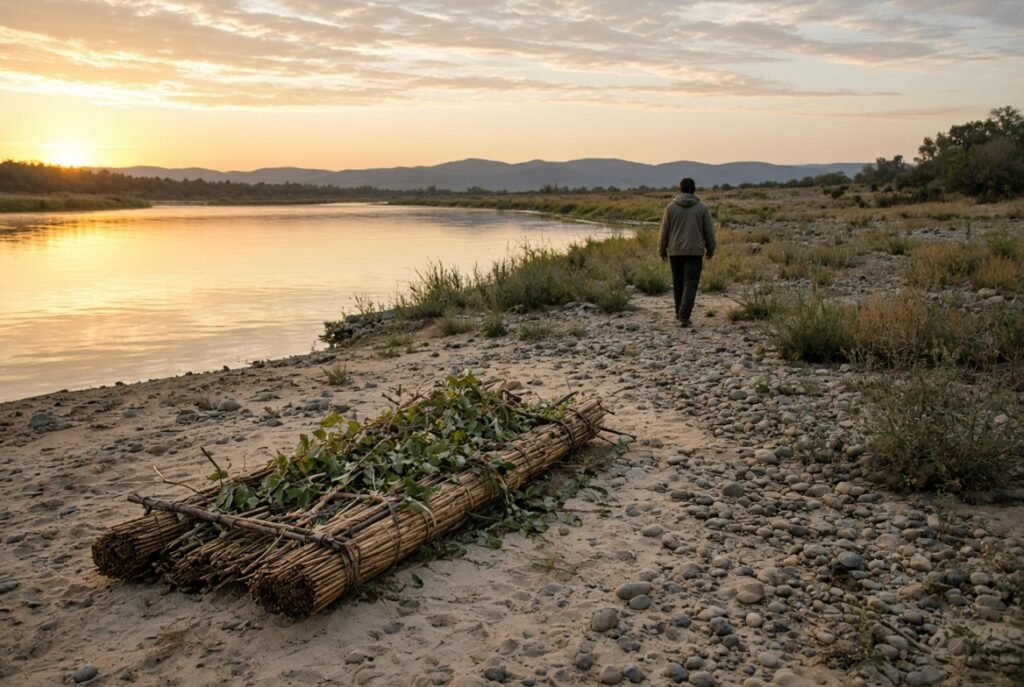
The Buddha, in the Alagaddūpama Sutta, Majjhima Nikāya 22.13, tells of a man who comes to a great expanse of water. The near shore is dangerous; the far shore is safe; there is no ferry and no bridge. He gathers grass, twigs, branches, and leaves, binds them into a raft, and crosses with the effort of his own hands and feet. On the far shore he thinks:
“This raft has been very helpful to me, since supported by it and making an effort with my hands and feet, I got safely across to the far shore.”
—Majjhima Nikāya 22.13, trans. Ñāṇamoli and Bodhi
Then he asks whether he should hoist it onto his head and carry it wherever he goes. No. He hauls it onto dry land or sets it adrift, and walks on. “When you know the Dhamma to be similar to a raft,” the Buddha concludes, “you should abandon even the teachings, how much more so things contrary to the teachings” (MN 22.14).
The order matters. Gratitude comes first, then the setting down. The man does not curse the raft for being crude, or himself for having needed it. It carried him. It deserves his thanks. And it does not belong on his head.
This is the hardest claim in the whole movement out from under: the endurance that carried a person across must itself be set down. Not the capacity. That remains, and the wilderness and everything after it will call on it again. What is set down is its permanent assignment: the standing order that every weight must be accommodated because one has learned how to accommodate weight. The strength stays. The obligation to keep proving it does not. Carry that obligation into the land and it will go on tolerating what no longer needs to be tolerated. Egypt’s patience, kept past Egypt, becomes Egypt’s last hold.
Distance alone does not complete this. A person can cross a great deal of water and still measure every step from the shore that was left. Release is not how far away the old shore is. It is the old shore no longer being the point from which everything is measured.
Gilgal
Forty years after the sea, Israel crosses the Jordan. At Gilgal, the generation born in the wilderness is circumcised, the sign of the covenant that went unkept on the road. Then the text adds a detail that is easy to pass over: the people “abode in their places in the camp, till they were whole.” Then:
“And the LORD said unto Joshua: ‘This day have I rolled away the reproach of Egypt from off you.’ Wherefore the name of that place was called Gilgal, unto this day.”
The freedom came at the sea, with walls of water and a song. The reproach of Egypt, cherpat Mitzrayim, did not come off there. “This day,” the verse says: not at the sea, but here. It went with a free people through forty years of wilderness, through every camp and every complaint, and came off on the far side of a second crossing, in an ordinary camp, while people lay still and waited to heal.
No song is recorded at Gilgal. But the place was named, and the name is the verb: galal, to roll. A weight can outlast the freedom it came with. When it finally comes off, that is its own event, and it was given its own name.
Source note: Translations of Exodus and Joshua follow the JPS Tanakh (1917). The Sfas Emes is quoted from Arthur Green’s The Language of Truth (JPS, 1998); the Yoga Sutras from Edwin F. Bryant’s The Yoga Sutras of Patañjali (North Point, 2009); the Majjhima Nikāya from Bhikkhu Ñāṇamoli and Bhikkhu Bodhi’s The Middle Length Discourses of the Buddha (Wisdom, 1995); Autobiography of a Yogi from the 1946 edition; and Who Am I? from the Sri Ramanasramam edition. Online links are provided for reference; their translations may differ from those quoted here.

Discover more from Many Lamps, One Flame
Subscribe to get the latest posts sent to your email.