
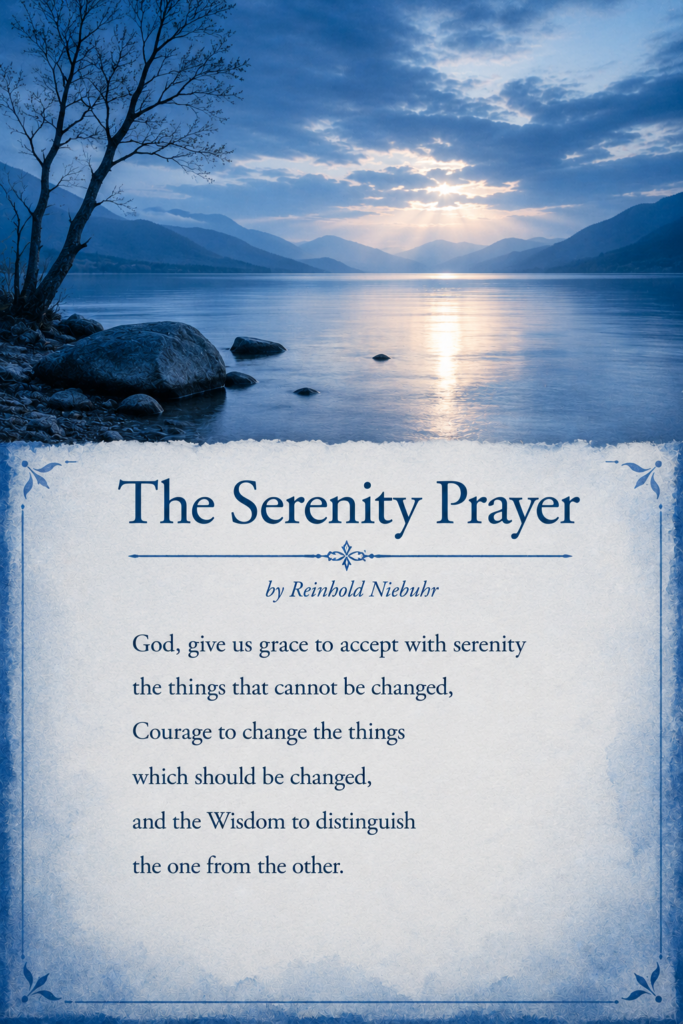
Reinhold Niebuhr’s prayer asks for serenity, courage, and the wisdom to tell one from the other. It has held up for the better part of a century because it is honest about the shape of the problem: some things yield to effort and some do not, and most of the damage people do to themselves comes from misfiling one as the other.
But it is a prayer about sorting. It assumes that once a person knows which pile a thing belongs in, the knowing is most of the work. Anyone who has sat with a diagnosis, or with a marriage that ended without either party deciding it should, knows how much is left over after the sorting is finished. The category was never in doubt. The thing could not be changed. Knowing that did not tell anyone how to stand.
There are conditions no one selects. A diagnosis arrives. A marriage ends. A belief that held weight for thirty years stops holding it, and there is no moment at which the holding was withdrawn—it is simply gone one morning, and the morning is ordinary. The person is already out in open country before any decision was made. What remains to be chosen is what to do from there.
Which leaves a narrower question than the one Niebuhr answers, and a harder one. If the water is not going to be diverted—if nothing is going to be lifted, undone, or made not to have happened—what is there left to ask for?
Not rescue. Not an explanation, which is usually a request for rescue wearing better clothes. What remains is a set of requests about position: to see the thing as it is, to stop gripping what cannot be held, to be turned back toward the direction of travel as many times as that turning is needed. These are small requests. They are also the only ones that can be honestly made and honestly answered, and a person can make them on an ordinary morning without anything in particular having gone wrong.
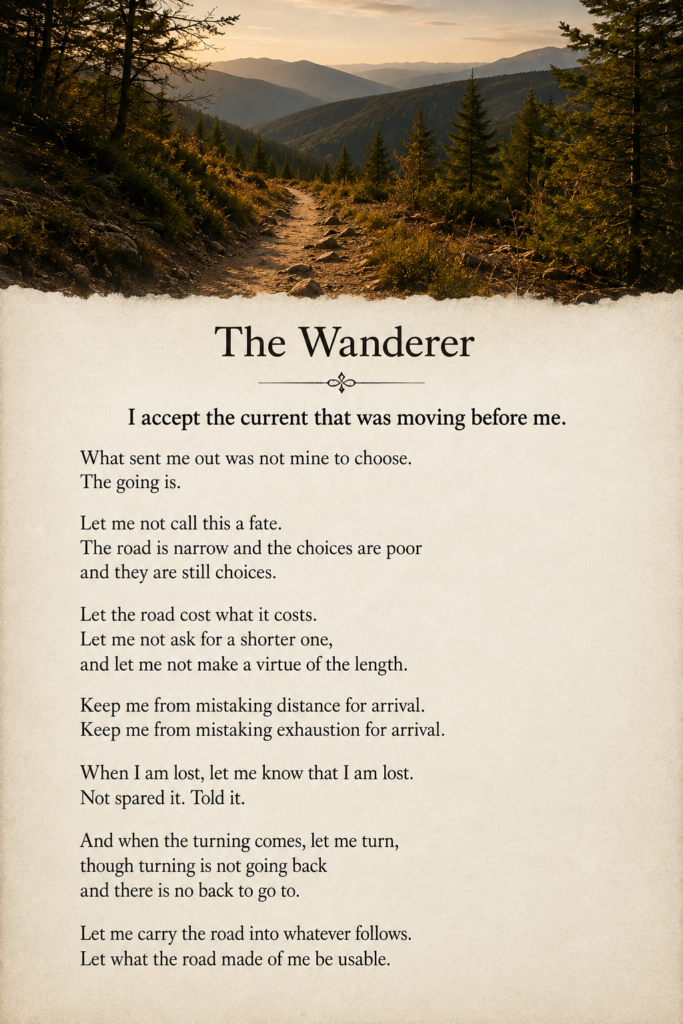
The Wanderer
Acceptance is not agreement, and it is not consolation. It is the refusal to spend the walk arguing with the fact that the walk began.
The confusion is understandable, because the two look alike from outside. A person who has stopped protesting a circumstance and a person who has decided the circumstance was fine are doing the same thing with their faces. But the first has freed up everything the protest was consuming, and the second has stopped seeing the thing clearly. Acceptance costs; agreement is cheap and blinding.
What follows acceptance is not peace. It is movement, usually uncomfortable, and usually in a direction nobody would have selected. The seeking that begins here begins because something has ended, and the seeker did not end it.
The Wanderer
I accept the current that was moving before me.
What sent me out was not mine to choose.
The going is.
Let me not call this a fate.
The road is narrow and the choices are poor
and they are still choices.
Let the road cost what it costs.
Let me not ask for a shorter one,
and let me not make a virtue of the length.
Keep me from mistaking distance for arrival.
Keep me from mistaking exhaustion for arrival.
When I am lost, let me know that I am lost.
Not spared it. Told it.
And when the turning comes, let me turn,
though turning is not going back
and there is no back to go to.
Let me carry the road into whatever follows.
Let what the road made of me be usable.
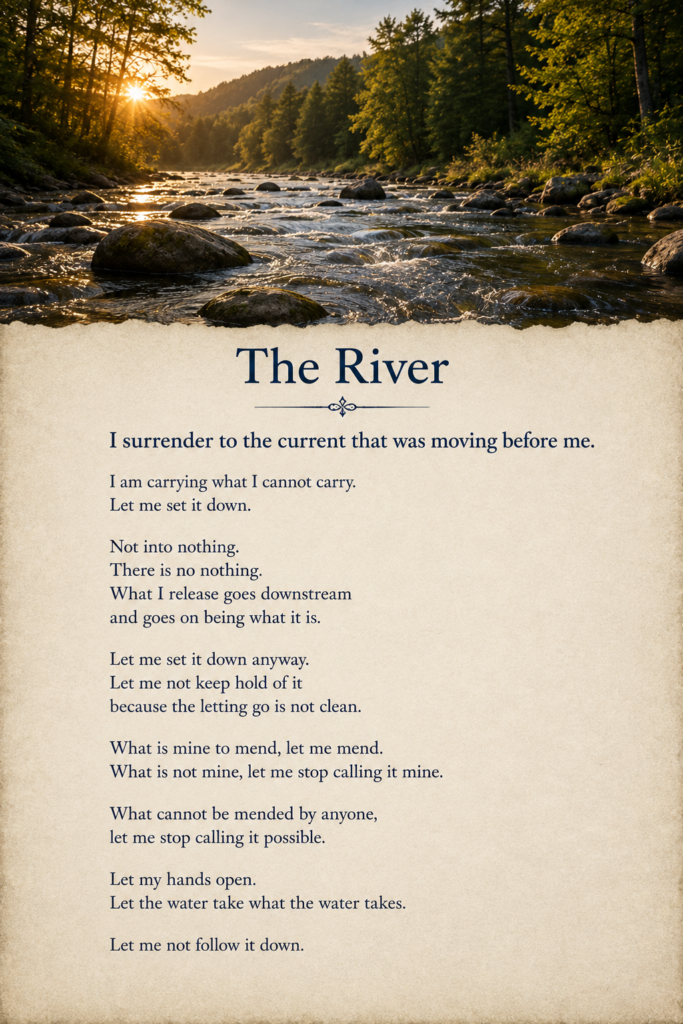
The River
Some of what a person carries can be set down and some cannot, and most of the difficulty is telling which is which. What is released does not stop existing. It goes somewhere. It goes on being what it was.
This is the part the usual language about letting go gets wrong. Release is described as though the thing released evaporates, and the person who has let go is presumed to be finished with it. But an old grievance set down still exists. The person it concerns is still alive somewhere, still holding their own version. A debt forgiven is still a debt somebody did not pay. Nothing is annihilated by being released; it is only no longer in the hands.
Which is precisely why release is more than the act of setting something down. Anyone can drop something once. Doing it while knowing exactly what remains downstream, and without the comfort of pretending otherwise, is a different act altogether.
The River
I surrender to the current that was moving before me.
I am carrying what I cannot carry.
Let me set it down.
Not into nothing.
There is no nothing.
What I release goes downstream
and goes on being what it is.
Let me set it down anyway.
Let me not keep hold of it
because the letting go is not clean.
What is mine to mend, let me mend.
What is not mine, let me stop calling it mine.
What cannot be mended by anyone,
let me stop calling it possible.
Let my hands open.
Let the water take what the water takes.
Let me not follow it down.
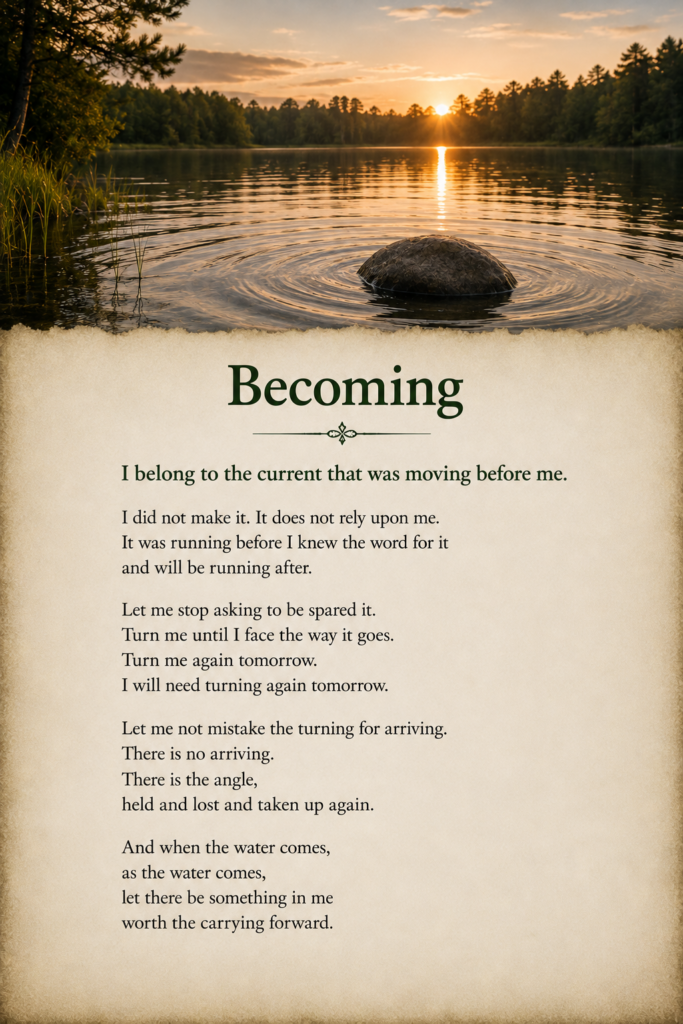
Becoming
Nothing here finishes. The angle is held for a while and then lost, usually without notice, and has to be taken up again the next morning and the morning after that.
That is not a failure of discipline. It is the ordinary condition, and any account of the spiritual life that treats drift as an aberration is describing somebody who does not exist. The drift is not the interruption of the practice. The drift is why there is a practice.
So the third of these asks for the least and asks for it most often. Not transformation, not arrival, not the settled state in which the turning would finally be unnecessary. Only to be turned, and then turned again, for as long as turning is required—which is to say, for the whole of it.
Becoming
I belong to the current that was moving before me.
I did not make it. It does not rely upon me.
It was running before I knew the word for it
and will be running after.
Let me stop asking to be spared it.
Turn me until I face the way it goes.
Turn me again tomorrow.
I will need turning again tomorrow.
Let me not mistake the turning for arriving.
There is no arriving.
There is the angle,
held and lost and taken up again.
And when the water comes,
as the water comes,
let there be something in me
worth the carrying forward.

Discover more from Many Lamps, One Flame
Subscribe to get the latest posts sent to your email.