
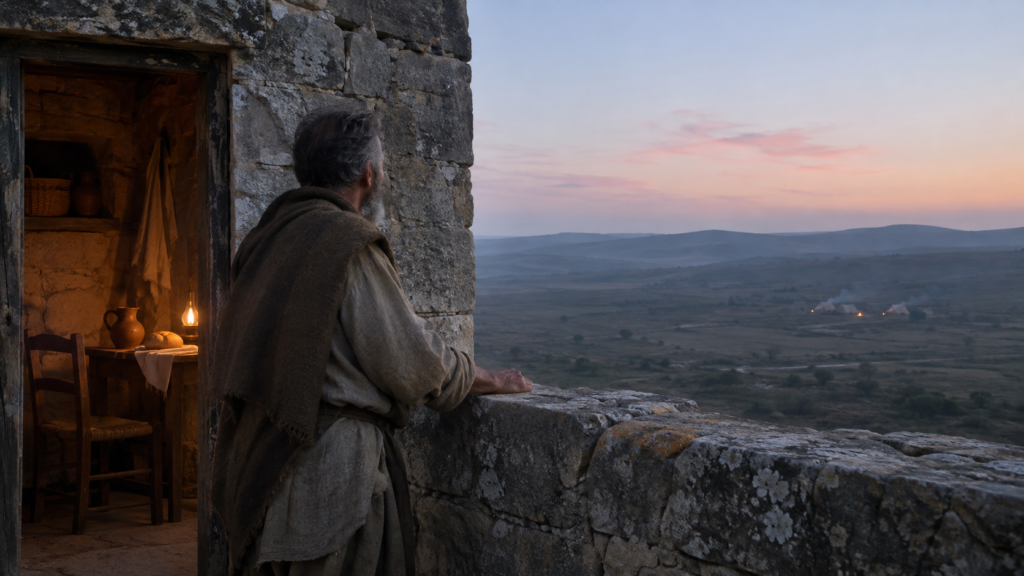
I am more eager for the Lord than watchmen for the morning, watchmen for the morning.
A voice calls up to the wall in the dark: “Watchman, what of the night? Watchman, what of the night?” Isaiah sets down the question twice and the answer once. “The watchman said: ‘The morning cometh, and also the night’” (Isaiah 21:11–12). It is a strange kind of comfort. The shomer, the watchman, does not promise an end to nights. He promises that this one, like every night before it, will give way to morning, and that another night will follow that morning in its turn. There is no consolation in the answer beyond its certainty, and no illusion in it either. It leaves a question of its own, harder than the one that was called up to the wall: what does it mean to wait for something one knows will come?
On the Walls
A siege does not need a single enemy to be a siege. A season can lay one: a long stretch of time that will not end on request, pressing at the same places morning after morning, testing whatever was built to hold. Nothing has to break through for the pressure to be real. It is enough that it does not stop, and that every day begins with the same walls to look at and the same distance to watch.
The wall is where that pressure is felt, and the psalm that names it does not pretend otherwise. “Should an army besiege me, my heart would have no fear; should war beset me, still would I be confident” (Psalm 27:3). The psalm does not say the army will not come. It does not even say the war will be short. It grants the encampment, the siege and the war, and refuses only one thing: the fear. That refusal is not bravado, because it is not aimed at the army. It is a statement about what the one inside the walls knows.
The watchman’s task follows from it. He cannot lift the siege; no watchman can. He is not posted on the wall to win anything. He is there to stay awake and keep watch, through a night he did not choose and cannot shorten. That is a different kind of work from fighting, and it is in some ways harder, because nothing he does on the wall makes the night end sooner. A long siege is endured the way any long contest is endured, a morning at a time. What makes the watch bearable is not the height of the wall. It is what the watchman knows about the night.
Evening and Morning
What he knows is written into the first chapter of Torah. Six times Genesis closes a day of creation the same way: “It was evening and it was morning, one day” (Genesis 1:5). The order is evening first. The Torah’s day begins in the dark, and the tradition has kept that order ever since; Shabbat and every festival begin at sundown. The night is not an interruption of the day. It is how a day begins, and morning is already built into it.
When that order is threatened, it is restored by promise. After the flood, after the longest night the world in Genesis had known, G-d says: “As long as the earth lasts, seedtime and harvest, cold and heat, summer and winter, and day and night, shall never again cease [to exist]” (Genesis 8:22). Winter is named in the promise. So is night. Neither is abolished; both are guaranteed to give way. Jeremiah goes further and makes the sequence the measure of G-d’s other promises: “If you could break My covenant with the day and My covenant with the night, so that day and night should not come at their proper time” (Jeremiah 33:20), only then could His covenant with David be broken. “As surely as I have established My covenant with day and night—the laws of heaven and earth” (33:25), the offspring of Jacob will not be rejected. The coming of morning is not luck. It is covenant.
The evening prayer says this every night. Ma’ariv, the evening service, opens by blessing G-d for the dark: He “rolls the light away from before darkness, and darkness from before light,” and the blessing closes on the One “Who brings on evenings.” The night is blessed as His work, not endured as His absence. Whoever says those words at nightfall is thanking G-d for a darkness that has not ended yet, because the same order that brings it on is the order that will roll it away.
The Tao Te Ching reaches the same certainty from the other side, by looking. “Wild winds never last all morning and fierce rains never last all day” (23, Hinton). No covenant is invoked; the storm simply does not last, and anyone who has watched one knows it. Yet the next line asks, “Who conjures such things if not heaven and earth,” and the observation turns out to rest on an order too. The two lamps light the same morning. One knows it will come because it was promised; the other knows it because it has always come. The watchman needs both, and he needs neither to fight. His trust is not that someone will win the battle for him. It is that the night was made to end.
The watchman’s answer never promised that there would be no more nights. “Also the night” is part of what he said, and it is honest: there will be other sieges, other long stretches on the wall. What he promised is that this one ends. The night was made to give way, and when the morning comes, the siege it held in place goes with it.
Provisioned
Certainty about the morning does not make the night short. The watchman still has to get through it, and much of what gets him through was laid up long before dark.
Proverbs describes a household that has already done that work. “She is not worried for her household because of snow, For her whole household is dressed in crimson” (Proverbs 31:21). The snow comes; the worry does not, and the reason is not courage. It is wool, spun and dyed and sewn in the warm months, when no one was thinking about snow. A few verses later the same woman meets the future in a way that sounds almost careless: “Strength and dignity are her clothing; And she laugheth at the time to come” (31:25). The Hebrew is va-tischak, and she laughs. It is not the laugh of someone who doubts the winter will come. It is the laugh of someone who knows it will and has already done what could be done before it arrived.
Proverbs sends the idle to the smallest example it can find: “Lazybones, go to the ant; Study its ways and learn… It lays up its stores during the summer, Gathers in its food at the harvest” (Proverbs 6:6–8). The ant does not work harder in winter. It works in summer, so that winter can be waited out.
The parable of the ten virgins makes the same distinction in the dark. All ten go out with lamps to meet the bridegroom, but “the wise took oil in their vessels with their lamps” (Matthew 25:4). Then the bridegroom is late, and something happens that is easy to read past: “while the bridegroom was delayed, they all slumbered and slept” (25:5). All ten, the wise as well as the foolish. Their readiness did not depend on their staying awake; the oil was in the vessels while they slept. When the cry comes at midnight, “those who were ready went in with him to the wedding; and the door was shut” (25:10). The parable still closes with a charge, “Watch therefore, for you know neither the day nor the hour” (25:13), and the charge stands. But the watching it asks for is not the sleepless vigilance of someone who has prepared nothing. Readiness cannot be assembled at the moment it is needed. It has to be in the vessel already, and once it is, even the watchful may rest.
That is the difference between bracing and being prepared. Bracing is a defense improvised at the last moment, in fear and haste, against something already arriving. Preparation is what was done earlier, and it gives a person something to draw on when the hour of need arrives. It does not end the work; stores run down in a long siege, and needs turn up that no one foresaw. It does not end fear either. What it ends is the panic of having nothing at all to reach for. That is why the household can laugh: not because the winter will be mild, but because it will not find them empty-handed. The watchman on the wall is not bracing. The oil is in the lamp, the stores are laid up, and though there will be more to do before morning, what is left, mostly, is to wait.
The Keep
The watchman cannot leave the wall, and he should not. Someone has to see what is coming across the plain. But keeping watch on the wall is not the same as living there. A person can stay attentive to everything outside, the encampment and the fires and the slow movement of the siege, without making that exposed position the whole of where he dwells. The walls take the pressure. Behind them is somewhere else to stand, and three traditions describe it, each in its own way.
The Buddha’s version is the most practical, and it is a matter of stores. In the Simile of the Fortress, a king’s frontier fortress is “well provided with seven appurtenances”: a deep-set pillar, a moat, a patrol path, weapons, troops, a high rampart, and “a gatekeeper… wise, competent, and intelligent, one who keeps out strangers and admits acquaintances.” It also holds four kinds of food, grass and firewood and water, rice and barley, beans and sesame, ghee and honey and salt. So provided, “it can be said that the king’s frontier fortress cannot be assailed by external foes and enemies” (Aṅguttara Nikāya 7.67, Bodhi). Then he turns the fortress inward. The pillar is faith, the moat is moral shame, the gatekeeper is mindfulness, and the four foods are the four meditative absorptions. One detail is easy to pass over. The stores are laid up “for the delight, relief, and ease of its inhabitants.” The provisions are not only for survival. They are for ease, and a fortress provisioned like that can be lived in, not merely held.
Where the Buddha’s fortress is built from cultivated qualities, Marcus Aurelius locates his in a single place: what Hammond translates as “your directing mind.” He wrote it on campaign, far from Rome, on the empire’s northern frontier. “That is why a mind free from passions is a fortress: people have no stronger place of retreat, and someone taking refuge here is then impregnable” (Meditations 8.48, Hammond). He does not say the frontier is quiet. He says there is a place it cannot reach.
Teresa of Ávila adds what neither of them says outright: the keep is not silent. She built a whole account of the soul as a castle of many rooms, and near its end she explains how the innermost room can be at peace while the rest is in tumult. “A king is living in His palace: many wars are waged in his kingdom and many other distressing things happen there, but he remains where he is despite them all.” The noise is not denied: “the noise of all this can be heard,” she writes, yet “nobody enters this Mansion and forces the soul to leave it” (Interior Castle VII.2, Peers). The siege is audible from the keep. It does not get in.
Proverbs says the same thing twice about money. The first time it is plain: “The wealth of a rich man is his fortress; The poverty of the poor is his ruin” (Proverbs 10:15). Wealth protects, and the book does not pretend otherwise. The second time, the line is set directly after the Name: “The name of the Lord is a tower of strength To which the righteous man runs and is safe. The wealth of a rich man is his fortress; In his fancy it is a protective wall” (18:10–11). Beside the tower, the same fortress is only as high as its owner imagines it. The keep that holds through a long siege is not built from what a person owns. It is built from what a person knows, about the night and about the One who brings it on, and it was provisioned before the first army appeared on the plain.
The First Hours
“The morning cometh, and also the night.” The watchman’s answer sounded at first like cold comfort, a promise of morning hedged by the promise of more dark. Read beside Genesis, it says something else. If the day begins at evening, then the night is not standing between the watchman and tomorrow. It is the beginning of tomorrow. The hours he keeps on the wall are not the last hours of a day that has failed. They are the first hours of a day that has already started.
That is what it means to wait for something one knows will come. It is not to stand outside the day, counting the hours until it lets you in. It is to be inside it already, in the part that happens to be dark, with the oil in the lamp and the stores laid up and the gate kept. He may be tired, and fear may still come to him on the wall. Neither means the watch has failed, because the psalm’s refusal of fear was never a report on how he feels. It was a statement about what he knows. The watchman does not have to bring the morning, and he does not have to lift the siege. The morning will do that. He only has to be there while it comes.
Source note: Translations draw on Aryeh Kaplan’s The Living Torah, the JPS Hebrew-English Tanakh, the JPS Tanakh (1917), the Metsudah Siddur, the New King James Version, David Hinton’s translation of the Tao Te Ching, Bhikkhu Bodhi’s translation of the Aṅguttara Nikāya, Martin Hammond’s translation of the Meditations, and E. Allison Peers’s translation of the Interior Castle. Online links are provided for reference; their translations may differ from those quoted here.

Discover more from Many Lamps, One Flame
Subscribe to get the latest posts sent to your email.