Seu et rosh kol adat b’nei Yisrael—Lift the head of the entire congregation of Israel…
— Numbers 1:2
Bamidbar has always been the portion the rabbis work hardest to redeem. Open it and you find numbers—a great many of them. Six hundred three thousand five hundred fifty men of fighting age, distributed across twelve tribes, each assigned a position in the camp, each tribe under its own banner, the Levites set apart and counted separately, their assignments to the Mishkan specified in detail. It reads, on the surface, like the administrative records of a people preparing for a military campaign. Which, on one level, it is.
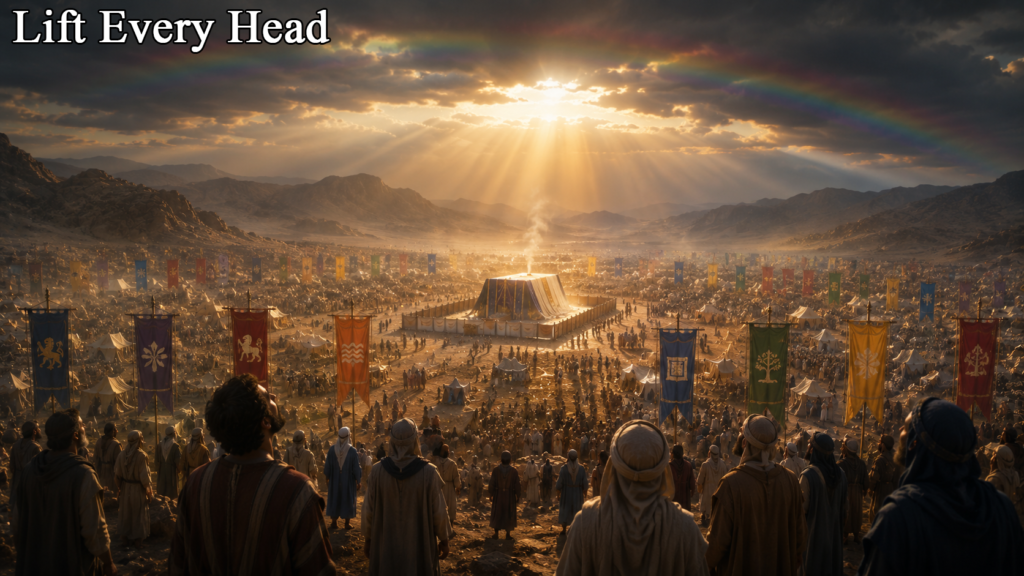
Over centuries of commentary, the tradition has reached past the administrative surface looking for the theological argument buried underneath. One productive thread begins with the flags. Each of the twelve tribes carried a standard whose color was distinct—and taken together, the banners evoke a spectrum of covenantal color. In Torah, that spectrum is not decoration. The rainbow is covenant made visible in the sky.
After the flood, G-d set the rainbow in the clouds as the sign of His pledge: lo yikaret kol basar od—never again will all flesh be cut off. Genesis 9:11. Some commentators, among them Rabbi Joseph Bechor Shor, read the rainbow as a visible trace of the divine presence—Shekhinah made briefly perceptible. Rabbi Shlomo Riskin reads it as humanity’s reminder to fulfill its own side of the covenant: to protect and tend what G-d has made. And whenever a rainbow appears, Jewish law commands a blessing:
בָּרוּךְ אַתָּה ה׳ אֱלֹהֵינוּ מֶלֶךְ הָעוֹלָם זוֹכֵר הַבְּרִית וְנֶאֱמָן בִּבְרִיתוֹ וְקַיָּם בְּמַאֲמָרוֹ
Baruch ata Adonai Eloheinu melech ha’olam zocher ha’brit v’ne’eman bivrito v’kayam b’ma’amaro.
Blessed are You, Lord our G-d, King of the universe, who remembers the covenant, and is faithful to His covenant, and keeps His promise.
The census, it turns out, is also an act of covenant remembrance. The twelve tribes arranged around the Mishkan, their rainbow of banners lifted against the wilderness sky, form a living embodiment of the pledge. But to see precisely how, you have to look at the word Torah chose for the census itself—a word it did not have to use, and whose choice changes everything.
A Word Torah Didn’t Have to Use
Torah has perfectly serviceable words for counting. Pakad—to appoint, to visit, to take account of—carries the weight of administrative reckoning. Mispar, sfor—number, enumeration—do the arithmetic. The book is called Sefer HaPekudim by the rabbis—the Book of Countings—for good reason; pakad appears throughout it. The census in Exodus 30, conducted through the half-shekel offering, uses pakad. The second census in Numbers 26 uses pakad. The word is Torah’s standard instrument for the counting of people.
But the command to Moses that opens Bamidbar is not pakad. It is seu—the imperative form of the root nasa—and nasa does not ordinarily mean count. At root, it means lift—and Torah chooses the census idiom that preserves that root sense.
Seu et rosh kol adat b’nei Yisrael. Lift the head of the entire congregation of Israel.
Why this word? Torah does not make careless choices. And nasa carries a weight that pakad cannot. The word appears more than six hundred times in the Hebrew Bible, across a range of contexts so varied that its full meaning can only be understood by watching what it does in the places that matter most.
What Lifting Does in Torah
Four instances are essential here, and each one adds a distinct register of meaning to what Torah is doing in Bamidbar.
Genesis 40 — Lifting as judgment. Pharaoh’s cupbearer and baker sit in prison, each carrying a dream he cannot interpret. Joseph reads them. Yisa Pharaoh et roshcha—Pharaoh will lift your head, he tells the cupbearer, Genesis 40:13—and restore you to your position. To the baker: yisa Pharaoh et roshcha me’alecha—Pharaoh will lift your head from upon you. Genesis 40:19. The same root, the same upward gesture, life and death in a single breath. To be lifted in this sense is to be brought before the one who holds the power of your fate—seen, weighed, and answered.
Exodus 20:7 — Lifting as desecration. Lo tisa et shem Adonai Elohecha lashav—you shall not nasa the name of the Lord your G-d in vain. Exodus 20:7. The same root, the same upward motion—but here it is prohibited. To lift the divine name without the weight of genuine intention behind it is not devotion. It is the precise hollowing out of devotion. The gesture of elevation can be the most sacred act in the tradition or its most empty performance, depending entirely on what is actually being carried in the lifting.
Numbers 21 — Lifting as healing. The people complain in the wilderness and are bitten by serpents. G-d tells Moses to make a bronze serpent and raise it on a pole—nasa—and whoever was bitten looked up at it and lived. Numbers 21:9. The lifting creates the possibility of rescue. But the healing is not automatic. The bitten person must respond: must lift their own eyes toward what has been raised. Nasa here is relational—an act of elevation that calls forth a corresponding act of orientation from the one who has been brought low.
Psalms — Lifting as restoration. Atem m’rimei roshi—You are the one who lifts my head. Psalm 3:4. The language of being raised out of shame, out of defeat, out of the prostration of one who has fallen, into dignity before G-d. To have one’s head lifted is to be restored to standing—not merely physically but covenantally. The lifted head is the head that can again face the One who lifts it.
When Counting Becomes Dangerous
Torah’s use of nasa in place of pakad is not stylistic preference. It is a response to a known danger.
Elsewhere in Torah and in the historical books, the counting of Israel is treated as spiritually perilous. The half-shekel census of Exodus 30 is conducted not through direct enumeration but through an offering—each person gives a coin, and the coins are counted rather than the people. Exodus 30:12. The text is explicit about why: v’lo yihyeh vahem negef bifkod otam—so that there will be no plague among them when they are counted. Direct counting carries a risk. The soul, reduced to a unit in a tally, is in some sense diminished by the reduction.
The clearest demonstration of this danger comes later, in Second Samuel. King David orders a census of Israel—a full military enumeration, conducted through pakad. His commander Joab protests. David insists. The census proceeds. And when it is complete, a plague kills seventy thousand people. 2 Samuel 24:15. The tradition has long debated precisely what David’s sin was—but the association between the census and the catastrophe is preserved in the text with unmistakable clarity. To count a people as numbers for war, to reduce individual souls to figures in a tally, is to commit a violation the tradition treats as serious.
This is the context in which Torah’s word choice in Bamidbar becomes theologically decisive. A census is required—Israel must be organized for the wilderness march. But the census cannot be conducted as pakadwithout risk of the very deformation that David’s census enacted. So G‑d gives Moses a different command entirely. Not: count them. Seu et rosh—lift their heads. One by one. By name. By family. By tribe. The difference between pakad and nasa is the difference between reducing a soul to a number and raising a soul into covenantal visibility. Bamidbar is showing one way a census can occur without becoming spiritually deforming.
The Nasi and the Nasa
The noun form of nasa is nasi—literally, one who has been lifted up. It became the word for prince, tribal leader, head of a community. Throughout Bamidbar, the nesi’im—the tribal princes appointed to assist Moses in the census—are named, listed, given their assignments. And the word for what they are is the noun form of the very verb being commanded.
The ones appointed to lift the heads of the people are themselves the lifted ones.
Leadership in Torah is not elevation above the community. It is the capacity to lift others. The nasi is not the one who stands highest—he is the one who has been raised up in order to raise. His authority is not separation from the people but a particular orientation toward them: face to face, head to head, the lifted raising those who have not yet been raised.
This structure mirrors the covenant itself. G-d lifts Moses. Moses and the nesi’im lift the heads of Israel. The shefa of covenantal recognition moves downward and outward through those who have received it—not accumulating, but transmitting. The Tabernacle stands at the center of the camp; the nesi’im stand between it and the people; and the command that moves through them is: seu et rosh—lift.
A Liturgy of Recognition
Return now to the opening command. G-d does not tell Moses to pakad the people—to count, to inventory, to enumerate. He tells him to nasa their heads. One by one, by name, by family, by tribe. Each soul raised individually into covenantal visibility.
This is not administration. It is the same act as the rainbow blessing: zocher ha’brit—the covenant being remembered, enacted, made present again. The people who stood at Sinai—and Torah insists this includes every soul yet to be born, Deuteronomy 29:13–14—are being seen again. Not as a mass. Not as numbers for war. Not as a workforce. As individual souls, each one lifted before the One who counts. The census is covenant renewal in human form, one lifted head at a time.
The rainbow of tribal banners lifted against the wilderness sky and the lifted heads of the census are the same theological statement at two different scales. One written in light across the heavens. One enacted in the naming of names, tribe by tribe, in the wilderness of Sinai. Both say the same thing: zocher ha’brit—He remembers. He sees. He lifts.
And the bronze serpent makes explicit one response that nasa can require: the willingness to look up. The healing is not automatic. The lifting calls forth an answering orientation. The covenant is not remembered by G-d alone—it must be remembered by the soul that is being lifted, who must raise its own eyes toward what has been raised over it.
The Ledger That Is a Liturgy
The portion that reads like a census is, on close reading, a liturgy of recognition. Every soul counted is a soul lifted. Every name recorded is a covenant remembered. Seu et rosh is not a command to take stock. It is Torah’s most precise statement about what the relationship between G-d and Israel actually is: not a transaction between a sovereign and a subject, not a contractual arrangement between parties of unequal power—but the repeated, renewed, individual act of one who lifts the head of the other and holds it there long enough for the eyes to meet.
At the burning bush, Moses was told to remove what stood between the sole of his foot and the holy ground. The ground was already holy; the sandals were the only problem. Here, in the wilderness of Sinai, the command runs in the other direction: G-d lifts each soul into its full covenantal dignity. The soul was already there. The lifting names what was always true.
Every soul counted is a soul lifted. The portion that looks like numbers is, underneath, a record of faces.

Discover more from Many Lamps, One Flame
Subscribe to get the latest posts sent to your email.