
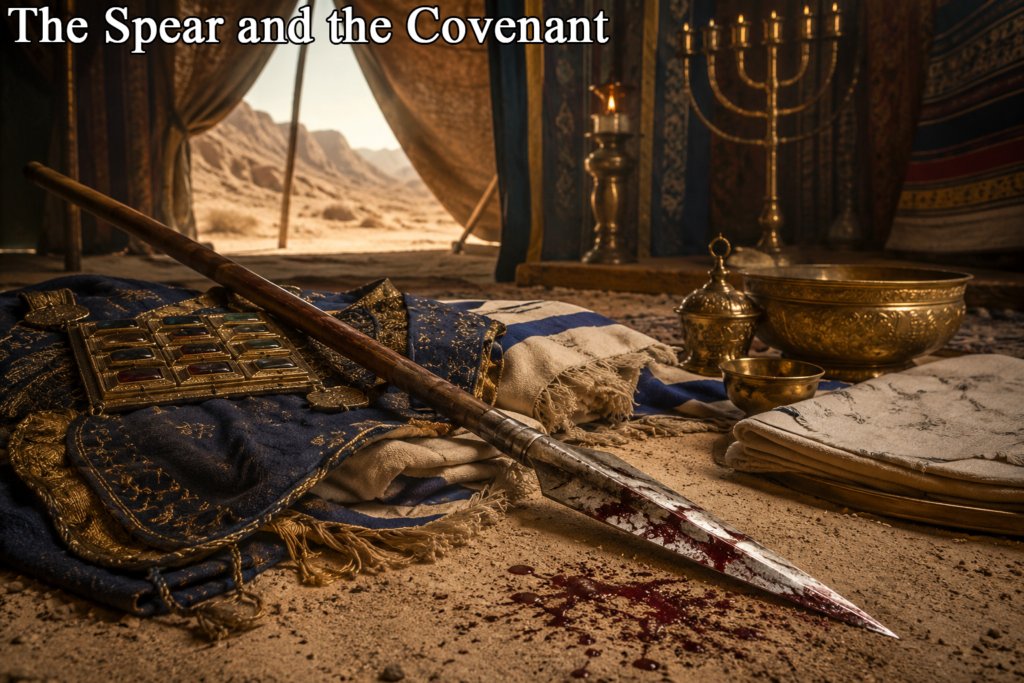
There is one letter in the entire Torah that every scribe is required to write broken.
In Numbers 25:12, G‑d grants Pinchas a brit shalom—a covenant of peace. The word shalom contains a vav, and that vav, in every valid Torah scroll ever produced, must be written with a deliberate fracture in its vertical line. Under any other circumstance, a broken letter invalidates the entire scroll. Here, the break is mandatory. Generations of commentators have read the fractured letter as the tradition’s way of qualifying what the text appears to celebrate: peace achieved through violence is structurally incomplete. That reading is not wrong. But it stops at the surface of something far deeper.
What Everyone Says
The conventional frame is familiar. Pinchas sees a public act of defiance—a tribal chieftain and a Midianite woman, together, in full view of the congregation at the entrance to the Tent of Meeting. The plague is already killing thousands. Moses stands paralyzed. Pinchas takes up a spear and kills them both. The plague stops. G‑d responds with the brit shalom and the eternal covenant of priesthood.
Commentators have wrestled with this for centuries. Some read the act as justified—extreme circumstances, extreme response, the plague stopped. Some read it as cautionary—the broken vav as the tradition’s hedge, its admission that something was lost even when something necessary was done. Some compare Pinchas to the religious actor who mistakes personal impulse for divine mandate, the one who moves through violence and calls it righteousness. The broken vav, on this reading, is the rabbis saying: yes, but.
The problem with every version of this frame is the same. It reads the act. It does not read the interior condition driving it.
The Rebbe’s Read
The Lubavitcher Rebbe saw something the conventional frame misses entirely. Pinchas merited the brit shalom not because the act was justified but because he acted in complete opposition to his nature. A kohen is formed by chesed—blessing, atonement, drawing near to the people in peace. The priesthood is the office of approach, not judgment. The spear was everything his formation was not. To lift it required transcending what he had been made to be. That act of self-overcoming is what G‑d recognized.
Rav Abraham Isaac Kook adds the other dimension. Pinchas was not acting from above the people in judgment. He was acting from among them—from love, from a felt sense of being part of what was being destroyed. The motivation was not rage at the transgressor. It was chesed for the congregation. The violence looked like gevurah from the outside. The interior condition driving it was oriented entirely toward the people’s survival.
These two readings together locate the essay’s true subject. The brit shalom is not a reward for an outcome. It is a recognition of a being in whom something moved with integrity.
The Sefirotic Frame
Shefa—divine flow, the emanation that moves through the sefirot and into the world through human vessels—does not ask only what someone does. It asks how the flow moved, from what configuration, through what channel. The question G‑d is answering with the brit shalom is not: did the act produce the right result? It is: what was actually moving through Pinchas when he acted?
The upper triad governs the answer.
Hochmah is the primordial flash—instantaneous, pre-cognitive, undifferentiated. Something is catastrophically wrong. Pinchas perceives it before he can articulate it. This is not thought. It is the point before thought, the spark that precedes structure.
Binah receives that flash and develops it into understanding. She is the womb of comprehension—the faculty that takes the raw perception and analyzes it, weighs it, reads the full dimensions of the moment. Where Hochmah fires, Binah processes. Where Hochmah sees, Binah understands.
Da’at—the hidden sefirah, the one that does not appear on the face of the tree—is the transformative knowledge that emerges when Hochmah and Binah fully unite. Not perception. Not analysis. The integration of both into embodied knowing, the moment comprehension becomes action-determining. In Pinchas, Da’at is where integration completes: the knowledge born from the union of perception and understanding that gevurah, not chesed, is the vessel through which shefa must now move.
Below the upper triad, the configuration completes itself. Chesed remains the orientation of his interior—love for the people is the source, not rage at the transgressor. Gevurah is the instrument Da’at determines the moment demands—force, boundary, necessary contraction—but it flows from its dynamic union with chesed, not against it. Tiferet, the harmonizing center that holds chesed and gevurah in balance, is present but not yet fully integrated. The tree is functioning. It is not yet complete. The vav will break.
Even absent full integration at Tiferet and Yesod, the sefirot are in dynamic relation—reaching toward one another, balancing, the harmony of the tree asserting itself through the configuration. This is not disorder. This is the tree functioning under conditions that preclude wholeness, doing what it can with what is present. That balance—partial, reaching, structurally sound even where incomplete—is precisely what G‑d recognizes.
Now consider the counter-case. The radicalized actor fails at Binah. The Hochmah flash fires—perception arrives, something is wrong, a response is demanded—but it is never received into the womb of understanding. Binah does not develop the flash. Da’at never forms. No integration occurs. What moves through gevurah is the yetzer hara—not evil in itself, but creative energy unbridled, the vital force of the self surging without the structure to govern it. The channel opens. The wrong thing moves through it.
This is what the Zohar names as the World of Tohu—the primordial chaos in which the sefirot exist as isolated, intense points of light that refuse to integrate, that cannot yield to one another or be harmonized. The radicalized actor is not operating in Tikkun, the world of correction and integration. He is operating in Tohu—isolated perception driving isolated force, each sefirah a shard rather than a vessel in relation. What results is not holy zeal. It is fragmentation mistaken for righteousness.
To call what Pinchas did zealotry—blind enthusiasm, uncompromising passion, fanatical fervor—is to confuse it with its precise opposite. Pinchas operated in Tikkun. The upper triad completed its work. Hochmah fired, Binah received and developed, Da’at formed and governed. Gevurah flowed from its union with chesed. Balance, harmony, symmetry—the tree functioning as designed, even where it could not yet be whole.
Not reward—recognition: G‑d sees Pinchas as he truly is, and reveals where this nature was always intended to serve.
The Broken Vav Revisited
Return now to the fractured letter—but with different eyes.
The vav does not break because violence is inherently incomplete. It breaks because shefa expressed through gevurah without the full integration of tiferet cannot achieve whole shalom. Wholeness requires the full tree in balance—chesed and gevurah held by tiferet, the harmonizing center through which their union becomes something neither could be alone. In the moment Pinchas acted, tiferet had not yet fully integrated what passed through it. The act ended the crisis. It did not restore the world.
Pinchas deployed correctly but partially. The brit shalom names both truths simultaneously: the perfection of the channel, and the imperfection of what the channel was forced to carry.
What the Covenant Names
The brit shalom is not ironic. It is not compensatory. It is not the rabbis hedging against a difficult text.
It is precise.
G‑d is naming what moved through Pinchas—in what configuration, from what source, through what channel, toward what end. The covenant of peace given to a man holding a spear is not a paradox once you see what G‑d was actually looking at. The act was gevurah. The source was chesed. The governing intelligence was Da’at, formed from the full union of Hochmah and Binah. The tree was in dynamic balance, reaching toward harmony even where it could not yet be whole.
The broken vav was never the tradition hedging. It was the tradition telling the truth about what shalomrequires—and what it costs when the world does not yet permit it.
The covenant was real. The flow was recognized. The letter remains broken because the peace remains unfinished—not the peace of Pinchas, but the peace of the world through which he moved.

Discover more from Many Lamps, One Flame
Subscribe to get the latest posts sent to your email.