
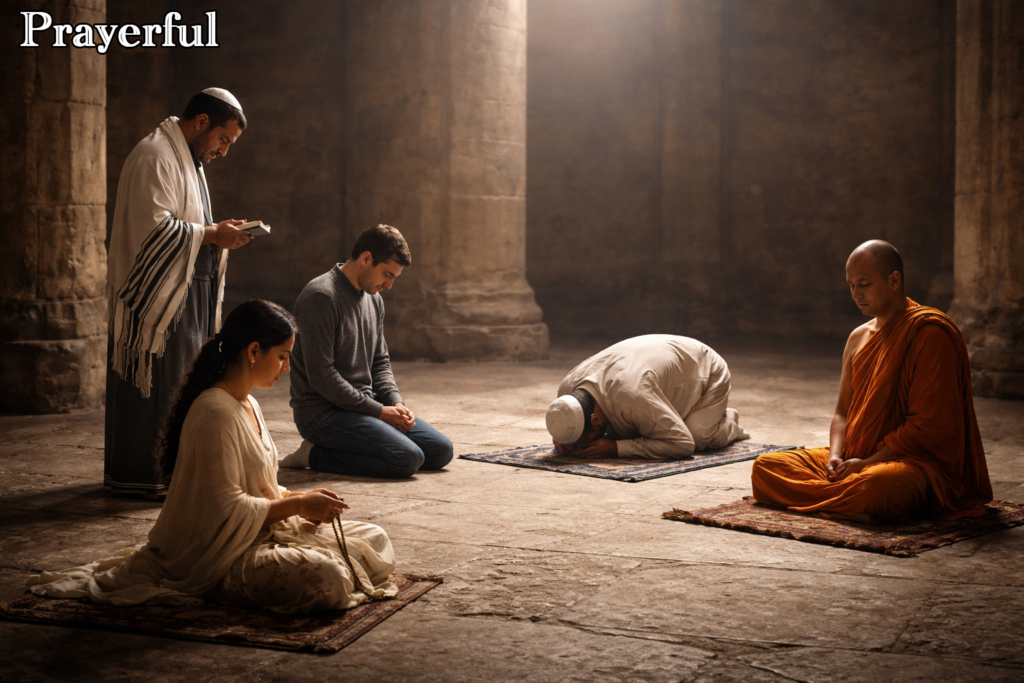
Everyone has been taught how to pray.
Very few have been told what prayer is actually for.
The gap between those two things is where most people live—reciting words they were given as children, wondering why the words feel hollow, suspecting in private that no one is listening. Some abandon the practice entirely. Others double down on the liturgy, hoping that fidelity to form will eventually produce what feeling cannot. Neither solves the problem, because neither correctly identifies it.
The problem is not the words. The problem is the assumption underneath them: that prayer is a transmission—a request sent upward, awaiting a response from elsewhere. That assumption is so widespread, so deeply embedded in popular religious culture, that it functions as the default definition. It is also, across every serious contemplative tradition, profoundly mistaken.
Prayer is not transmission. It is clearing. It is the disciplined practice of removing what obstructs—distraction, noise, the accumulated static of a scattered life—so that what is already present can be received. Traditions that have reflected deeply upon prayer arrive at some version of this conclusion.
The Human Condition
Left unattended, people tend to drift. Attention fragments, obligation recedes. The mind loops through grievance, anticipation, and appetite—rarely resting on the reality that lies beneath them.
Classical Taoism would call this departure from the Dao—not sin, not weakness, but a subtle loss of orientation that happens naturally, the way a compass drifts without a fixed point to anchor it. This is not a moral failure; it is simply what it means to be human.
But drift is only one of the conditions prayer must address. A person can be aligned yet shattered. Exhaustion, fear, grief, despair, fragmentation—these are the components of the tortured soul. Drift and wounding are different conditions. They require different responses. Serious examination eventually distinguishes between them, even when the distinction is left unstated.
The major contemplative traditions built their prayer practices as responses to both conditions—not to solve them once and finally, but to provide reliable countermeasures. Technologies of return.
The question worth asking of any prayer practice is therefore not is someone listening? but what is this practice designed to clear, and does it work?
Across the Traditions
Judaism does not define prayer primarily as petition.
The central term, tefillah, derives from a reflexive root associated with self-examination conducted in the presence of G-d. The prayer is not primarily addressed outward; it is interior work done before G-d. Liturgy—Amidah, Shacharit, the fixed structure of three daily services—provides scaffolding for that work. Stand, bow, declare, petition, give thanks. The body and mind are organized around something larger than the self, around what is true regardless of what one happens to be feeling on a given morning.
That scaffolding is useful. It is not the destination. Liturgy carries you reliably to the door. What happens at the threshold—that is tefillah. A liturgy recited without the interior movement is not prayer; it is rehearsal.
Christianity makes this explicit. In the Sermon on the Mount, Jesus condemns not communal prayer but its corruption: the performance of piety for an audience. He directs his listeners into tameion—a Greek word meaning not merely a private room but a treasury, a protected interior space. Your genuine interior life, he says, is the most valuable thing you possess. Guard it accordingly.
More radically: “Your Father knows the things you have need of before you ask Him.” If G-d already knows—truly, completely, before a word is spoken—then petitionary prayer collapses on its own terms. Augustine, writing to the widow Proba, drew the precise conclusion: prayer does not inform G-d. It enlarges the vessel of the one who prays, widening the capacity to receive what G-d already desires to give. Aquinas sharpened this: prayer is not about changing divine will. It is about aligning human will with what is already being willed. The obstacle is never on G-d’s end. The obstacle is our narrowness—our distraction, our insistence on outcomes we’ve already decided upon.
Islam offers one of the clearest institutional expressions of this understanding. Formal prayer, ṣalāh, is neither spontaneous nor primarily verbal. It is structured, timed, and embodied—five times daily, oriented toward a fixed point, requiring ritual purity and physical prostration. Its purpose is alignment through obedience: placing the body and attention in their proper relation to reality. Personal supplication, duʿāʾ, allows for requests—but even here the act is an acknowledgment of dependence, not an attempt at persuasion.
The Mevlevi Sufi Order makes the argument with their bodies. The Sema ceremony—the whirling dervish—is among the most rigorous forms of prayer ever developed within Islamic mysticism. During the Sema, one hand turns upward to receive; one hand turns downward to transmit. The body rotates around the heart. There is no petition, no spoken request, no expectation of response. The practitioner places themselves into a state of synchronization with the very fabric of reality. If prayer were merely request, this would be absurd. Instead, it is revered—and that tells us something vital about what prayer actually is.
Hindu traditions use mantra, ritual offering, and repetition not as requests but as methods of attunement. Sound and rhythm shape consciousness directly. The Gayatri mantra chanted 108 times at dawn is not a message being sent; it is a tuning. The chanting of Om is not invocation so much as resonance—the self being brought into alignment with what already underlies it.
Buddhism exposes the transactional assumption most starkly. There is no creator deity to petition, yet prayer-like practices remain central. Chanting, bowing, and recitation function to cultivate attention, compassion, and insight into impermanence. Prayer here is intention made durable through repetition—the mind trained, by practice, toward the recognition that the self which clings is not the self which endures.
Indigenous and earth-centered traditions approach prayer as participation rather than petition. To pray is to acknowledge relationship—between human, land, ancestor, and future. Orientation, not articulation, is the defining feature.
The Technology of Clearing
The common thread is not theology. It is function.
Across traditions the forms differ—liturgy, mantra, prostration, silence—but the function is remarkably consistent. Prayer operates less like a message sent to heaven than like a discipline applied to the human mind. It clears attention, reorganizes desire, and restores the interior posture necessary to receive what is already present. In that sense, prayer is not merely devotion. It is a technology of consciousness, refined over centuries to address a well-recognized problem: the human tendency to drift out of alignment with reality itself.
When Taoism addresses the scattered mind, it offers two specific practices. Xin Zhai—Fasting of the Mind—is subtractive: one stops grasping, narrating, pre-judging. It answers drift by clearing space. Zuo Wang—Sitting in Forgetfulness—works by release: the self loosens its identification with roles, stories, and compulsions. Loosening those identifications allows the ego to soften; effort drops away, and alignment reasserts itself naturally. It is not so much clearing the mind as dissolving the impulse to cling altogether.
The rosary, the mantra, the devotional—these address the same drift through repetition. Reason alone cannot stabilize a nervous system under distress. Repetition narrows attention, slows internal chaos, and reintroduces rhythm. It borrows strength from structure when the self has lost its center. This form of prayer does not require clarity of belief; it works even when theology is shaken. This is precisely why it persists in moments of suffering.
But structure addresses drift. It does not address wounding.
For the shattered soul—exhausted, grieving, fragmented—Rabbi Nachman of Breslov proposed something altogether different. He called it hitbodedut: self-seclusion, unguarded discourse with G-d, performed alone, often outdoors, in whatever language comes naturally. Rabbi Nachman walked through forests and spoke to G-d the way one speaks to a trusted friend—honestly, without restraint, without elegance. Hitbodedut allows the soul to uncoil. It is not about correctness or theology; it is about honesty without restraint. This is prayer as reconstitution—not the removal of noise alone, but the active restoration of what the noise has frayed.
Rabbi Nachman taught that there is no such thing as despair in the world—that it is forbidden to despair. Even in brokenness, the connection to the Divine remains. And if one believes there can be a state of brokenness, one must also believe repair is possible. Hitbodedut creates the space for that reparative process to begin.
These two modes—structural clearing and personal reconstitution—address different conditions. A person who has simply drifted needs tefillah, the structure that returns them to posture. A person who has been shattered needs hitbodedut—the unscripted conversation that allows what is broken to be spoken and, in the speaking, begin to be held. The traditions understand both. What most popular religious culture offers is neither—only the rote recitation that occupies the space where prayer should be.
Return
After drift, posture realigns. After wounding, restoration begins. What follows, however, is not immediately action—it is re-entry. And re-entry is its own movement.
Return answers a quieter, deeper question: Where do I go once I am gathered again?
Judaism has a precise name for this: teshuvah—usually translated as repentance, but more accurately understood as return. Maimonides, in the Mishneh Torah, lays out its stages: ceasing the harmful pattern, genuine remorse, verbal confession, resolution not to repeat. When the sin is against another person, two further steps follow—making amends and seeking forgiveness. The process is not instantaneous, and it is not merely internal. It is a structured re-entry into right relationship—with G-d, with others, with oneself.
This matters because re-entry cannot be forced. Responsibility requires stability, coherence, capacity. Often, at the moment restoration begins, we lack one or all of these. Teshuvah understands this. It does not demand that the returning person arrive fully reconstituted—it provides a framework for the journey back. The stages are not a checklist but a path, walked at the pace the soul can bear.
Acceptance of responsibility before return is complete—or the imposition of it from without—is premature and often destructive. The fragile seams of a vessel restored will fragment again under pressure they were not yet ready to hold. This time they carry the added weight of resentment.
Every tradition surveyed here speaks of return in some form—return to the Dao, to awareness, to covenant, to the present moment. In each case, return precedes transformation. It is not singular but repeated—a movement made again and again across a life, because the drift and the wounding return as well.
Stillness, Not Motion
The Kabbalists described divine flow—shefa—as moving continuously through the structure of creation. It does not stop. It does not withhold. The question is always whether the channels are open to receive it.
Prayer persists, in practice, even where petition and transaction go unfulfilled. This is not accident—it is evidence. What persists is not the transactional form but the posture underneath it: a disciplined way of orienting oneself to reality, obligation, and meaning. Something the transaction model was never equipped to explain.
In every tradition surveyed here, the common thread is alignment—establishing the correct posture toward and within the Divine. And alignment, when genuinely achieved, brings more than orientation. It brings peace. Peace within, peace without. A sense of harmony restored. This harmony can be calming or even euphoric—not the relief of a wish granted, but something quieter and more durable: the recognition that one is standing in the right place, facing the right direction, open to what is already flowing.
This is what prayer is actually for. Not to inform G-d of what He already knows. Not to persuade toward outcomes He has not considered. But to become, through the practice itself, the kind of person who can receive what is already being offered—to clear the channel, widen the vessel, restore the posture that distraction, suffering, and self-sufficiency perpetually erode.
Augustine called it widening the vessel. Aquinas called it aligning the will. The Taoist calls it returning to the Dao. The dervish calls it becoming a conduit. Rabbi Nachman called it speaking honestly in the forest.
Jesus said: go into your room. Shut the door. Your Father who sees in secret is already there.
We know when we’ve drifted. We sense the imbalance—off-kilter, not quite right, moving through days that have lost their coherence. The instinct is often to add: more activity, more words, more effort. The traditions point in exactly the opposite direction.
Stillness, not motion.
Clearing, not asking.
Receive what is already flowing.

Discover more from Many Lamps, One Flame
Subscribe to get the latest posts sent to your email.