
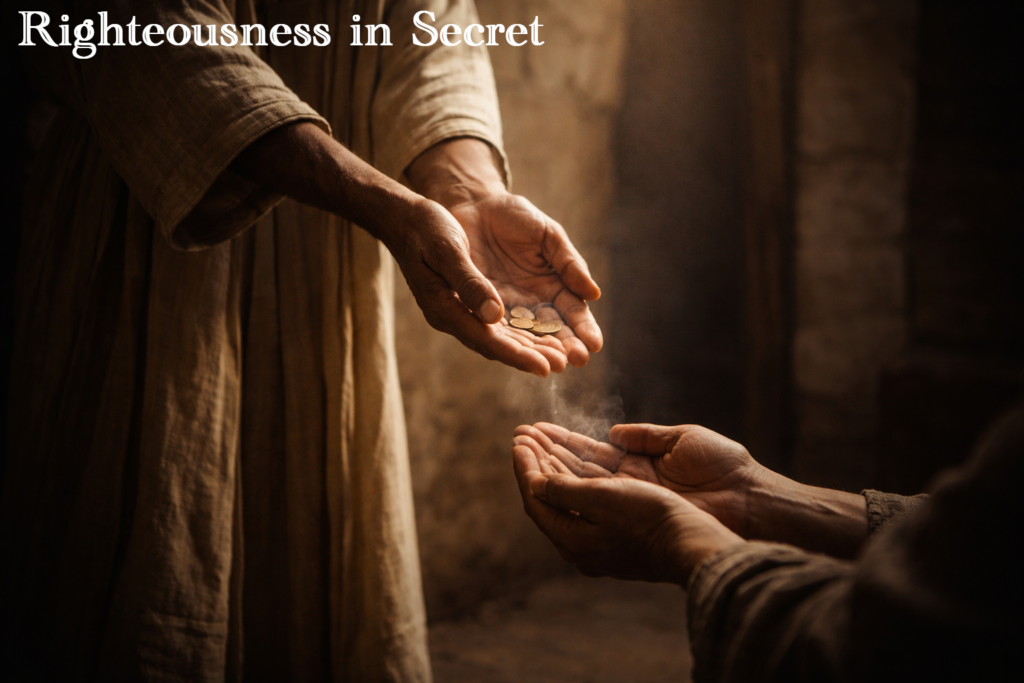
Take heed that you do not do your charitable deeds before men, to be seen by them. Otherwise you have no reward from your Father in heaven. Therefore, when you do a charitable deed, do not sound a trumpet before you as the hypocrites do in the synagogues and in the streets, that they may have glory from men. Assuredly, I say to you, they have their reward. But when you do a charitable deed, do not let your left hand know what your right hand is doing, that your charitable deed may be in secret; and your Father who sees in secret will Himself reward you openly.
(Matthew 6:1–4)
There is a persistent suspicion among the skeptical that nothing is ever truly free. Every act of kindness harbors an agenda; every gift conceals a hook. This instinct is not paranoia. It is pattern recognition—and it is correct often enough to have earned its place. People do have ulterior motives. What Jesus addresses here is precisely what generates that cynicism in the first place. The skeptics have correctly diagnosed the disease. This passage is the cure.
The Word Beneath the Word
The Greek Matthew records is eleēmosynē—almsgiving. But the concept underneath, the word Jesus almost certainly spoke in Aramaic, is tzedakah. And tzedakah is not simply charity. It is justice; alignment with covenant.
As explored at length in Tzedakah—Should It Be Without Conditions?, this is not sentiment. You give because the covenant demands it—not because you are generous, but because Torah is unambiguous on the point. What you hold has never been entirely yours. G-d’s claim on your resources precedes your own.
Torah places zero conditions on the act. The need is the only criterion. Those who lack—the anawim, the poor and lowly and marginalized whom Torah consistently places under divine protection—require nothing further to qualify. Not worthiness, not effort, not whether they made good choices. Paul’s “if anyone will not work, let him not eat” (2 Thessalonians 3:10) introduced a moral filter that Torah explicitly refuses, and it set the tone for more than a millennium of conditional giving dressed as righteousness. If tzedakah is justice, conditions are incoherent. You do not require someone to prove they deserve justice before you extend it.
The Trumpet and the Trojan Horse
The trumpet image is not abstract. Public almsgiving in Second Temple Judaism had structural functions; the announcement could literally summon the poor to receive. The apparatus was not cynical—it served the recipient. Jesus is not attacking a straw man.
He is identifying the moment of corruption: when the mechanism designed to serve the poor becomes a vehicle for the giver’s self-aggrandizement. The gift arrives. Inside it: the need for recognition, the implicit social debt, the performance of virtue that places the recipient in a subordinate position. Something is now owed—gratitude, acknowledgment, deference. The gift was never free. It was a transaction dressed as justice.
The Greek word rendered “hypocrite” is hupokritēs—an actor. Not a conscious deceiver. The performance may be entirely sincere, which is precisely what makes it spiritually dangerous. The actor has mistaken the role for the reality.
“They have their reward”—apechousin ton misthon autōn—is a commercial term. Receipt given. Account settled. Transaction complete. You chose which economy to operate in. You were paid in full. There is nothing further. The other economy—the one that operates entirely outside human approval, the one with the Father who sees in secret—was never entered. Thus, what you could not buy with applause remains uncollected.
Maimonides and the Architecture of Pure Giving
Working entirely within the Jewish legal tradition (independently, without reference to the Sermon), the Rambam—Rabbi Moses ben Maimon, twelfth-century physician, philosopher, and the most systematically rigorous legal mind Judaism has ever produced—built his eight levels of tzedakah as a ladder of increasing purity. Each rung describes not what you give, but the quality of the act itself. The question is never whether the recipient has earned it. That question doesn’t appear anywhere on the ladder. The only variable is how completely the giver has removed themselves from the transaction.
At the bottom: giving reluctantly, or less than one should, but giving. Already obligatory. Already an act of justice, however compromised by resentment. Moving upward: giving cheerfully but only when asked. Giving before being asked. Giving without knowing who receives. Giving where the receiver doesn’t know who gave. And at the summit—the highest rung, the form of tzedakah that Maimonides considers most aligned with the purpose of Torah—enabling a person’s self-sufficiency entirely: a loan, a partnership, steady employment. Not the transfer of resources but the restoration of capacity. The goal is not dependency. The goal is that the act eventually makes itself unnecessary.
But notice what is absent from every level: any assessment of the recipient. No rung says, “give only to the deserving.” No rung qualifies the obligation by the circumstances that produced the need. The ladder concerns itself entirely with the interior condition of the giver—the gradual dissolution of self-interest, the progressive removal of the social transaction, the slow approach toward an act so pure it carries no fingerprints.
This is precisely what the left hand not knowing what the right hand is doing looks like when rendered as legal architecture. The highest tzedakah is anonymous on both sides, which means the social economy that generates the trumpet—the ledger of who gave what to whom, the obligation of gratitude, the currency of public virtue—has been dissolved entirely. What remains is the act itself, moving from its source to its destination without interruption.
Maimonides arrives in the twelfth century and reaches the same place as the first-century rabbi from Galilee. This is not coincidence. Both are drawing from the deep logic of Torah: tzedakah is only tzedakah when the recipient is the point.
The Left Hand and the Right
The left-hand and right-hand image is not decorative. It maps directly onto the structure of the Kabbalistic Tree of Life.
The right column—Ḥokhmah, Chesed, Netzach—is the column of overflow and outward flow. Chesed is the archetype: loving-kindness that flows from abundance without calculation, without condition, without keeping score. The right hand gives.
The left column—Binah, Gevurah, Hod—is the column of boundary, judgment, and discernment. In its unrectified form, Gevurah applied to your own giving becomes self-accounting: I gave this much, I am owed this recognition, this act belongs on my ledger. The left hand knows exactly what the right hand did—and it is keeping records.
The teaching points toward Tiferet: the heart of the Tree, the integration of Chesed and Gevurah into something neither indiscriminate nor calculating. The left hand doesn’t know what the right hand is doing not because you concealed it—but because the part of you that would have cared is no longer running the transaction.
When you give tzedakah in this way, you are not performing a virtuous act. You are becoming a conduit. The Chesedflowing through you does not originate in you. Human beings made b’tzelem Elohim—in the image of G‑d—are designed to participate in the movement of divine energy throughout creation. When you act from genuine Chesed, you are not imitating G‑d. You are extending G‑d into the world. The emanation continues through you.
The abundance is not yours in origin — but whether it passes or meets resistance does depend on you.
The person blowing the trumpet has interrupted the circuit. The energy moving outward—from Ein Sof, through the sefirot, through the human agent, toward the one in need—has been redirected. It now terminates in the giver. The applause absorbs what was meant to flow through.
The emissary has become the destination.
The trumpet doesn’t merely corrupt the act. It breaks the channel. And when the channel breaks—when the emissary becomes the destination and the flow stops—the divine presence that was moving through that act goes unexpressed in the world.
When we fail to channel the Divine, it feels as though G‑d is no longer in the world.
The Teaching as Act
Jesus does not merely instruct this. His teachings themselves are the modeling. He returns to the unconditional obligation toward the poor repeatedly, across all four Gospels, without hedging, without the Pauline filter. The stream predates him: John the Baptist in Luke 3:11—“if you have two tunics, share with the one who has none”—draws from the same Torah. Jesus does not innovate. He takes what was always there to its source.
Luke 6:30—“Give to everyone who asks of you”—offers no qualifier, no conditions. Matthew 25:31–46 makes the theological depth explicit: “Whatever you did not do for the least of these, you did not do for me.” The recipient of tzedakah is not the object of charity. They are the destination of divine flow. In Luke 16, the rich man’s failure to see Lazarus at his gate is framed not as moral failure but as spiritual blindness—a trained inability to see where G‑d has already arrived.
Mark 12:41–44 completes the picture. The widow drops two small coins into the treasury—everything she has—while the wealthy give from their surplus. Jesus does not commend her generosity. He states a fact: she gave more than all of them. Not more in quantity. More in reality.
When Jesus himself acts, he moves immediately to prevent the act from becoming a social event. To the leper in Matthew 8: “See that you tell no one.” The pattern is deliberate. He acts and then closes the door on the audience.
Transformation, Not Technique
Jesus is not teaching a technique for appearing humble. He is describing the fruit of interior transformation. The self-aggrandizing impulse suppressed is not eliminated—it is waiting. What the Sermon describes is a person whose character has been so formed by covenant faithfulness that giving flows the way Chesed flows from its source: naturally, without calculation, without drama.
The wealthy giver fulfills an obligation—and that is not nothing. But giving from surplus costs nothing the giver will feel. It does not require trust. It can be performed as technique. The one who gives from lack gives from Da’at—the deep knowing that comes from lived experience. They know what it is to be without. Their giving is not moral aspiration. It is recognition. And you cannot give from nothing while simultaneously performing for an audience. The act itself strips the performance away.
Of those to whom much has been given, much is expected. Of those who have less, something more demanding still is asked—and they may be most naturally equipped to offer it. Not despite their poverty, but because of what it has taught them. The vessel has become transparent. The Chesed flows because there is nothing left to stop it. These are the people Jesus had already described on the hillside—the anawim of the Beatitudes, the ones whose poverty and grief and hunger have already done the forming that the rest of us are still working toward.
This is what Torah is always after. Not behavior modification but transformation of the person. The mitzvot are instruments of formation. A person who has truly internalized tzedakah does not refrain from trumpets because they are following a rule. They no longer hear the trumpet calling—because the audience it was summoning no longer has any hold on them.
The Economy of Hiddenness
The person who gives in secret does not receive nothing. They receive the act itself—in its pure form, undiluted by audience. And they receive what the public giver has structurally traded away: relationship with the Father who sees in secret, who operates entirely outside the human social economy.
The applause-seeker bought something real—recognition, status, the pleasure of being seen. But they paid for it with the only thing that would have lasted.
The hidden act participates in a different economy altogether. The reward is not deferred compensation. It is the completion of the circuit itself: Ein Sof → sefirot → human emissary → the one in need → back to G‑d. When it flows unobstructed, something is completed. Tikkun olam—the repair of the world—accomplished not through fanfare but through the quiet, unwitnessed, unconditional flow of Chesed from those who have been formed to carry it.
The world suspects nothing is ever free. The hidden act proves otherwise.

Discover more from Many Lamps, One Flame
Subscribe to get the latest posts sent to your email.