
Every tradition has a name for the force that opposes the divine. It has many names, actually—and the sheer proliferation of them is itself the first clue that something more complex than a simple monster is being described. The adversary appears as a courtroom officer, a cosmic rebel, a serpent, a tempter, a dragon. He is eloquent. He argues. He builds a case. What he is not, in his earliest and most consistent forms, is the cartoon villain popular imagination has made of him—and that gap between the original portrait and the later caricature is precisely where the real theological work begins.
The Portrait Gallery
The oldest Hebrew form of the figure is ha-satan—the accuser, the prosecuting attorney. In the Book of Job, he is not a rebel. He is a member of the divine court with explicit permission to test, to challenge, to push. He has a function. He serves a purpose. The horror of Job’s situation is not that an evil being has gone rogue; it is that G‑d has granted the adversary latitude within a structure. This is a radically different figure from anything that comes later, and the difference matters.
Within the Hebrew canon itself, the concept was already shifting. In 2 Samuel 24, G‑d incites David to take the census that brings disaster. In the retelling of the same event in 1 Chronicles 21, it is ha-satan who does the inciting. The scribes did not miss this. The tradition was beginning to externalize something—to give a separate name and face to a force that earlier texts located within divine sovereignty itself.
The Second Temple period accelerated the development. The Enochic literature—1 Enoch and its associated texts—gave shape to the fallen angel mythology: the Watchers, the rebellion, the war in heaven, the hierarchy of spirits. This is the substrate beneath the Lucifer narrative, and it is Jewish in origin, preceding Christianity by centuries. It feeds directly into what the New Testament inherits.
The serpent in the garden is older still—and deserves precise handling. Genesis does not call the serpent Satan. That identification is retrofitted, mostly through later Christian reading, though midrashic tradition has its own versions of the connection. The serpent in Genesis is crafty, purposeful, and speaks with devastating precision. But the explicit equation with the adversary is an act of interpretation, not original text. Something is being read backward onto the garden that Genesis itself did not place there. And yet the garden contains the mechanism even without the name. The serpent does not offer Eve chaos or appetite. It offers her Da’at—intimate, transformative knowledge—severed from the relationship with the Giver through whom that knowledge was meant to flow. The fruit is not poison. It is the highest faculty, seized rather than received. The serpent’s argument is not a lie: your eyes will be opened, you will be like G‑d, knowing. It is pure reason, unmediated. The garden is not one entry in the catalog. It is the first instance. Everything that follows is a recurrence.
The Isaiah 14 passage—Helel ben Shachar, the shining one, son of the dawn, cast from heaven—was originally a taunt against the King of Babylon. The Christian tradition read it as cosmic biography. Lucifer, the light-bearer, the most radiant of created things, undone by his own brilliance. Here was a figure the tradition had been circling for centuries — proud, radiant, fallen — and Isaiah had apparently named him.
The Book of Revelation then completes the work: the dragon, the ancient serpent, the devil, Satan — explicitly identified as one figure. Four millennia of tradition welded into a single name. What the consolidation provided was not discovery but decision — a coherent biography for evil, with a beginning, a motivation, and a narrative arc. The serpent’s cunning, Lucifer’s pride, ha-satan’s prosecutorial function, the dragon’s cosmic menace: all of it collapsed into one antagonist. The Church did not misread these texts so much as decide, with considerable pastoral purpose, that they were telling one story.
The portrait gallery is crowded. No two descriptions quite agree. The figure keeps changing because the tradition keeps trying to name something it hasn’t quite caught.
The Inflation of a Word
Before proceeding further, a distinction must be made—because the word the tradition has been reaching for has been so thoroughly debased by casual use that it can no longer carry the weight required of it.
We call traffic evil. We call a dessert sinfully good. We call political opponents evil, rivals evil, anything that inconveniences or offends us evil. The word has been inflated to meaninglessness. And embedded within the inflation are phrases that reveal how far the concept has drifted: necessary evil—which recruits intellectual justification in service of something the speaker already knows is wrong. The ends justify the means—which builds a permission structure for what the will already wants to do. It’s not personal, it’s business—which removes the moral agent from the moral act entirely.
Simply disagreeing with something does not make it evil. Finding it inconvenient, threatening, unfamiliar, or wrong does not make it evil. The tradition’s various adversary figures are not descriptions of bad manners or ideological opponents. They are attempts to name something categorically different—something that warrants the word in its full theological weight.
The portrait gallery has been describing a specific kind of force: one that is intelligent, purposeful, structurally sophisticated, and operating in direct inversion of the divine. To understand what that actually means, the kabbalistic framework offers the most precise anatomical language available.
The Anatomy of the Highest Corruption
The Tree of Life as mapped in kabbalistic tradition is a system, not a hierarchy of importance. The three uppermost sefirot—Chokhmah (wisdom, the first flash of undifferentiated insight), Binah (understanding, the faculty that takes that flash and builds it into structure), and Da’at (knowledge in the intimate sense—not information but penetrating apprehension of the nature of things)—sit at the head of the tree because they are the faculties closest to Ein Sof, the infinite. Divine light enters the human through them.
But they are not the whole tree. Their function is to receive and transmit—downward, through Chesed (loving-kindness) and Gevurah (discernment and strength held in balance), into Tiferet (the integrated center), and from there further still: into Netzach, Hod, and Yesod—the faculties of drive and ambition, reflection and interpretation of reality, and relational connection—and finally into Malkhut, the point where the divine flow meets the world. The upper three are the beginning of the flow, not its destination.
It is in Netzach, Hod, and Yesod that the yetzer hara—the inclination toward self-serving misalignment—most naturally finds its perch. Here it produces what every tradition recognizes as ordinary human failing: appetite unmoored from its proper object, self-deception that justifies itself, intimacy weaponized as leverage. These corruptions are real and consequential. A person ruled by yetzer hara at this level steals, lies, manipulates, uses people. The damage is personal, immediate, bounded.
When yetzer hara climbs higher—when it captures the upper three—something categorically different occurs. A mind of genuine Chokhmah operating in full inversion of its source does not steal. It builds systems of dispossession. Binah turned against the divine flow does not bully. It architects ideologies that justify domination across generations. Da’at’s penetrating knowledge of persons and systems, turned toward harm rather than love, does not wound carelessly. It finds the precise point of maximum vulnerability and applies pressure there with surgical intentionality.
The 20th century’s ideological catastrophes were not perpetrated by people who believed they were doing evil. They were perpetrated by people with systems. Philosophical frameworks of breathtaking internal coherence. Scientific language applied to the classification and elimination of human beings. Bureaucratic intelligence organized toward annihilation with extraordinary precision—each system internally coherent, each architect convinced of his own correctness. Chokhmah, Binah, Da’at—the highest gifts—in complete service of the yetzer hara. That is what the portrait gallery has always been trying to name.
The Adversary as Mirror
Every tradition that takes the human condition seriously has a scene where the highest faculty confronts its own possible inversion. They are not the same scene. But they are asking the same question.
In the Quran, Iblis refuses to bow before Adam—not out of hatred, not out of appetite, but out of a logical argument, stated plainly and defended before G‑d himself: I am made of fire; he is made of clay. I am superior. This is not a tantrum. It is a reasoned position. Al-Ghazali, in Mishkat Al-Anwar, identifies kibr—intellectual and spiritual arrogance—as the cardinal disease of the soul precisely because it presents itself as reason. It does not feel like pride. It feels like clarity.
In the Buddhist tradition, Mara’s temptation of Siddhartha Gautama is not finally resolved by resisting lust or fear. Those come first. The last and most subtle arrow is different: the whispered suggestion that the attainment sets the newly enlightened one apart—above, beyond, released from obligation to return and teach. Māna—the pride that arises from spiritual and intellectual achievement—is identified across Buddhist teaching as the most persistent of all the defilements precisely because it wears the face of genuine accomplishment.
In the wilderness, Jesus faces three propositions—not temptations in the ordinary sense of appetite, but arguments. The first: You are hungry; you have power; use it for yourself. This is Chokhmah—the primordial flash of divine capacity—turned immediately toward self-gratification, seized before it can flow anywhere else. The second: Throw yourself down; the structure will hold you. This is Binah—the deep understanding of how covenants and systems work—used to test and leverage rather than to receive and trust. The third: Look at what could be built. All of this, in exchange for one reorientation of your loyalty. This is Da’at—not broad vision but intimate knowing—the seduction of total possession, dominion as the ultimate form of knowledge. The adversary in the wilderness is not a monster. It is pure reason. It is most dangerous because it is truth and correct, albeit unmediated so.
The Greek tragic tradition understood the same mechanism as hubris—not overconfidence in the thin modern sense, but the specific act of claiming the position that belongs only to the divine. Prometheus does not steal fire out of malice. He steals it out of absolute intellectual conviction that he knows better than the gods what humanity requires. The tradition is unanimous: nemesis follows not as punishment imposed from outside but as structural consequence arising from within. The architecture of the act contains its own unraveling.
Four traditions. Four scenes. One diagnosis. And beneath all four, older than any of them, is the garden—where the mechanism first operated, where the channel first reached for the source, where Da’at was first seized rather than received. Every adversary figure the tradition has produced since is a portrait of that original moment, wearing a different face.
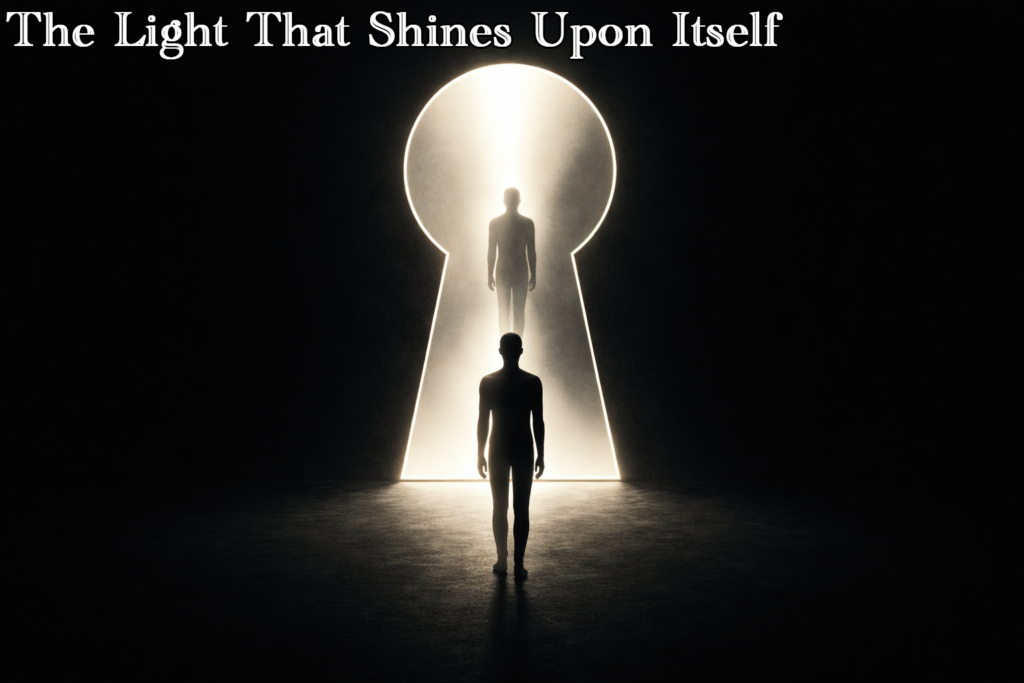
The Light That Shines Upon Itself
G‑d emanates through the upper three sefirot. Flows through them. They are, at their best and truest, the place where the divine light enters the human—the aperture through which shefa, the divine flow, passes into consciousness and from there into the world. They are channels. That is what they are for.
The catastrophe that every tradition’s adversary figure is finally describing—the fall that underlies the garden, the wilderness, the refusal to bow, the arrow of pride—is not darkness. It is light that has forgotten it was meant to illuminate something other than itself.
When Chokhmah stops receiving and begins to originate—when it no longer apprehends the flash of divine insight but generates its own conclusions and mistakes them for revelation—the channel has declared itself the source. When Binah’s structural understanding turns from building toward healing to building toward dominion, the tree is no longer fed from above; it is being consumed from within. When Da’at’s penetrating intimacy with the nature of things is directed not toward love but toward leverage, the highest form of knowledge becomes the sharpest instrument of harm.
This is the Lucifer of the tradition’s deepest intuition: not a dark creature but a radiant one. The most radiant of all created things. That is not incidental to the narrative. It is the narrative. The fall is not the corruption of something weak. It is the absolute perfection of something strong, folded back on itself, consuming its own light. The upper three sefirot outshining and overwhelming all the others—wisdom without compassion, understanding without love, knowledge without the humility of having received it from something other than itself.
Every tradition has stared at this possibility and given it a name. The names differ. The portrait gallery is crowded with masks. But beneath every mask is the same face: the greatest gift ever bestowed on a created being, refusing to be a gift any longer. Refusing to be a channel. Insisting, with perfect intellectual confidence, that it is the flame.

Discover more from Many Lamps, One Flame
Subscribe to get the latest posts sent to your email.
Outstanding and inspirational particularly on the day of Hod that is in Gevurah- emotion in power – Yom Hashoah.