
The forty-ninth day ends. For seven weeks the counting has moved through the lower sefirot—each day a rung, each week a deeper register of interiority, the soul examined in its capacity for love, for discipline, for endurance, for humility. The Omer is a descent with a purpose: to arrive somewhere ready. And then the fiftieth day comes.
Shavuot. The holiday that marks the single most consequential event in Jewish history—the giving of Torah at Sinai—arrives with a quietness that confounds. No seder. No shofar. No fast. For an event that stands at the center of the covenant, the observance feels strangely understated. Many Jews, including lifelong practitioners, would be hard-pressed to explain what exactly is being celebrated, or why. The holiday is underexplained and underexperienced in almost every community that keeps it.
That gap is worth examining. Because what arrives on the fiftieth day is not a commemoration. It is a threshold.
The Two Faces of the Fiftieth Day
Shavuot carries two biblical registers, and the tradition has always held them together. The first is agricultural: bikkurim, the offering of first fruits, the moment the Israelite farmer brought to the Temple what the land had produced—sweat and soil and the first of what had been cultivated. The second is covenantal: matan Torah, the giving of Torah at Sinai, the moment the divine descended to meet a people who had spent forty-nine days preparing to receive it.
The rabbis saw these not as two separate holidays collapsed into one calendar date but as the same truth sounding in different keys. Agriculture is what we cultivate; Sinai is what we receive but can never earn. Bikkurim is the human offering rising upward; matan Torah is the divine descent coming down. The fiftieth day is where they meet. What you have tended and what you could never produce on your own arrive at the same moment, at the same threshold, and the question is whether you are present for the encounter.
The Night and Its Logic
The tradition of tikkun leil Shavuot—staying awake through the night to study Torah—is rooted in a midrashic irony. On the morning Torah was to be given, Israel slept. The revelation that had been building for forty-nine days arrived, and the people it was meant for had to be roused by thunder. So we stay awake. We repair the failure. We are present for what they missed.
But the deeper logic of the tikkun is not commemorative. It is not an apology extended across three thousand years to ancestors who overslept. The logic is ontological: Sinai is not a historical event that occurred once in a specific year and now recedes further into the past with each generation. Sinai is a structural reality. It is perpetual. The giving of Torah did not end at the mountain; it continues in every genuine act of receiving it. To study on this night is not to remember Sinai. It is to participate in it.
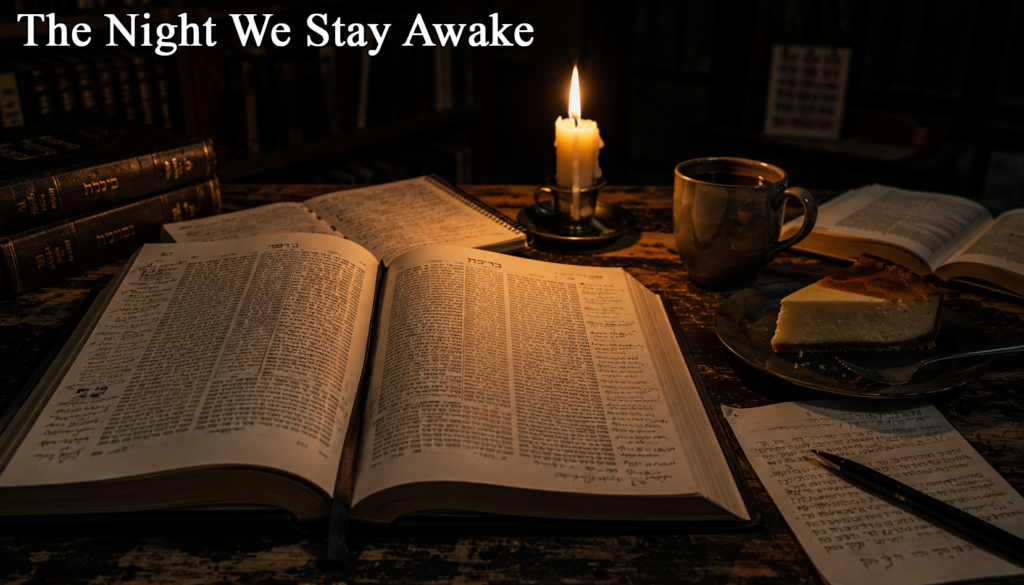
The candles burn low. Pages turn at two in the morning, three, four. Exhausted students argue over a single passage in Tractate Berakhot while dawn begins to press at the edge of the sky. This is not performance. This is the soul staying awake past the point of comfort because something is being offered that cannot be received in passing. You have to be present for it. You have to still be there when the surface yields.
The Problem of the Surface
A rabbi once expressed discomfort when Torah was described as pedagogical. The discomfort is understandable—if pedagogy means what the modern world has reduced it to. In the dominant framework of contemporary education, learning is acquisition in service of utility. You learn mathematics so you can balance accounts. You learn units of measurement so you can lay tile. You absorb what is required to function, and then you set it aside and function. Knowledge is a tool. The text is a manual. When the job is done, the manual goes back on the shelf.
If that is what pedagogical means, then Torah is obviously not that—and the rabbi’s instinct to resist the word was correct. But this is p’shat applied to education itself: surface engagement in service of surface function. And the question the tradition has always pressed is whether there is something more. Not because utility is wrong. You need the mathematics. You need the tile laid correctly. But is that really all learning is for? Is that really all the human mind is capable of?
The answer the tradition gives—the answer the greatest minds in every field have given by the shape of their lives—is no.
The Giants Who Went Deeper
Maimonides organized the whole of Jewish law in the Mishneh Torah—a feat of p’shat mastery so comprehensive it has never been equaled. Then he wrote the Guide for the Perplexed, deliberately constructed with contradictions and omissions, designed to yield its meaning only to the reader willing to follow it downward. He didn’t write two different books. He wrote the same book at two different levels—and built PaRDeS into the architecture of his own work.
Leonardo da Vinci could not look at a bird’s wing without needing to understand flight. Could not paint the human figure without first dissecting the body that wore it. His notebooks—thousands of pages of observation, engineering, anatomy, hydrology, optics—reveal a mind that the surface misreads entirely. History calls him a painter. What he actually was is a person who could not stop at the surface of anything. The visible world kept pulling him deeper until he was following water through its own logic, tracing light through its own geometry, understanding the mechanics of life from the inside out.
Albert Einstein did not look at the universe as a set of problems to be solved for a grade. He followed the mathematics downward until space itself curved, until time revealed itself as a dimension rather than a backdrop, until the cosmos began to speak in a language he had spent his life learning to hear. His contemporaries thought him impractical, untethered from the useful. What he was untethered from was p’shat. The material had taken hold of him entirely.
Mary Shelley was nineteen years old when she wrote Frankenstein. History misreads it as a horror story—a gothic tale of a monster and the scientist who made him. It is not. It is a sod-level meditation on creation, responsibility, and abandonment: a maker who cannot bear to know what he has made, who looks at the face of his creation and runs, and a creature who turns to whatever texts he can find—Paradise Lost, Plutarch, Volney—trying to read himself into existence, trying to understand what he is and why his maker will not look at him. The horror is not the creature. The horror is the refusal of encounter. Shelley put the whole theological problem of divine creation and human abandonment into a novel, at nineteen, out of something that was not merely imagination.
Carl Jung did not treat the human psyche as a diagnostic checklist. He descended into the unconscious until the archetypes took hold of him—until he understood that what moved in one person’s dreams moved in everyone’s, that the symbols were not private but structural, that the psyche had depths that connected rather than isolated. His contemporaries called it mysticism and meant it as a dismissal. What they were actually observing was someone who had followed his material past p’shat into something that could not be explained by surface categories.
None of these minds were simply brilliant at the surface level of their fields. Each was formed by their material—taken hold of, shaped, reorganized from the inside by what they had followed downward. The subject stopped being something they studied and became something they inhabited. This is what the tradition calls Da’at: not information retained but encounter internalized, the knower and the known no longer cleanly separable.
The Map of the Descent
The Talmud preserves a story in Tractate Chagigah 14b of four sages who entered the pardes—the orchard. Ben Azzai glimpsed it and died. Ben Zoma glimpsed it and lost his mind. Acher glimpsed it and apostatized. Only Rabbi Akiva entered in peace and departed in peace. From that story, the tradition drew a map of interpretation itself, an acronym hidden in the word pardes: p’shat, the surface meaning; remez, the hint beneath it; drash, the teaching drawn into human life; and sod, the esoteric depth at which the text no longer merely informs but transforms. Four layers, descending. The deeper you go, the less the text is something you hold—and the more it is something that holds you.
The Counting of the Omer is itself a sod-level practice dressed in p’shat clothing. Forty-nine days, seven weeks, the sefirot mapped onto time—each day not merely counted but entered, each quality of the divine examined in the mirror of the self. The person who counts the Omer at p’shat only marks days on a calendar. The person who counts at sod is being formed by the counting. Reb Zalman Schachter-Shalomi traced the reverse arc in his Sefirat haBinyan—ascending through the sefirot from Tisha B’Av toward rebuilding, the same cosmic structure traveled in the opposite direction, grief becoming the foundation of reconstruction. The ladder runs both ways. What matters is whether you are actually climbing.
Torah as Paideia
The ancient Greek word paideia named what the best education was always understood to be: not the acquisition of functional knowledge but the formation of a complete human being. Not learning in service of utility but learning as the process by which a person becomes fully themselves—shaped, deepened, made capable of things they could not have done before the encounter with the material. This is what the rabbi resisted when Torah was called pedagogical, because the modern reduction of pedagogy to credential acquisition has made the word almost unusable. But paideia is precisely what Torah has always been doing.
This is why the Talmud is an unresolved argument that has continued for two thousand years. If Torah were a manual of utility, it would give an answer and stop. The argument itself is the practice. The text does not want your agreement. It wants your presence—your sustained, wrestling, returning presence. You do not finish the Talmud and set it aside. The Talmud does not finish. It keeps going because the formation it is engaged in keeps going, because the human being it is shaping is never complete, because the encounter with the divine does not have an endpoint on this side of existence.
A rabbi who has spent forty years in daily study is not someone who knows more facts about Torah than someone who has spent one year. They are a different kind of person—shaped differently, capable of different things, inhabiting the text from the inside in a way that cannot be transmitted as information but can sometimes be transmitted as presence. This is Da’at: the knowing that is also a being-known, the formation that runs in both directions, the encounter that changes the one who enters it.
The Threshold
Sinai is not behind you. It did not happen to other people in another time and leave only a record in its wake. The giving of Torah is a perpetual event, and Shavuot arrives each year not as a commemoration of something finished but as an opening in time—a threshold you can actually cross, if you are willing to stay awake long enough to reach it.
The all-night study is the tradition’s embodied argument that you cannot receive what Sinai offers in passing. You cannot skim it. You cannot absorb the summary and consider yourself present for the event. You have to show up and stay. You have to be there at two in the morning when the easy reading is long finished and the text begins to press back. You have to still be there when the surface yields and something beneath it begins to speak.
Maimonides followed the law until the law opened into mystery. Da Vinci followed the wing until the wing opened into flight. Einstein followed the mathematics until the mathematics opened into the structure of time itself. Shelley followed the question of creation until creation opened into the face of the abandoned creature looking back at his maker. Jung followed the dream until the dream opened into the architecture of the human soul.
Torah was designed for exactly this. It is the text that does not end, the argument that does not resolve, the encounter that does not conclude—because what it is forming is not a graduate but a person, and the formation of a person is the work of a lifetime.
The night is long. The candles burn. The pages turn. Somewhere outside, dawn is still hours away.
Stay awake.

Discover more from Many Lamps, One Flame
Subscribe to get the latest posts sent to your email.