
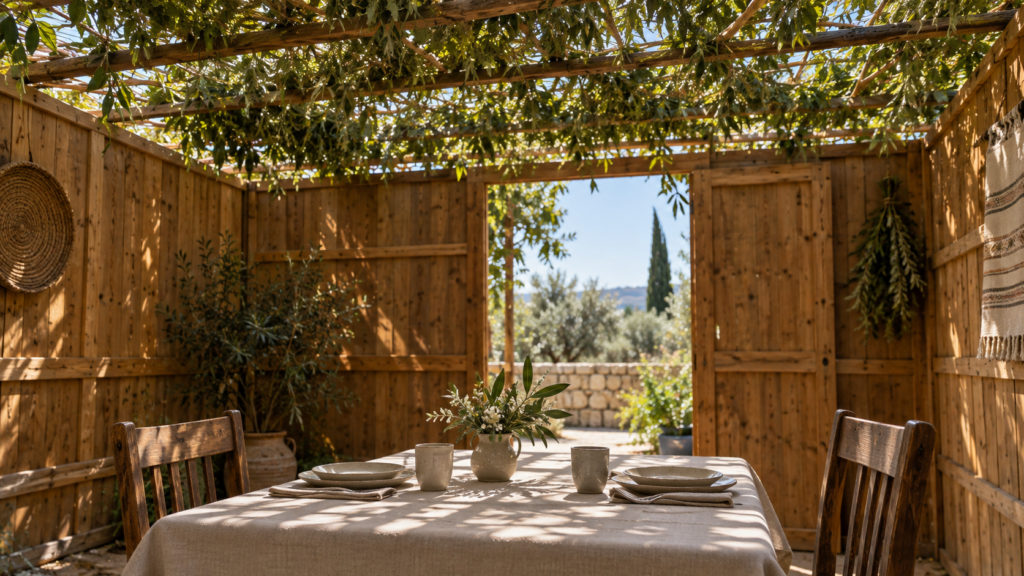
During [these] seven days you must live in thatched huts. Everyone included in Israel must live in such thatched huts. This is so that future generations will know that I had the Israelites live in huts when I brought them out of Egypt.
This year the first day of the festival falls on Shabbat, and the four species will not be lifted. The palm, the citron, the myrtle, and the willow will be taken up on Sunday, but that is the second day, and the second day is its own occasion. The first day’s taking simply does not happen this year. Meanwhile the other obligation of the festival proceeds without interruption. The sukkah is untouched by any of it. People will eat in it and sit in it tomorrow, and nothing about Shabbat reaches that at all. One of the day’s commands has been stopped. The other continues. The difference between them is worth following, because it says something about what these two obligations actually are.
What Continues
The decree that sets the species aside is not aimed at any forbidden labor in the taking itself. It guards against what a person might do on the way to performing it. Sukkah 42b–43a sets it out: someone who does not know how to perform the mitzvah might take his lulav to an expert to learn, and carry it four cubits through a public domain on the way. The same reasoning silences the shofar when Rosh Hashanah falls on Shabbat (Rosh Hashanah 29b). A person carrying an object toward a mitzvah is a person carrying an object.
Once the taking is suspended, the object follows it out of the day. The lulav may not even be picked up on Shabbat, the Rema ruling it muktzeh, like a stone, while the etrog may be handled, since one may smell it (Orach Chayim 658:2).
None of this was ever inherent to the mitzvah. The Mishnah records that when the first day of the festival fell on Shabbat, the lulav was taken in the Temple that day too, making seven days of taking there (Sukkah 4:2). Lifting a palm branch is not intrinsically incompatible with the day.
What the decree reaches is the taking, and the taking is a discrete act: lifted, held, shaken, set down, at an hour that can be named. Dwelling runs differently. There are timed obligations inside it—the first night carries a requirement to eat bread in the sukkah—but the obligation extends through the ordinary hours, in eating and resting and talking and sleeping, and it is discharged by being where you are. Shabbat makes the asymmetry visible this year. The hands have been told to refrain. The person is still asked to dwell.
Always the Roof
The walls can be far more substantial than the word “booth” suggests. They may be pre-existing. They may be the walls of your house. Sukkah 2a entertains a sukkah with partitions of iron and finds no one who disqualifies it. There are rules about the walls: how many there must be, how high they stand, how gaps are reckoned, and whether they hold in an ordinary wind. But their solidity is no objection, and their materials are almost unrestricted. A wall built to last a century is a perfectly good wall for seven days.
Overhead, the requirements change entirely.
The sekhakh must have grown from the ground and been cut from it, and may not be anything that can contract ritual impurity (Sukkah 11b)—a vessel cannot become a roof, though a mat woven for the purpose of roofing can. The shade must exceed the sun (Sukkah 22b). The covering should be laid lightly enough that the large stars show through, though a roof thick as a house’s is still valid (Shulchan Arukh, Orach Chayim 631:3). And the structure may not rise above twenty cubits, which Rava explains by the purpose of the week: emerge from the permanent residence in which you live all year and reside in a temporary one.
The dwelling even takes its name from up there. Sukkah and sekhakh share a root. The word is not pointing at the enclosure.
Which is why the one vehicle that looks purpose-built for the festival fails on the feature that makes it livable. An RV is temporary by design, movable, made for exactly the kind of provisional dwelling the week describes, and none of that settles anything. Its walls are not the obstacle. The roof is, and it would have to come off before valid sekhakh could go on in its place.
All year a dwelling is judged at eye level, by what encloses it and how well it does so. For this one week the question moves overhead, to what lies between the person inside and the sky, and the answer has to be something that grew, was cut, and was laid there to give shade.
The Shade of Faith
That is the physical arrangement. The Zohar gives it a name.
Reading the verse In his shade I delighted to sit from the Song of Songs alongside the commandment to dwell in booths, it says a person should show himself sitting b’tzila di-mheimnuta, in the shade of faith (Zohar 3:103a). The seven clouds of glory that covered Israel in the desert are bound to the Assembly of Israel, and dwelling in the booth places a person back beneath them.
The word carrying the weight is shade. Not light, which is the usual vocabulary for these things. Shade is cast, which means it always indicates something standing between the sitter and what would otherwise fall on him.
Push the image one step further and it begins to say something about faith that a sealed roof could not. Cover that admitted nothing would be certainty, which is a different structure with different requirements and much better weatherproofing. What the festival asks a person to sit under is the other thing: cover enough to be cover, and open enough to keep pointing past itself.
The Mishkan was built to exact specification from gold and acacia and woven linen, everything skill could bring to a dwelling place. The sukkah stands at the other end of the year’s vocabulary, and the two are not in competition. One is what a people builds for the Presence. The other is what the Presence is said to have provided in the wilderness.
What Is Held, and in Which Hand
The four species work the other way.
The Zohar says they are linked to the Holy Name above, and that we must grasp them and perform an act with them in order to arouse what they are linked to (Zohar 1:220b). Each is assigned: the fruit of the majestic tree, the fronds of the palm, the branch of the thick-leaved tree, the willows of the stream, read as the patriarchs and as the rungs through which the flow descends. The word kappot, fronds, is heard as kaphut, bound, because the Righteous One is bound to all sides.
Then it becomes specific about the hands. The etrog is held on the left, corresponding to the heart. The lulav, with its bound companions, is held on the right (Zohar 1:221a). Israel comes out of the days of judgment carrying these as the King’s own signs, and the Zohar’s image is a courtroom: the litigant who emerges holding the royal insignia is the one who won.
All of it is held. Gathered, bound, lifted, waved through the six directions, and then set down. That is not a complaint about the species. It is what they are for, and it is why they can be signs at all. A sign is something you carry and can show.
But a sign can be set down, and tomorrow it will be. The shade cannot be, short of walking out from under it. Shabbat has separated the two cleanly: the mitzvah that occupies the hands, and the mitzvah that occupies the person.
When the Hands Are Empty
There is a way to keep a festival that turns it into a series of completed tasks. The roof was built to specification, the species were bought and inspected, the guests were invited, and each obligation can be discharged at its hour and crossed off. On a day when the species are in hand, this is easy to miss, because the day supplies something to do, and doing can become a way of not noticing where you are.
The first day supplies less. The hands are empty of the signs, and what is overhead was never meant to be more than branches.
Which is where the Zohar puts the rest of the obligation. It reads the doubled verb in the verse as two seatings: in sukkot you shall dwell, and then they shall dwell—the first for the guests, the second for the inhabitants of the world (Zohar 3:103b). Rav Hamnuna Sava would stand just inside the opening, set the table, and call them in before sitting down himself: Sit, sublime guests, have a seat. And the portion of those guests belongs to the poor. A person who invites the supernal guests and does not feed the poor finds that Abraham rises from the table and the rest leave with him (Zohar 3:104a).
So the hands are not idle after all. They are empty of the signs and have a table to set. The shade was occupied before anyone arrived, and the arrangement holds only if the opening stays an opening.
Which leaves the festival’s first day making an unexpected claim about what faith is for. Not only the thing carried in the hands and displayed, but the roof a person consents to sit beneath while knowing exactly what it is: cut branches, laid loosely, giving real shade and promising nothing about the weather. It is enough to sit under. It is enough to invite someone else under.
Source note: Translations draw on Aryeh Kaplan’s The Living Torah and The Zohar: Pritzker Edition. Online links are provided for reference; their translations may differ from those quoted here.

Discover more from Many Lamps, One Flame
Subscribe to get the latest posts sent to your email.