
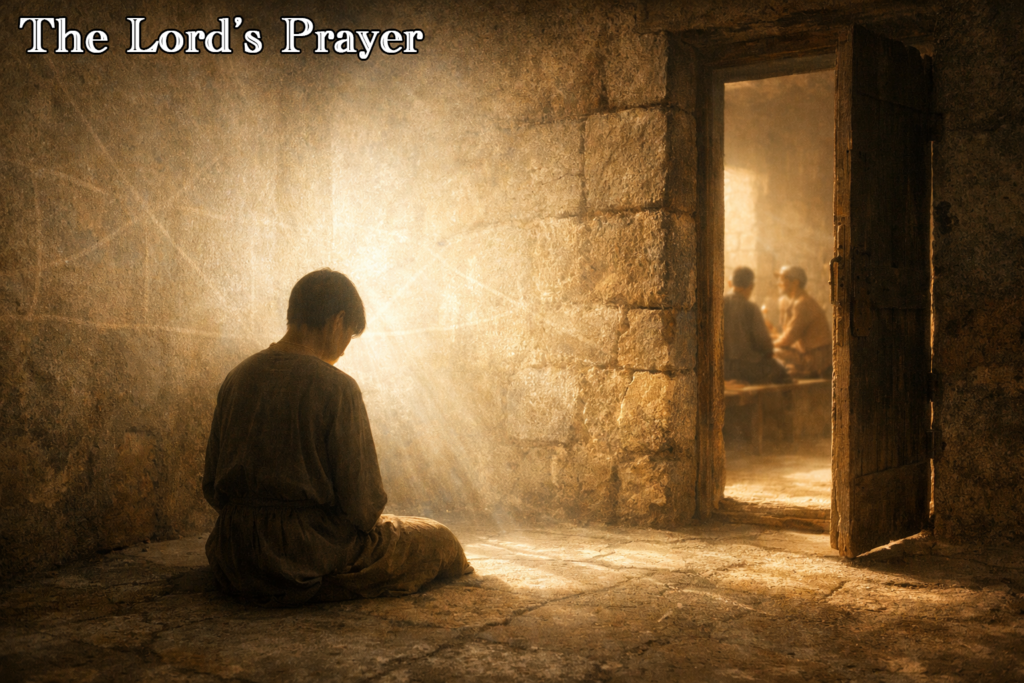
“And when you pray, you shall not be like the hypocrites. For they love to pray standing in the synagogues and on the corners of the streets, that they may be seen by men. Assuredly, I say to you, they have their reward. But you, when you pray, go into your room, and when you have shut your door, pray to your Father who is in the secret place; and your Father who sees in secret will reward you openly. And when you pray, do not use vain repetitions as the heathen do. For they think that they will be heard for their many words.
Therefore do not be like them. For your Father knows the things you have need of before you ask Him. In this manner, therefore, pray….”
(Matthew 6:5-15)
The Problem of Prayer
Prayer.
There is perhaps no single idea more misunderstood than prayer. It is commonly defined as an invocation or act of petition, usually associated with worshipful practice. Often, it becomes a request for divine intervention; insert prayer in the slot, turn, and await your gumball wish.
Prayer finds itself well entrenched within the liturgy but there is a gap between the communal prayer of the liturgy and personal prayer which often feels hollow, without purpose, even embarrassing. The question most carry but rarely say aloud: is anyone actually listening?
This is not a modern problem; the question predates even organized religion. The observant will ask themselves why pray at all, and why does personal practice even matter with what is clearly a communal system?
To answer these questions, it is important to first understand exactly what prayer is.
What Prayer Actually Is
Tefillah, root palal (reflexive), refers to self-examination conducted in divine presence. Prayer in Judaism is not primarily addressed outward—it is interior work done before G-d.
Liturgy provides structure and order to the process of prayer. Amidah, Shacharit—stand, bow, declare, petition, give thanks…stand, sit, kneel…prostrate before the Divine. These are structures of alignment, working precisely because they impose order on the interior life. The body and mind are being organized around something larger than the self—around what is real, true, present regardless of what we happen to be feeling on a given morning.
However, this is external scaffolding. Liturgy is the vehicle, not the destination—and a vehicle that carries you reliably to the door. Simply repeating prayers three times a day out of habit, without the interior movement, is like a child seeking attention. If I say it often enough, surely it will get through. The words become currency rather than practice; recitation rather than examination.
Furthermore, the insistence that liturgy is personal prayer—that directing fixed words inward is sufficient—misses the very thing palal points toward. Self-examination cannot be fully outsourced to a fixed text. The liturgy can prompt it, structure it, hold it. But at some point the one who prays must bring something of their own into the room—must step through the door the liturgy has opened.
What happens at that threshold is what Jesus speaks of in the Sermon.
The Condemnation of Performance
Jesus made clear his thoughts of public-facing piety. In the matter of prayer, his condemnation is no less.
“And when you pray, you shall not be like the hypocrites. For they love to pray standing in the synagogues and on the corners of the streets, that they may be seen by men. Assuredly, I say to you, they have their reward. But you, when you pray, go into your room, and when you have shut your door, pray to your Father who is in the secret place; and your Father who sees in secret will reward you openly.”
The word Jesus uses—hypokritai—is the Greek word for actors in a theater. These are not merely insincere people; they are performing a role for an audience. The applause is the point. And Jesus is unsparing: they have their reward. The performance succeeded. That is all they will receive.
Jesus is not critiquing communal prayer or Jewish liturgical practice—he is defending it from its own corruption. Be it vain repetition—magical thinking that volume of words somehow produces divine attention—or public display of piety, the purpose of prayer is neither self-aggrandizement nor the granting of wishes.
The inner room he points toward—tameion in Greek—means not merely a private space but a treasury, a storehouse. The place where what is most valuable is kept and protected. Jesus is saying something precise here: your genuine interior life is the most valuable thing you possess. It belongs in the most guarded space available to you, not on a street corner where it can be spent for social currency.
This does not elevate privatized faith over communal practice—to the Jewish mindset, both are equally relevant. When prayer turns outward and becomes demonstrative, it is no longer prayer. It is theater.
The Scandal of Verse 8
Then Jesus says something radical to this day.
“Your Father knows the things you have need of before you ask Him.”
Sit with that for a moment. If G-d already knows—truly, completely, before you open your mouth—then the entire apparatus of petitionary prayer collapses. Every wish list prayer, every desperate bargaining in the dark, every carefully worded request designed to persuade a divine ear—rendered not merely ineffective but beside the point entirely. If He already knows, why pray at all?
This is not a rhetorical question. It is the question.
Augustine, writing to the widow Proba on the subject of prayer (Letter CXXX), wrestles with precisely this problem. His answer is striking: prayer does not inform G-d. It enlarges the vessel of the one who prays to receive what G-d already desires to give. The obstacle is never on G-d’s end. The obstacle is our capacity—our narrowness, our distraction, our insistence on outcomes we’ve already decided upon. Prayer, practiced genuinely, stretches that capacity. It widens the opening through which what is already being offered can enter.
Aquinas sharpens this further in the Summa Theologica (II-II, Q.83). Prayer, he argues, is not about changing divine will. It is about aligning human will with what G-d already wills. He calls this the virtue of religio—the proper acknowledgment of the creature’s dependence on the Creator. Not groveling. Not transaction. Simply the honest recognition of what is already true about the nature of things—that we are not the source, that we do not govern outcomes, that something larger than our preferences is already at work.
This is where alignment, orientation, and posture become not merely useful concepts but theological necessities. Anxiety—that most modern of afflictions—is at its root the refusal of that dependence. It is the insistence that your will should govern what it cannot govern, that your vigilance is what stands between you and catastrophe. Prayer practiced as Aquinas describes it is the repeated, disciplined surrender of that insistence. Not once. Daily. Because the misalignment returns daily.
The answer to why we pray is this: not to inform G-d of what He already knows. Not to persuade Him toward outcomes He has not considered. Not to transact, but to become, through the practice itself, the kind of person who can receive what is already being offered. To widen the vessel. To align the will. To restore the posture that anxiety, distraction, and self-sufficiency perpetually erode.
Prayer does not change what G-d offers. It changes what you can hold.
The Lord’s Prayer as Demonstration
Jesus does not say “pray these words”—he says “in this manner, pray”. The distinction is subtle but clear; the prayer is a model of posture, not an invitation to vain repetition.
More importantly, the Lord’s Prayer is neither petitionary nor pious by design.
The prayer opens with pure orientation: hallowed be your name, your kingdom come, your will be done. These statements declare what is true about the nature of reality and serve as acknowledgement, positioning the one who prays correctly within it.
The prayer continues with descent from orientation to the concrete—bread, forgiveness, deliverance. These are the conditions of human existence; recognition of the need for sustenance, mercy, and tolerance of the human condition.
In just a few short lines, the Lord’s Prayer accomplishes the minimum necessary structure for genuine reorientation. Notice what is absent: petitions for wealth, victory, vindication—there’s no money for the gumball machine here.
There is one more thing worth noting. Jesus does not say “My Father”—he says “Our Father.”
This is not accidental. Judaism has never been a solitary enterprise. The covenant at Sinai was made with a people—כָּל־יִשְׂרָאֵל, all of Israel—not with a collection of individuals who happened to be standing in the same place. Even the minyan, the quorum of ten required for certain prayers, encodes this understanding structurally: some things cannot be said alone. The individual carries the community into the inner room, whether they are aware of it or not.
Jesus is not teaching privatized spirituality here. He is removing performance while preserving communal identity. The inner room is not isolation—it is the removal of audience. You carry Israel with you through that door. Jesus understood this well—”For where two or three are gathered in my name, I am there among them” (Matthew 18:20). The inner room and the gathered community are not opposites. They are the same reality at different scales.
And yet—the covenant reaches the individual directly. No institution stands between a person and that relationship. Religious systems are remarkably effective at building community and equally effective at excluding people from it. Know this: the inner room has no lock that any institution can hold; the covenant was never theirs to revoke. They can exclude you. The covenant cannot. Once accepted, the relationship is between you and G-d.
Which means this model of prayer—this posture—belongs to everyone. It requires no particular vocabulary, no theological sophistication, no institutional standing. It can be expressed in the precise language Jesus provides or in something as plain as a line from a 1971 pop song, Signs: “Thank you Lord for thinkin’ ’bout me, I’m alive and doin’ fine.”
Same posture. Same orientation. Same prayer.
The Forgiveness Coda
Verses 14-15 are not an appendix. They are the test.
“For if you forgive men their trespasses, your heavenly Father will also forgive you. But if you do not forgive men their trespasses, neither will your Father forgive your trespasses.”
The forgiveness clause embedded in the prayer itself—as we forgive our debtors—is not a condition imposed on G-d’s forgiveness. It is a description of the posture required to receive it.
You have heard that forgiveness is divine. Jesus goes further. When Peter asks how many times he must forgive—seven times?—Jesus answers: not seven times, but seventy times seven (Matthew 18:21-22). Forgiveness without limit, because the posture of the one who has received grace cannot coexist with the accounting of grievances.
The logic is physical. A clenched fist cannot receive. If nothing has shifted in you toward the person you are holding something against, you have recited.
You have not prayed.
Living Practice—The Inner Room
The inner room Jesus describes is not a place. It is a posture—the interior space where the individual stands directly before G-d, without audience, without performance, without intermediary. In the Jewish tradition, the Mishkan—the portable dwelling place of divine presence—traveled with Israel through the wilderness. The inner room is its human equivalent: the internal Mishkan, the holy of holies of the interior life, always accessible, always present.
Private prayer in this sense is broader than any single form. It is direct, personal, unscripted—the individual speaking in their own voice, or sitting in their own silence, before G-d. No correct formula. No prescribed prose. No intermediary. It is the relationship made audible.
One expression of this is hitbodedut (התבודדות)—self-seclusion, personal communion with G-d, spoken aloud, intimate, free-form. Rabbi Nachman of Breslov, who made hitbodedut central to Breslov Hasidic practice, taught simply: speak directly to G-d in your own language, about whatever is on your heart. The practice predates his teaching by centuries. Isaac walked alone in the field toward evening, pouring himself out in solitary communion. Hannah wept before G-d without words, her lips moving silently while her soul did the speaking. David retreated into wilderness and caves, bringing his full unfiltered self before the Holy One. None of them were following a prescribed form. All of them were in the inner room.
Hitbodedut sits alongside the liturgy—not above it, not in competition with it, not as improvement upon it. The liturgy provides structure, discipline, communal continuity. Private prayer is where the individual brings what the liturgy has opened—the unscripted conversation, the honest accounting, the silence that says what words cannot.
It can sound like confession. It can sound like gratitude. It can sound like nothing more than this:
Show me what I need to see, tell me what I need to hear, teach me what I need to learn.
Not asking G-d to change circumstances. Asking to be changed. That is non-transactional prayer in its purest form—and exactly what your Father who sees in secret will recognize.
Why It Matters
We began with a question most people carry but rarely say aloud: is anyone actually listening?
The answer Jesus offers is not reassurance. It is a reorientation. Your Father already knows. Prayer was never the coin for the gumball machine.
The Kabbalists understood prayer as the practice of opening channels through which divine flow—shefa—moves through the structure of creation into lived experience. You are not sending a message upward. You are emptying the vessel, clearing the channel, making room for what is already flowing—the presence that was never absent, the orientation that was always available, the grace that required only your willingness to receive it.
Augustine called it widening the vessel. Aquinas called it alignment. Jesus called it going into your room and shutting the door.
Many lamps. One flame.
Show me what I need to see. Tell me what I need to hear. Teach me what I need to learn.

Discover more from Many Lamps, One Flame
Subscribe to get the latest posts sent to your email.